


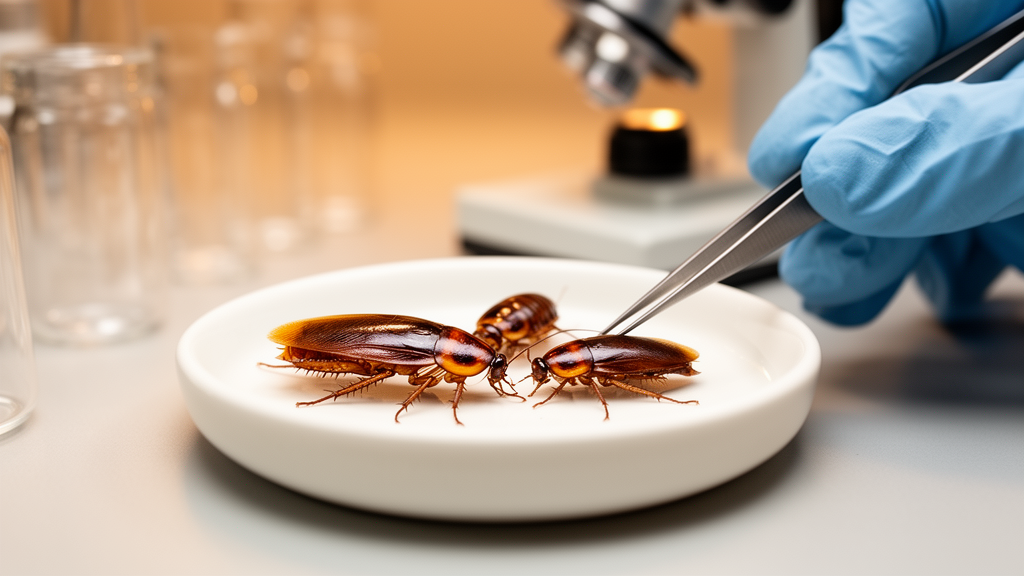
Deep in the karst landscapes of Guizhou, the forests of Shennongjia, and the slopes of Mount Qinling, three metallic cockroaches have been hiding in plain sight. A new study published in the journal ZooKeys describes them formally as Eucorydia parva, Eucorydia qinlingensis, and Eucorydia absens, raising the number of known species in this jewel-like cockroach genus and, just as importantly, opening up a long-neglected half of its biology: the female genitalia. The work, led by researchers at Southwest University in Chongqing, combines classic morphology with DNA barcoding in an integrative taxonomic approach that is rapidly becoming the standard for sorting out lookalike insect species.
Eucorydia is not your average cockroach. Members of this genus, placed in the family Corydiidae within the superfamily Corydioidea, wear a striking metallic bluish-green or dark blue armor accented with bright orange-yellow markings, making them among the most visually distinctive cockroaches in East, Southeast, and South Asia. Of the 22 species known worldwide before this study, ten occurred in China, meaning the country already harbored nearly half of the genus’s diversity. Yet even with that richness, the taxonomy of Eucorydia has long been lopsided. Early descriptions relied on body color and the patterns of the tegmina, the leathery forewings; later revisions added the intricate sclerotized structures of the male genitalia, which greatly improved species delimitation. Females, by contrast, were largely described from the outside only.
That neglect mattered because research on cockroach relatives has shown that the sclerotized, or hardened, parts of the female genitalia are stable and species-specific, serving as reliable diagnostic characters since McKittrick’s foundational work in 1964. Until now, such characters had never been systematically investigated in Eucorydia. The new study examined 13 female specimens spanning five species, including E. westwoodi, E. dasytoides, E. linglong, E. guilinensis, and one of the new species, E. qinlingensis. To expose the genital structures, the researchers excised the terminal three to four abdominal segments, soaked them in 10% sodium hydroxide, and heated them for 10 to 20 minutes to digest away soft tissues, then observed the cleared sclerites in glycerol under stereomicroscopes.
The comparative analysis revealed that four key structures are consistently highly sclerotized across all examined species: the spermathecal plate, which houses the sperm-storage organ; the basivalvula, a sclerite associated with the egg-laying apparatus; the vestibular sclerite; and laterosternite IX, a plate on the ninth abdominal segment. All four show species-specific variation, supporting their taxonomic value. The differences are often subtle but consistent. In E. dasytoides, the first valvifer, one of the skeletal elements of the ovipositor, bears an oblique fold, while it is smooth in the other species. The spermathecal plate of E. westwoodi carries two small apical horns, whereas in the remaining species it is nearly trapezoidal. The basal end of the basivalvular lobe is bulbous in E. dasytoides but acute in most of its congeners.
On the molecular side, the team generated 13 new COI sequences, the standard 658-base-pair barcode fragment of the mitochondrial cytochrome c oxidase subunit I gene, and combined them with 10 sequences from GenBank for a total of 23, using two distantly related cockroaches, Ergaula nepalensis and Diploptera punctata, as outgroups. All newly generated sequences were deposited in GenBank under accession numbers PZ945043 through PZ945055. The researchers aligned the fragments with the MUSCLE algorithm in MEGA 11 and calculated genetic distances using the Kimura 2-parameter model, then reconstructed a maximum likelihood phylogenetic tree in IQ-TREE v. 2.2.0 with 10,000 ultrafast bootstrap replicates and the -bnni option to mitigate severe model violations.
Species delimitation was performed with two complementary methods. The Assemble Species by Automatic Partitioning (ASAP) approach, which partitions sequences based on pairwise genetic distances and a recursive split threshold, identified ten molecular operational taxonomic units, largely congruent with the morphological identifications. The Generalized Mixed Yule Coalescent (GMYC) method, which requires a fully resolved ultrametric tree, was run on a maximum clade credibility tree built in BEAST 1.8.2 under an uncorrelated lognormal relaxed-clock model and a birth-death tree prior, with two independent Markov Chain Monte Carlo analyses of 5 million generations each. GMYC identified 11 units, and that extra split turned out to be scientifically crucial.
The crux of the study lies in a mismatch between molecules and morphology involving E. dasytoides, a widespread species whose populations have long been shuffled under several names. The maximum likelihood tree recovered all conspecific clades as well-supported monophyletic groups except E. dasytoides: its zonata population, from Taiwan’s Mount Lalashan, clustered with E. qinlingensis rather than with the type population. Interspecific genetic distances ranged from 3.39%, between the zonata population and E. qinlingensis, to 22.21%, between E. linglong and the Japanese E. yasumatsui. Strikingly, the maximum intraspecific divergence within E. dasytoides reached 8.67%, between samples from Guizhou and Taiwan Provinces, so the low distance between the zonata population and E. qinlingensis falls inside the range of variation within a single recognized species, erasing the usual DNA barcoding gap.
Consequently, the distance-based ASAP analysis failed to separate the two lineages, delimiting them as a single unit, while the tree-based GMYC resolved them as two. The researchers argue that the combined evidence still supports their distinctiveness. Morphologically, the orange band on the tegmina is markedly wider in the zonata population, and the posterior margin of the male supra-anal plate is relatively flat in that population but distinctly concave in E. qinlingensis. The two taxa are also geographically isolated by roughly 1,700 kilometers in a straight line. The authors note that such overlaps between intra- and interspecific distances have been reported in related corydiid genera as well, with maximum intraspecific distances reaching 9.54% in Eupolyphaga and 6.90% in Pseudoeupolyphaga, suggesting the absence of a clear barcoding gap may be a broader feature of this cockroach family.
Each new species carries its own diagnostic signature. Eucorydia parva, whose name derives from the Latin parvus, meaning small, is a miniature at just 14.00 millimeters overall, compared with 18.60 to 22.30 millimeters in the Hainan population of E. dasytoides; it also has a narrower orange-yellow transverse band on the tegmina, white pubescence at the wing base, and the last four abdominal segments entirely black. Its holotype, a male found freshly dead on a roadside at the edge of a town ringed by karst terrain in Dushan County, Guizhou, shows genetic distances of 10.85 to 19.77% from its sequenced congeners. Eucorydia absens, from Shennongjia in Hubei Province, is named for what it lacks: entirely black antennae without the meristal annuli, the pale rings that mark the antennae of all its congeners. Its tegminal markings bear a median fissure, and the L3 genital hook is more strongly curved than in E. dasytoides, with genetic distances of 9.35 to 18.93% from other species.
Eucorydia qinlingensis, from Mount Qinling in Shaanxi Province, is known from both sexes, allowing the first illustrated female genitalia of a new Eucorydia species: the spermathecal plate is trapezoidal and medially constricted, the basivalvula is broad with two spherical protrusions, and the vestibular sclerite is hillock-shaped. The study also provides an updated key to the Chinese species of Eucorydia, based on males, and the authors caution that single mitochondrial markers can be undermined by incomplete lineage sorting, introgression, and recent divergence. They call for broader geographic sampling, quantitative morphometric analyses, multi-locus nuclear markers, and genomic-scale data to clarify species boundaries and evaluate cryptic diversity in corydiid cockroaches. For a genus that has spent centuries dazzling collectors with its metallic sheen, the brightest discoveries may still be the ones hidden inside.
Subject of Research: Integrative taxonomy of Eucorydia cockroaches in China, combining morphology and COI barcoding to describe three new species and analyze female genitalia.
Article Title: Three new species of Eucorydia Hebard, 1929 ( Blattodea , Corydioidea , Corydiidae ) from China, with notes on female genitalia
Article References: Cai, T.-T., Han, W., Wang, Z.-Q., & Che, Y.-L. (2026). Three new species of Eucorydia Hebard, 1929 (Blattodea, Corydioidea, Corydiidae) from China, with notes on female genitalia. ZooKeys, 1293, 187-207. https://doi.org/10.3897/zookeys.1293.199475
Image Credits: AI Generated
DOI: 10.3897/zookeys.1293.199475
Keywords: Eucorydia, cockroaches, Blattodea, new species, integrative taxonomy, COI barcoding, female genitalia, China, ZooKeys, species delimitation, ASAP, GMYC
Cite Scienmag News
Gavin Prescott. (October 17, 2026). Three Shimmering New Cockroach Species Emerge from China, and Their Females Finally Get a Look. Scienmag. https://scienmag.com/three-shimmering-new-cockroach-species-emerge-from-china-and-their-females-finally-get-a-look/
Gavin Prescott. "Three Shimmering New Cockroach Species Emerge from China, and Their Females Finally Get a Look." Scienmag, 17 October 2026, https://scienmag.com/three-shimmering-new-cockroach-species-emerge-from-china-and-their-females-finally-get-a-look/. Accessed 17 October 2026.
Gavin Prescott. "Three Shimmering New Cockroach Species Emerge from China, and Their Females Finally Get a Look." Scienmag. October 17, 2026. https://scienmag.com/three-shimmering-new-cockroach-species-emerge-from-china-and-their-females-finally-get-a-look/


