


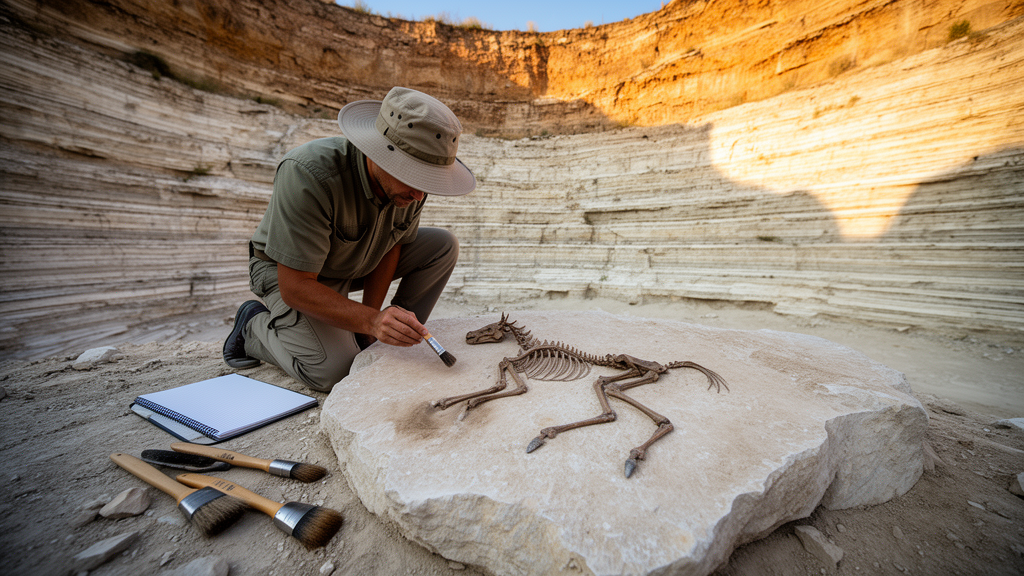
Deep inside an actively exploited diatomite mine in Armenia, paleontologists have uncovered a trove of fossil horse remains that is forcing a rethink of how the last three-toed horses of Eurasia are classified. The site of Jradzor, a 57-meter-thick succession of Late Pliocene sediments, has yielded 61 well-preserved dental and postcranial specimens of hipparionine horses, the tridactyl relatives of modern equids that once thundered across the grasslands of the Old World. A new study, published in the Swiss Journal of Palaeontology, describes these fossils in exhaustive anatomical detail and concludes that one of the most enigmatic species of the group belongs in a different genus than nearly everyone assumed.
The Jradzor section, dated by multiproxy methods to between 4.3 and 3.03 million years ago, contains 19 fossiliferous horizons and at least 48 identified vertebrate taxa. Almost all of the hipparionine material comes from a single horizon, JZ-7, corresponding to lahar deposits of early MN16 age, with just two additional isolated specimens from pyroclastic flow deposits. The dramatic volcanic setting helps explain the remarkable preservation: teeth, mandibles, vertebrae, humeri, radii, metapodials, ankle bones and phalanges were rapidly buried and sealed, giving researchers an unusually complete picture of a horse population that lived at the twilight of the hipparionine lineage.
Hipparionine horses are among the most successful and confusing groups in the mammalian fossil record. Defined by an isolated, ovoid protocone on their upper cheek teeth and three-toed feet, they first entered the Old World from North America around 11.2 million years ago in an immigration event long known as the Hippotherium Datum. They diversified explosively across Eurasia, reaching their peak of taxonomic and ecological diversity during the Turolian age of the Late Miocene. But at the end of the Miocene, a sharp extinction event wiped out several hipparionine genera in South and West Eurasia, leaving only a handful of lineages, including Cremohipparion, Proboscidipparion, Plesiohipparion, Eurygnathohippus and Baryhipparion, to carry on into the Pliocene.
The species at the heart of the new study, originally named Hipparion longipes in 1952 from Pavlodar in Kazakhstan, has been shuffled between genera for decades. Recent work placed it in Plesiohipparion almost exclusively on the basis of the extreme gracility and elongation of its metapodials, the long central cannon bones of its limbs. The Jradzor fossils, however, preserve both teeth and limb bones in combination, allowing the researchers to test that assignment against the full suite of diagnostic characters rather than measurements alone.
The anatomical evidence proved decisive. The Jradzor horses show a constellation of features matching the genus Cremohipparion: an incisor row with a non-atrophied third incisor, an isolated protocone on the deciduous upper cheek tooth, lower cheek teeth with rounded metaconid and metastylid, shallow V- to U-shaped linguaflexids, a hypoflexid that separates the metaconid and metastylid on lower molars but not on premolars, and the general absence of the pli caballinid and ectostylid. Crucially, they lack the derived double knot and persistent pli caballinid that define Plesiohipparion. On this combined evidence, the authors formally reassign both Hipparion longipes and the related Hipparion fissurae to Cremohipparion, creating the new combinations Cremohipparion longipes and Cremohipparion fissurae.
The methodology behind these conclusions is as instructive as the result. The team measured every specimen to a precision of 0.1 millimeters and then, before running any statistics, tested which measurements were actually independent of one another using Spearman rank correlations and Mantel tests. This preliminary analysis revealed a serious pitfall in earlier work: many commonly used variables, such as metapodial length and distal articular width, are strongly autocorrelated. Principal component analysis performed on autocorrelated variables can overestimate the variance captured by the first component, artificially compressing the apparent differences between taxa. The study shows that when this bias is controlled for, the discriminating power of the analyses improves and the boundaries between Cremohipparion, Plesiohipparion and Proboscidipparion become far clearer.
Paleobiological estimates add vivid detail to the animal itself. Using established equations based on metapodial dimensions, the researchers calculated body weights, shoulder heights and gracility indices for the Jradzor horses. All specimens fall into the very slender category, with gracility indices below 13.5, averaging 11.2 on the metacarpal and a remarkable 9.5 on the metatarsal. Combined with true hypsodont cheek teeth, whose hypsodonty index exceeds 5, the picture is of a large, long-legged, highly cursorial grazer adapted to open and dry environments, exactly the kind of animal expected as cooling climates and expanding C4 grasslands transformed Eurasian landscapes during the Pliocene.
The reclassification ripples outward across geography as well. The revised distribution of Cremohipparion longipes traces a species that likely originated in Central Asia, as indicated by its record at Pavlodar in Kazakhstan, spread to the Middle East at Baynunah in the United Arab Emirates, and reappears in the late Pliocene at Megalo Emvolon in Greece, at Calta in Turkey and now at Jradzor in Armenia. Meanwhile, Hipparion cf. longipes from Akkasdagi in Turkey is tentatively reidentified as Cremohipparion cf. fissurae, extending the known range of that species far beyond its type locality at Layna in Spain. The large, slender-limbed Cremohipparion from Ruscinian sites on the Iberian Peninsula, including La Gloria 4, La Calera, Orrios-1 and Villalba Alta Rio 1, is confirmed as morphologically distinct from Cremohipparion fissurae and probably endemic to Spain during MN14.
Perhaps most strikingly, the dispersals of Cremohipparion longipes appear to track dramatic environmental upheavals in the Paratethys region. Its appearance in Central Asia coincides with the Khersonian Drying, when the Eastern Paratethys Sea shrank and exposed vast new territories of Central Eurasia. Its later presence at Jradzor and other MN15 to early MN16 sites correlates with the period when the Caspian Sea contracted to its smallest extent, the Productive Series interval, an event attributed to climate change, tectonic reorganization, or both. The following Akchagylian stage brought a humid climate and a different hipparionine, Plesiohipparion rocinantis, at the nearby site of Kvabebi in Georgia, underscoring how sensitive these horses were to shifting environments.
Beyond the taxonomy, the study delivers a pointed methodological message: the evolutionary history of hipparionine horses cannot be resolved by measurements alone. Uncontrolled statistical analyses of autocorrelated data can lead to erroneous generic assignments, as the long misplacement of Hipparion longipes in Plesiohipparion demonstrates. Instead, the authors argue for an integrative approach that combines morphological observation, morphometrics, paleoecology, biostratigraphy and biogeography. With three-toed horses persisting in China until the latest Pliocene and even briefly coexisting with the modern one-toed genus Equus at sites like Roca-Neyra in France, the group’s final chapter is still being written, and the fossils from an Armenian mine are helping to set the record straight.
Subject of Research: Taxonomic revision of Late Pliocene hipparionine horses from Jradzor, Armenia, and the reassignment of Hipparion longipes and Hipparion fissurae to the genus Cremohipparion
Article Title: The Hipparionini horses ( Equidae , Perissodactyla , Mammalia ) from the Late Pliocene of Jradzor (Armenia)
Article References: Becker, D., Mouhat Bourquard, M., Maridet, O., & Vasilyan, D. (2026). The Hipparionini horses (Equidae, Perissodactyla, Mammalia) from the Late Pliocene of Jradzor (Armenia). Swiss Journal of Palaeontology, 145, 625-653. https://doi.org/10.3897/sjp.145.189856
Image Credits: AI Generated
Keywords: Hipparionini, Cremohipparion longipes, Jradzor, Armenia, Late Pliocene, paleontology, Equidae, taxonomy, morphometrics, Plesiohipparion, biogeography, hypsodonty
Cite Scienmag News
Gavin Prescott. (October 17, 2026). Three-Toed Horses from an Armenian Diatomite Mine Rewrite the Pliocene Family Tree. Scienmag. https://scienmag.com/three-toed-horses-from-an-armenian-diatomite-mine-rewrite-the-pliocene-family-tree/
Gavin Prescott. "Three-Toed Horses from an Armenian Diatomite Mine Rewrite the Pliocene Family Tree." Scienmag, 17 October 2026, https://scienmag.com/three-toed-horses-from-an-armenian-diatomite-mine-rewrite-the-pliocene-family-tree/. Accessed 17 October 2026.
Gavin Prescott. "Three-Toed Horses from an Armenian Diatomite Mine Rewrite the Pliocene Family Tree." Scienmag. October 17, 2026. https://scienmag.com/three-toed-horses-from-an-armenian-diatomite-mine-rewrite-the-pliocene-family-tree/


