


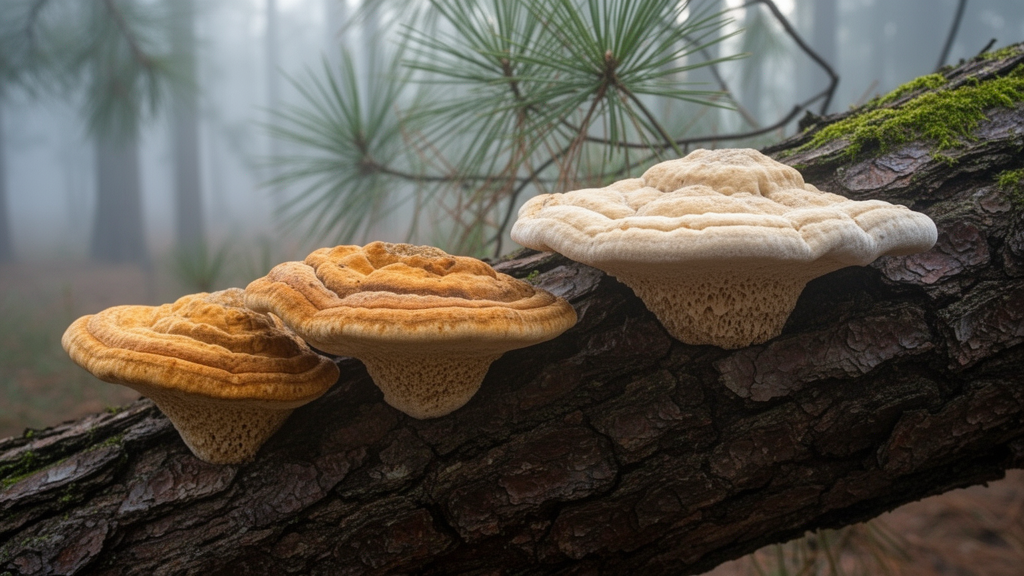
Researchers have formally described three new species of wood-inhabiting fungi discovered on Pinus massoniana, a common pine species in China. These findings, published in the journal MycoKeys, expand the known biodiversity of two significant fungal orders, Cantharellales and Hymenochaetales, within the class Agaricomycetes. The discovery highlights the ongoing potential for new fungal species to be identified in East Asian forests, where ecological surveys are increasingly revealing hidden diversity in woody substrates. The three species, Botryobasidium massonianae, Peniophorella crassibasidiata, and Peniophorella variegata, were identified through a rigorous combination of morphological analysis and molecular phylogenetic evidence.
The genus Botryobasidium, belonging to the family Botryobasidiaceae and order Cantharellales, is characterized by annual, resupinate basidiomata that cause white rot in wood. The new species, B. massonianae, is distinguished by its fluffy, pellicular fruiting bodies and a hypochnoid hymenophoral surface. Microscopic examination revealed generative hyphae that are simple septate, along with basidia possessing four to six sterigmata. The basidiospores of this species measure between 6.3 and 9.2 micrometers in length and 2.8 to 3.9 micrometers in width, providing distinct morphological markers that separate it from previously known relatives in the genus.
Phylogenetic analyses using combined ITS and nLSU datasets confirmed that B. massonianae belongs to the genus Botryobasidium. The species grouped with B. aureum, B. coniferarum, and B. indicum with high statistical support in both Maximum Likelihood and Bayesian Inference trees. Despite this close phylogenetic relationship, B. massonianae is morphologically distinct from these species. For instance, it differs from B. aureum by having slightly thick-walled generative hyphae rather than thin-walled ones, and it is distinguished from B. coniferarum by its shorter basidia, which range from 11 to 16 micrometers in length compared to the 16 to 20 micrometers observed in B. coniferarum.
The other two new species belong to the genus Peniophorella, which is part of the order Hymenochaetales. This order is known for its high diversity of corticioid fungi, which often present taxonomic challenges due to their inconspicuous nature and reliance on microscopic features for identification. Peniophorella crassibasidiata is characterized by soft, coriaceous basidiomata and thick-walled generative hyphae. A notable feature of this species is the presence of three distinct types of cystidia, including stephanocysts, fusiform cystidia, and subulate cystidia. Its cylindrical basidiospores measure 8.4 to 12.4 micrometers in length and 3.1 to 4.2 micrometers in width, contributing to its unique identification profile.
In phylogenetic reconstruction, P. crassibasidiata formed an independent lineage within the genus Peniophorella. While it shares the presence of stephanocysts with species such as P. pinicola and P. stellata, it is clearly differentiated by its spore and basidia dimensions. P. pinicola, for example, has significantly shorter basidiospores, ranging from 5.7 to 8 micrometers, whereas P. stellata possesses longer basidia, measuring 22.5 to 32 micrometers. These morphological distinctions, supported by molecular data, confirm P. crassibasidiata as a distinct species within the Hymenochaetales.
The third new species, Peniophorella variegata, is defined by its farinaceous basidiomata and a smooth hymenophoral surface. This species also exhibits three types of cystidia and the presence of hyphidia, which are rare in some related taxa. The basidiospores of P. variegata are short cylindric to oblong-ellipsoid, measuring 7.9 to 10.8 micrometers in length and 3.9 to 5.1 micrometers in width. Phylogenetically, P. variegata is closely related to P. alba, P. albohymenia, P. stellata, P. subalbohymenia, and P. tenuissima, forming a well-supported clade with high bootstrap values and Bayesian posterior probabilities.
Despite its close relationships, P. variegata is morphologically distinct from its relatives. It differs from P. alba by having thin-walled cystidia instead of thick-walled ones, and it is distinguished from P. albohymenia by the presence of hyphidia and cystidioles. Compared to P. subalbohymenia, P. variegata has significantly longer basidia, ranging from 25 to 46 micrometers, whereas P. subalbohymenia has basidia measuring 18 to 25 micrometers. These detailed morphological differences, combined with molecular evidence, underscore the importance of integrating multiple lines of evidence in fungal taxonomy to accurately delimit species boundaries.
The specimens for this study were collected from natural forests in Guangdong, Henan, and Jiangxi provinces, representing southern, central, and eastern China, respectively. All three new species were found on fallen branches of Pinus massoniana, highlighting the ecological association between these fungi and this specific host tree. The geographic distribution of the discoveries suggests that the diversity of Cantharellales and Hymenochaetales is widespread across different climatic zones in China. This broader coverage provides a more comprehensive perspective on the national diversity of these fungal groups and indicates that substantial undiscovered diversity remains in East Asian forests.
Wood-inhabiting fungi play essential roles in forest ecosystems by decomposing lignin, cellulose, and hemicellulose, thereby driving matter cycles and carbon storage. The discovery of these three new species contributes to a better understanding of the ecological and evolutionary dynamics of wood-decaying fungi. As molecular phylogenetics continues to advance, the taxonomic framework for these groups is being refined, revealing new species and clarifying relationships among existing taxa. The findings from this study emphasize the need for continued biodiversity surveys in biodiverse regions to uncover the full extent of fungal diversity and its ecological significance.
Subject of Research: Three new species of Cantharellales and Hymenochaetales from Pinus massoniana in China
Article Title: Three new species of Cantharellales and Hymenochaetales from Pinus massoniana in China
Article References: Luo, K.-Y., Dai, Y.-C., Yuan, Y., & Wu, Y.-D. (2026). Three new species of Cantharellales and Hymenochaetales from Pinus massoniana in China. MycoKeys, 137, 273-297. https://doi.org/10.3897/mycokeys.137.203862
Image Credits: AI Generated
DOI: 10.3897/mycokeys.137.203862
Keywords: Three, species, Cantharellales, Hymenochaetales, Pinus, massoniana, China, scientific research
Cite Scienmag News
Roger Howard. (October 18, 2026). Three New Wood Fungi Species Identified on Chinese Pine. Scienmag. https://scienmag.com/three-new-wood-fungi-species-identified-on-chinese-pine/
Roger Howard. "Three New Wood Fungi Species Identified on Chinese Pine." Scienmag, 18 October 2026, https://scienmag.com/three-new-wood-fungi-species-identified-on-chinese-pine/. Accessed 18 October 2026.
Roger Howard. "Three New Wood Fungi Species Identified on Chinese Pine." Scienmag. October 18, 2026. https://scienmag.com/three-new-wood-fungi-species-identified-on-chinese-pine/


