


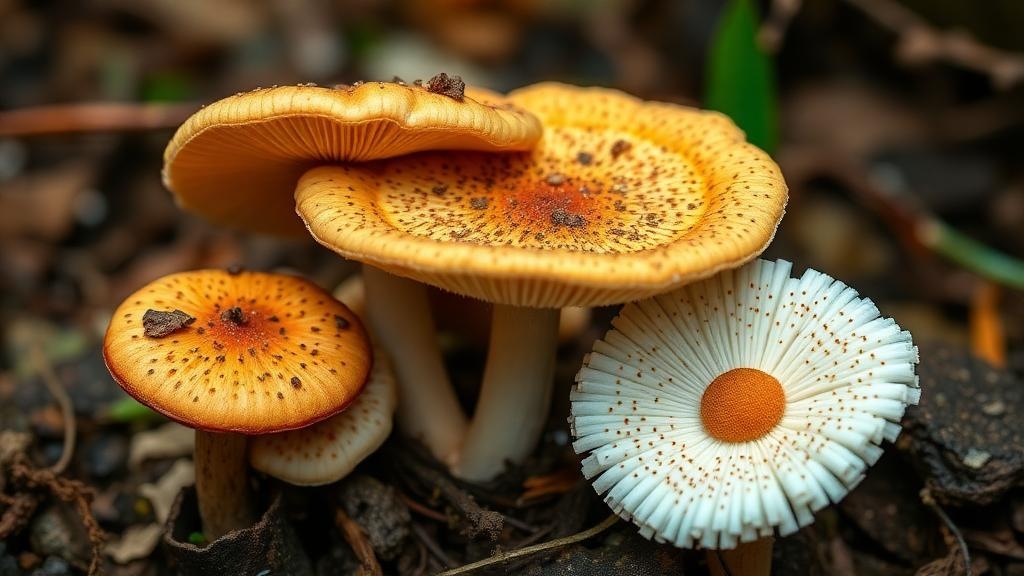
Deep in the forests of the Yunnan-Guizhou Plateau, tiny mushrooms with wrinkled yellow caps, grayish-brown funnels, and mottled white tops have been quietly decomposing leaf litter for millennia without a formal scientific name. A new study published in MycoKeys has now described three previously unknown species of the genus Marasmius, a sprawling group of saprophytic fungi found in forests across the globe. The discoveries, made in Guizhou and Yunnan provinces, underscore how much fungal diversity remains hidden in one of the world’s richest biodiversity hotspots, even for genera that mycologists have been cataloguing for nearly two centuries.
Marasmius was established by the pioneering Swedish mycologist Elias Fries in 1835, with Marasmius rotula as its lectotype species. Today, more than 700 species have been documented worldwide, with diversity peaking in tropical and subtropical regions. These fungi play a crucial ecological role as decomposers, breaking down organic matter on the forest floor. Some are even edible or medicinally interesting: Marasmius oreades, the fairy ring mushroom, has demonstrated antioxidant, anticancer, antimicrobial, and antibiofilm properties in laboratory studies, while other species can cause blight in cash crops. Despite this importance, the true extent of the genus’s diversity remains far from fully revealed, and China’s species inventory has long been under-documented.
The genus has a notoriously tangled taxonomic history. Fries originally recognized two sections, Collybaria and Mycenarii, distinguished by whether the cap margin was initially rolled inward or straight and attached to the stem, and a third section, Apus, was later added for the single sessile species. Kühner expanded the framework to nine sections in 1933, and Singer’s system of twelve sections, proposed in 1951 and refined in 1976, remained authoritative for decades. Only recently, integrating morphological evidence with multi-locus phylogenetic analyses, did researchers introduce a modern hierarchical scheme of subgenus, section, subsection, and series. Even so, Marasmius remains polyphyletic and taxonomically challenging, with molecular data continually forcing re-definitions of its internal boundaries.
The three new species all belong to Marasmius subgenus Globulares, a group characterized by small to large fruiting bodies, gills ranging from distant to crowded with several short gills interspersed, a central to slightly off-center stem that is not sititious, and dextrinoid flesh that stains reddish-brown in iodine reagents. The research team, working from specimens collected across southwestern China, noticed that several collections displayed unique morphological features and occupied distinct positions in DNA-based phylogenies, prompting a formal description of each as a new species.
The first of the trio, Marasmius flavosulcatus, is a striking lemon-yellow mushroom with a deeply wrinkled and striated cap measuring 1 to 4 centimeters across and a long reddish-yellow stem reaching up to 95 millimeters. Its most remarkable microscopic feature is its unusually large basidiospores, which measure 27 to 34 micrometers in length, elongate-clavate to fusoid and often curved in profile. Phylogenetically, the species belongs to the purpureostriatus series within subgenus Globulares and groups with Marasmius grandiviridis, a relative from Mauritius. The two can be told apart easily in the field: M. grandiviridis has a much larger, olive-green cap, whereas the new Chinese species produces small yellow fruiting bodies lacking any olive coloration, along with more regularly clavate, bulbous cheilocystidia.
The second species, Marasmius griseobrunneus, presents a very different appearance. Its cap, 1 to 3 centimeters broad, is white to cream when young and matures to orange-gray or grayish brown, sometimes becoming shallowly funnel-shaped. The stem tapers toward the base and is covered with white furfuraceous scales, and the gills are subdistant and reticulate. Its basidiospores are medium-sized, averaging 7.06 by 3.91 micrometers, and dense caulocystidia, distinctive hair-like cells on the stem, separate it from its closest relative, Marasmius wynneae, which lacks these structures entirely. Molecular comparisons revealed 92.62 percent identity with M. wynneae in the ITS region, with 52 substitutions and indels, ample evidence of species-level separation. Intriguingly, the phylogenetic analysis also revealed that three previously published sequences labeled as Marasmius oreades, from China and Korea, actually belong to this new species, a quiet correction to herbarium records spanning years.
The third discovery, Marasmius variegatus, earns its name from a white cap mottled with irregular light orange and grayish-orange patches. Found in the Ailao Mountains of Yunnan at elevations above 2,500 meters, it grows solitarily or in groups on well-rotted bark and wood. Its defining microscopic trait is dimorphism: both its cheilocystidia and its pileipellis contain two distinct cell types, Siccus-type broom cells with apical finger-like projections alongside smooth Globulares-type cells. This dual-cell architecture has never before been reported in other species of the luteoli series to which it belongs, making it a particularly valuable find for understanding character evolution within the group. Its sister taxon, Marasmius ochroleucus, possesses only one type of broom cell and more crowded gills.
The scientific case for each species rests on a combination of field morphology and molecular phylogenetics. The team photographed fresh fruiting bodies in the wild, recorded colors according to standard color charts, dried specimens at 50 degrees Celsius, and deposited them in the Fungal Herbarium of the Guizhou Biological Institute and the Cryptogamic Herbarium of the Kunming Institute of Botany. Microscopic structures were rehydrated in 3 percent potassium hydroxide, stained with Congo Red, and tested with Melzer’s reagent for amyloid reactions. DNA extracted from dried material was amplified for the nuclear ribosomal internal transcribed spacer and large subunit regions, and the resulting sequences were compared against international databases and combined with reference data from prior studies.
The phylogenetic reconstruction drew on 1,573 characters from 104 taxa, of which 374 were parsimony-informative. Maximum likelihood analysis run on the CIPRES Science Gateway and Bayesian inference with more than 1.8 million generations both placed each new species in a distinct, well-supported terminal lineage. M. flavosulcatus joined the purpureostriatus clade, M. griseobrunneus the wynneae clade, and M. variegatus the luteoli clade. Basepair comparisons reinforced the separations: the holotype of M. flavosulcatus shares only 92.82 percent ITS identity with M. grandiviridis, while M. variegatus shows 96.17 percent ITS identity with M. ochroleucus. These figures comfortably exceed the thresholds mycologists typically use to justify species recognition.
Beyond adding three names to the fungal inventory, the study carries broader implications. The authors note that recent work, including the clarification of the Marasmius haematocephalus and elegans species complexes and the description of new species in Japan, indicates that the genus’s diversity and its infrageneric subdivision still require substantial refinement. The placement of the three Chinese species in three different series within subgenus Globulares reinforces the validity of the recently revised sectional scheme and suggests that this subgenus represents a rapidly radiating lineage. With more than twenty new Marasmius species already described from China in recent decades, the Yunnan-Guizhou Plateau is emerging as a global center of diversity for the genus, and the researchers expect that further fieldwork and molecular sampling will continue to reveal species that have so far escaped scientific attention.
Subject of Research: Taxonomy and phylogeny of three newly described Marasmius mushroom species from southwestern China
Article Title: Three new species of Marasmius ( Agaricales , Basidiomycota ) from southwestern China
Article References: Deng, C.-Y., Li, T.-S., Xiang, Z., & Zhao, Q. (2026). Three new species of Marasmius (Agaricales, Basidiomycota) from southwestern China. MycoKeys, 136, 233-250. https://doi.org/10.3897/mycokeys.136.196875
Image Credits: AI Generated
DOI: 10.3897/mycokeys.136.196875
Keywords: Marasmius, new species, mycology, Yunnan-Guizhou Plateau, China, subgenus Globulares, ITS, LSU, phylogenetics, taxonomy, fungal diversity, Agaricales
Cite Scienmag News
Roger Howard. (October 19, 2026). Three New Mushroom Species Unearthed in Southwestern China’s Fungal Hotspots. Scienmag. https://scienmag.com/three-new-mushroom-species-unearthed-in-southwestern-chinas-fungal-hotspots/
Roger Howard. "Three New Mushroom Species Unearthed in Southwestern China’s Fungal Hotspots." Scienmag, 19 October 2026, https://scienmag.com/three-new-mushroom-species-unearthed-in-southwestern-chinas-fungal-hotspots/. Accessed 19 October 2026.
Roger Howard. "Three New Mushroom Species Unearthed in Southwestern China’s Fungal Hotspots." Scienmag. October 19, 2026. https://scienmag.com/three-new-mushroom-species-unearthed-in-southwestern-chinas-fungal-hotspots/


