


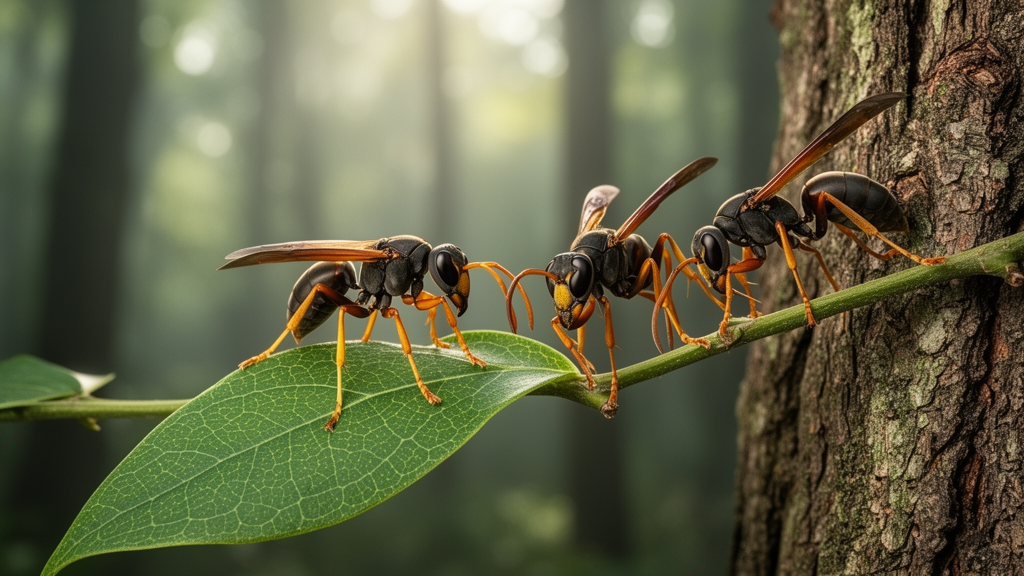
A morphological study of Ampulex predatory wasps collected in China has identified three previously unknown species: Ampulex fronticarinalis, A. genapunctata and A. rubifemoralis. The researchers also documented the first Chinese record of A. tridentata, provided the first description of the female of A. clypecomplana and presented a key for identifying the Ampulex species known from China. Adding the three new taxa raises the number of recognized Chinese species in the genus from 24 to 27.
The specimens came from Yunnan, Fujian, Guangxi and Zhejiang provinces, while additional material was examined from Guangdong. The researchers observed the insects with a stereomicroscope equipped with an ocular micrometer, took photographs with a VHX-5000 imaging system and prepared detailed comparisons of external anatomy. All type material was deposited in the Insect Collection of Yunnan Agricultural University in Kunming.
Their taxonomic assessment combined differences in head shape, body color, punctures, setae, thoracic sculpture, wing venation, leg structure and the form of the abdomen. Ampulex belongs to the family Ampulicidae within the Apoidea and was the largest genus in that family at the time of the study, with 134 recognized species and four subspecies worldwide. The genus has a wide distribution across all major biogeographical regions.
The Oriental Region had the largest listed regional representation, with 59 species, followed by the Afrotropical Region with 47; the source material listed smaller totals for the Palaearctic, Neotropical and Australasian regions. Before the three new descriptions, 24 Ampulex species were recorded from China, with the greatest richness reported in the Oriental Region. These wasps are solitary predators that hunt cockroaches.
Adults are most active in sunny weather and may search for prey or mates around tree trunks, leaf litter and shrubs, sometimes entering human-associated habitats. The available observations indicate that adults feed on nectar, honeydew, tree sap and fruit juices. During a capture, a wasp grips the cockroach with her mandibles, bends her abdomen and repeatedly stings the prey below the thorax and neck to paralyze it.
These are biological observations about the genus rather than experimental measurements of predation rates or population effects. Ampulex females use cavities already present in the environment, including soil burrows, hollow plant stems, crevices in rocks and tree holes. After paralyzing a cockroach, a female grasps the base of the prey’s antennae and drags it backward into the nest, lays an egg on its body and seals the entrance with debris.
The larva feeds on the paralyzed cockroach, pupates and spins a cocoon before emerging as an adult. Females may also bite off a captured cockroach’s antennae and feed on fluids released from the severed appendages. The study describes this established nesting behavior but does not experimentally test the reproductive success or ecological impact of the three new species.
The most conspicuous features of A. fronticarinalis are its metallic blue-green and purple body, red middle and hind femora and the pair of frontal carinae extending from the frontal lobes to enclose an elliptical area that includes the anterior ocellus. Females measure 21–23 millimetres long and have a nearly square pronotal collar bearing a median longitudinal carina. Their forewings have three submarginal cells, the 1rs-m vein is incomplete and the claws are bifid.
The species resembles A. quadraticollar, but differs in the enclosed elliptical frontal area, the median pronotal carina, four visible posterior lateral angles on the propodeum and the red coloration of both the middle and hind femora. A. genapunctata was described from females measuring 22–31 millimetres collected in Guangxi and Fujian. It has a dark metallic blue-green and purple body, red middle and hind femora and a beak-like clypeus with five teeth along its anterior margin.
Its forewings have three submarginal cells and a complete 1rs-m vein, while a short, narrow sternaulus is present on the mesopleuron. A. genapunctata resembles A. longiabdominalis but differs in the five-toothed clypeus, punctured scutum, short sternaulus, dark marking near the base of the forewing and mandible coloration. No male specimens were available, leaving the male of this species unknown.
A. rubifemoralis is a predominantly black species known from Yunnan, with the name referring to its red middle and hind femora. The female is 16 millimetres long and has a red anterior clypeal margin and mandible. Its forewings contain two submarginal cells, its claws are unidentate, and dense silvery setae cover the posterior surface of the propodeum, the dorsal hind coxae and the third metasomal tergite.
The species resembles A. rotundioculus but differs in the larger, oval female eyes, the presence of the silvery setae, red femora, absence of a median groove on the anterior half of the scutum and nearly unpunctured female pronotum. Known males are much smaller, measuring 7–11 millimetres, and lack the silvery setae on the third tergite. The first Chinese specimens of A. tridentata included five individuals collected at Western Tianmu Mountain in Linan District, Hangzhou, Zhejiang, on 8 August 2023.
Another female was collected at Nan Mountain in Ruyuan County, Guangdong, in April 2004. Previously known from Japan, including the Ryukyu Archipelago and the Yayeyama Islands, the species has a metallic blue-green and purple body. Chinese females measure 18–23 millimetres and possess a three-toothed clypeus, a nearly square pronotal collar, three forewing submarginal cells and an incomplete 1rs-m vein.
The Chinese specimens support a range extension rather than the description of a new species. The researchers also supplied the first description of a female A. clypecomplana, previously known from Yunnan. Females measure 14–23 millimetres and have metallic blue-green coloration, red hind femora, a three-toothed clypeus, a crenulate sternaulus and two forewing submarginal cells.
Because the female had not previously been described, the new morphological account supplies characters unavailable for comparison in the earlier treatment of the species. It also allows the sex-specific features used in the identification key to be assessed more fully, although the study is taxonomic rather than an analysis of population biology or conservation status. The accompanying key separates Chinese Ampulex using sex, antennal structure, body color, clypeal shape and teeth, pronotal features, punctures, femoral coloration, setae, propodeal sculpture, claws and wing venation.
The key also illustrates how closely related species can differ in minute structures, including the shape of the frontal carinae, the completeness of a forewing vein, the number of propodeal posterior lateral angles and the distribution of silvery setae. These are diagnostic observations from examined specimens; the study does not establish how widely the new species occur, whether they are locally abundant, or what effects they may have on cockroach populations.
Subject of Research: Taxonomic description of three new predatory Ampulex wasp species and a new Chinese record
Article Title: Three new species and one new record of Ampulex Jurine ( Hymenoptera , Ampulicidae ) from China, with a key to Chinese species
Article References: Liu, Z.-Z., Li, Q., & Ma, L. (2025). Three new species and one new record of Ampulex Jurine (Hymenoptera, Ampulicidae) from China, with a key to Chinese species. Journal of Hymenoptera Research, 98, 355-380. https://doi.org/10.3897/jhr.98.145619
Image Credits: AI Generated
Keywords: Ampulex, taxonomy, new species, China, Hymenoptera, Ampulicidae, predatory wasps, cockroach hunting, species identification, morphology, Three, species
Cite Scienmag News
Gavin Prescott. (October 20, 2026). Three New Ampulex Wasps and First Chinese Record. Scienmag. https://scienmag.com/three-new-ampulex-wasps-and-first-chinese-record/
Gavin Prescott. "Three New Ampulex Wasps and First Chinese Record." Scienmag, 20 October 2026, https://scienmag.com/three-new-ampulex-wasps-and-first-chinese-record/. Accessed 20 October 2026.
Gavin Prescott. "Three New Ampulex Wasps and First Chinese Record." Scienmag. October 20, 2026. https://scienmag.com/three-new-ampulex-wasps-and-first-chinese-record/


