


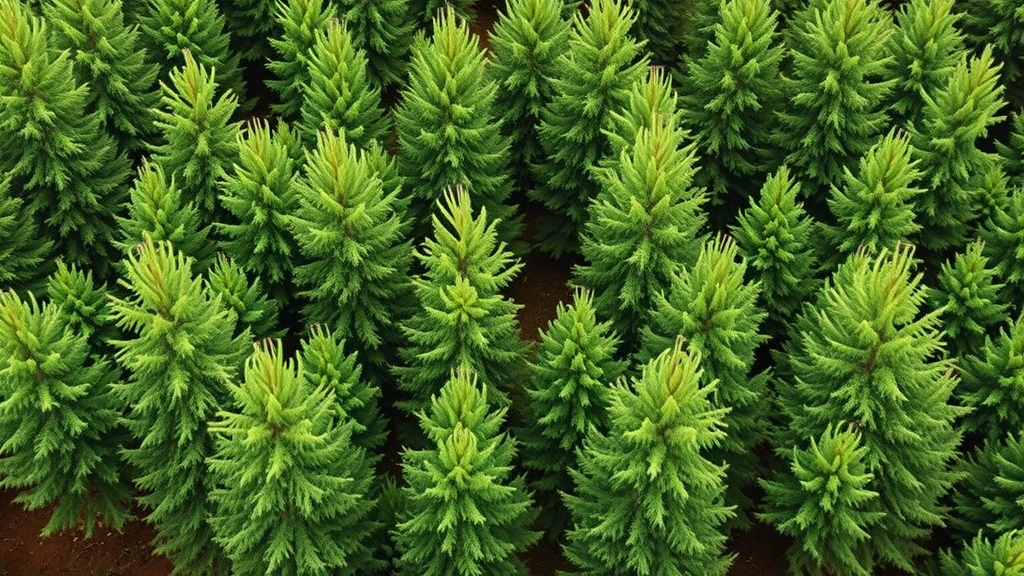
Germany’s Norway spruce forests are facing a double threat that arrives in sequence: first the wind, then the beetles. A new modelling study published in Regional Environmental Change suggests that the way foresters manage these stands over the next two decades could determine how much of the country’s most valuable conifer timber survives the escalating disturbances of a warming climate. The research, led by Robin Bourke of the University of Freiburg together with Barry Gardiner, Rasoul Yousefpour and Marc Hanewinkel, simulated the growth of spruce stands across all of Germany from 2020 to 2046 under two future climate pathways, and then subjected the virtual forests to a repeat of one of the most destructive storms in recent European history.
The stakes are considerable. Norway spruce is the second most abundant tree species in Germany after Scots pine and underpins the solid-timber, paper and pulp industries. In 2010 it accounted for roughly 60 percent of the land expectation value of European forestry, a share projected to fall to around 45 percent by 2040 as climate change erodes the species’ viability in much of its planted range. Disturbances are already taking a heavy toll: over the past twenty years, natural disturbances accounted for about 16 percent of the mean annual volume harvested in European forests, and wind alone was responsible for roughly 46 percent of that loss. Germany ranks among the European countries most affected economically by wind damage, particularly along the northern coast and in high-elevation regions.
What makes spruce forests especially vulnerable is the chain reaction that follows a storm. Wind-thrown trees provide fertile breeding ground for the European spruce bark beetle, Ips typographus, which can then erupt into standing timber. Pure spruce plantations, mature stands, exposed clearcut edges, warm temperatures and dry soils all amplify the risk. The study’s authors coupled three models to capture this cascade: the 3-PGmix process-based growth model to simulate how stands develop under changing temperature, precipitation and radiation; the ForestGALES hybrid mechanistic model to calculate the critical wind speeds at which trees break or overturn; and the IpsR bark beetle model to estimate how much wood beetles kill after a storm, using effective degree days and drought stress as key drivers.
Before running the national simulations, the team validated their approach in Baden-Württemberg by comparing ForestGALES against the statistical “Lothar” model, which was calibrated on damage from the 1999 storm of that name and rigorously tested in south-western Germany. The two models tracked each other closely over a 30-year simulation, both showing reduced damage probability under regular thinning compared with unthinned stands. ForestGALES proved consistently slightly more pessimistic, with differences of 14.7 to 15.8 percent between the models’ risk estimates — a smaller discrepancy than the 20 to 30 percent biases reported in earlier model comparisons. The authors note that the mechanistic model’s slight pessimism may reflect its sensitivity to stand density and soil type, factors the statistical model does not consider, and they caution that absolute damage figures should be interpreted with care.
For the national-scale experiment, the researchers drew stand data from the German National Forest Inventory and simulated three management regimes under both moderate (RCP 4.5) and high-emission (RCP 8.5) climate scenarios. The “Standard Thinning” regime removed 16 percent of stem density every ten years. The “No Thin” regime left stands to grow with only natural mortality. The “Adapted Thinning” regime, based on the risk-adapted spruce management system of Baden-Württemberg, applied thinning governed by height class: once stands reached 28 metres, a felling sequence began, with volume removed five times at two-year intervals before a final clearcut. Then, in each simulated year from 2020 to 2046, the team imposed the wind field of storm Kyrill — the January 2007 storm that swept almost the entire country, with a median maximum hourly wind speed of 29.5 metres per second across the simulated plots — and followed up with a bark beetle attack.
When disturbance risk was ignored, the results looked straightforward: “Standard Thinning” produced the highest total volume by 2046, reaching a median of 1,141 cubic metres per hectare under RCP 4.5 and 1,165 cubic metres per hectare under RCP 8.5, ahead of both “No Thin” and “Adapted Thinning.” The slightly higher yields under the warmer scenario suggest that, in the short term and on sites not limited by water, some German spruce stands may even grow faster. But the picture inverted once storms and beetles entered the equation. The “Adapted Thinning” strategy showed the lowest median wind damage probability, 0.46 under both climate scenarios, compared with 0.55 for “Standard Thinning” and 0.57 for “No Thin,” and it held the lowest damaged volume across the country in both climate pathways.
The bark beetle results reinforced the same message. Beetle damage was concentrated in central and southern Germany, where spruce is most abundant, and the “No Thin” regime suffered the highest absolute losses because more standing wood was available as host material. Notably, “Standard Thinning” and “No Thin” produced identical beetle damage rates as a percentage of volume — but because unthinned stands carried more timber, their absolute losses were significantly greater. Under “Adapted Thinning,” the damaged percentage declined with stand age and fell to zero by age 80 under both climate scenarios, simply because those stands had already been harvested. Under RCP 8.5, beetle damage increased over time in the conventional regimes, while it steadily declined under the adapted strategy. The conditional value at risk — the mean damage in the worst 5 percent of cases — was lowest for “Adapted Thinning” under both climate pathways, indicating that early, intensive timber extraction protects not just the average outcome but the tail risk.
The mechanism behind these results is physically intuitive. Wind damage scales with tree height, diameter and the sail area of the canopy, so taller, denser, older stands are more likely to break or overturn in a given gust. By removing volume before a storm arrives, adapted management reduces the amount of timber physically exposed to the wind and simultaneously eliminates the windthrown wood that beetles need to build up populations. The study also found that the differences between the two climate scenarios were minor over the 2020 to 2046 window, since the pathways diverge substantially only in the second half of the century — but the authors warn that rising heat sums and drought stress could still drive larger beetle outbreaks, and drought can decouple the wind-beetle link in complex ways.
The findings carry a pointed implication for German forestry policy. The latest national forest inventory shows that Norway spruce coverage has already declined, largely due to the droughts and beetle epidemics that began in 2018, and the authors suggest that earlier implementation of adapted management could have reduced some of that damage. They are careful to acknowledge limitations: the simulations used the third national inventory because the fourth was not yet available in detailed form, storm frequency changes were not modelled, and the probability of storm occurrence in any given year was not accounted for. They also stress that unmanaged forests can serve as effective carbon sinks over decades, so the optimal strategy depends on whether the goal is timber production, carbon storage or both.
Longer term, the outlook for spruce itself remains bleak, with studies projecting substantial range losses, and in some scenarios complete disappearance from lower elevations, by the end of the century. Species mixtures with beech, Scots pine, Douglas fir or birch offer another route to resilience, as mixed stands are generally more resistant to both wind and beetles. But for the maturing spruce stands that dominate German forests today, the message of this study is unambiguous: in a climate of intensifying storms and beetles, the safest harvest is the one taken before the storm arrives. A risk-averse strategy of early thinning and shortened rotations, the authors conclude, is one of the most effective tools available to keep Germany’s spruce forests standing — and their timber out of the windthrow — in the decades ahead.
Subject of Research: Modelling the effects of forest management strategies on the resilience of German Norway spruce forests to wind storm and bark beetle disturbances under climate change
Article Title: Impact of forest management on the future resilience of German Norway spruce (Picea abies (L.) H. Karst) forests to abiotic and biotic threats in the changing climate
Article References: Bourke, R., Gardiner, B., Yousefpour, R., & Hanewinkel, M. (2026). Impact of forest management on the future resilience of German Norway spruce (Picea abies (L.) H. Karst) forests to abiotic and biotic threats in the changing climate. Regional Environmental Change, 26(4), Article 197. https://doi.org/10.1007/s10113-026-02671-2
Image Credits: AI Generated
DOI: 10.1007/s10113-026-02671-2
Keywords: Norway spruce, bark beetle, wind storms, climate change, forest management, thinning, ForestGALES, 3-PGmix, Ips typographus, Germany, disturbance ecology, RCP scenarios
Cite Scienmag News
Sloane Callahan. (September 23, 2026). Thinning Early Could Save Germany’s Spruce Forests from Storms and Beetles. Scienmag. https://scienmag.com/thinning-early-could-save-germanys-spruce-forests-from-storms-and-beetles/
Sloane Callahan. "Thinning Early Could Save Germany’s Spruce Forests from Storms and Beetles." Scienmag, 23 September 2026, https://scienmag.com/thinning-early-could-save-germanys-spruce-forests-from-storms-and-beetles/. Accessed 5 October 2026.
Sloane Callahan. "Thinning Early Could Save Germany’s Spruce Forests from Storms and Beetles." Scienmag. September 23, 2026. https://scienmag.com/thinning-early-could-save-germanys-spruce-forests-from-storms-and-beetles/


