


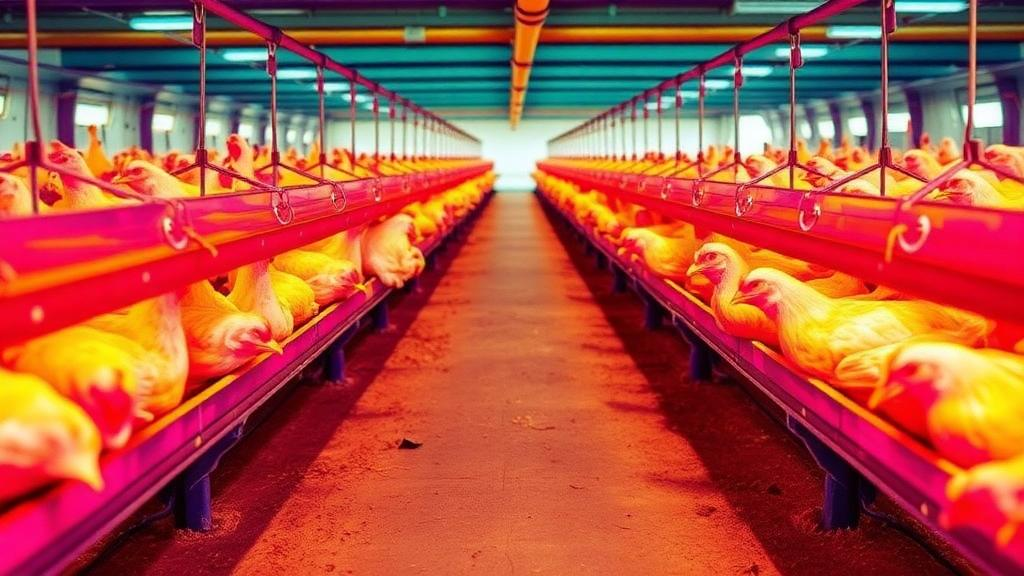
Environmental enrichment is one of the most widely promoted strategies for improving the welfare of broiler chickens, yet its real-world effects remain surprisingly difficult to pin down. A new study from researchers at the Universidad Nacional Autónoma de México and the Universidad Autónoma del Estado de México, published in Frontiers in Animal Science, combined infrared thermography, behavioral observation, and meat quality analysis to test how different enrichment designs affect fast-growing broilers. The findings reveal a striking disconnect: structures meant to improve animal welfare can leave visible traces in the birds’ joints and even alter the properties of the meat that reaches consumers.
The research team raised 300 one-day-old male Cobb 500 broilers under commercial conditions until 49 days of age. At 21 days, the birds were randomly divided into three blocks of 100, each containing four groups of 25: an unenriched control, a single-level perch (Perch 1L), a two-level perch with three bars (Perch 2L), and a platform with inclined access planks. All structures shared the same length of 90 centimeters and height of 15 centimeters, differing only in geometry and surface configuration. The enrichment devices were introduced at 14 days of age with a seven-day habituation period, positioned between the feeder and the drinker to encourage interaction.
To assess leg health without invasive procedures, the researchers used a FLIR C3-X thermal camera at a distance of one meter, with emissivity set at 0.95 for featherless areas. They imaged four regions of interest: the left and right intertarsal articulations and the left and right plantar surfaces, at 21 and 49 days of age. Infrared thermography detects the infrared radiation emitted by a body surface, which depends on local blood flow, metabolic activity, and vascular tone. Inflammation typically raises surface temperature through increased perfusion and vasodilation, while reduced blood flow, tissue necrosis, or hyperkeratosis can lower it. This makes the technique a sensitive, non-invasive window into subclinical leg problems that are common in fast-growing broilers.
The thermographic results told a nuanced story. Across all groups, superficial temperatures of the intertarsal joints dropped with age, from about 36.4 degrees Celsius at 21 days to roughly 34.7 to 34.9 degrees at 49 days, a pattern consistent with normal development in featherless regions. But the Perch 2L group stood out. At 21 days, these birds already showed markedly lower joint temperatures than the other treatments, around 34.1 degrees, and their temperatures did not decline further with age. Their plantar surfaces, in contrast, warmed between the two sampling points. The authors interpret this combination as suggestive of an inflammatory response, noting that values in the range observed for Perch 2L have previously been associated with gross joint lesions in other studies. Because thermography cannot discriminate between causes of tissue damage, the researchers emphasize that histological confirmation would be needed.
Behavioral data added another layer. The team recorded 120 hours of video across the 12 pens at 28 and 42 days of age, scoring perching, resting, feeding, drinking, and preening using a standardized ethogram analyzed in CowLog software. Perching declined sharply as the birds grew heavier, and the platform was by far the least used enrichment, with observed perching behavior approaching zero by the later measurement. Preening, by contrast, occurred more frequently in the afternoon than in the morning across all groups, consistent with known circadian preferences. Feeding and drinking were unaffected by treatment. The researchers suggest that the platform’s metal mesh surface, dimensions, or simply its role as an obstacle in the pen may have made it unattractive for resting, while the birds’ increasing body weight and potential joint discomfort likely reduced perch use overall.
Live weight told a simpler story: enrichment had no effect. Mean body weight rose from 0.46 kilograms at 21 days to 2.76 kilograms at 49 days in all groups. Interestingly, however, a Pearson correlation revealed a significant negative relationship between individual body weight and overall surface temperature across the four measured regions, driven mainly by the intertarsal joints. Heavier birds ran cooler at the joint surfaces, a finding that aligns with the idea that increasing weight compromises leg health through reduced blood flow, skin thickening, or tissue damage.
The most unexpected results emerged after slaughter. The researchers evaluated raw thigh meat for pH, texture, color, electrical conductivity, and water-holding capacity at 0, 1, 2, 7, 10, and 15 days post-slaughter. Texture and yellowness showed no differences among groups. But water-holding capacity, a key technological trait that influences juiciness, yield, and consumer acceptance, was higher in the Perch 2L and Platform groups at day 15 of refrigerated storage. The authors propose that the additional locomotion required to navigate these structures may have promoted muscle development, altering collagen crosslinking, sarcomere length, and myofibril behavior during rigor and storage. They caution, however, that improved water-holding capacity should not automatically be read as evidence of better welfare, given the thermographic signs of possible inflammation in the Perch 2L group.
Color and electrical conductivity showed more transient, storage-dependent shifts. Lightness differed among treatments at day 7, with Perch 2L showing the highest value, while redness differed at day 2 and increased over time in the Platform group. Electrical conductivity, a marker of ionic mobility and membrane integrity, separated Perch 1L from the other groups only at day 10. The authors stress that these parameters should be interpreted as complementary indicators rather than direct surrogates for water retention, and that mechanistic relationships established in breast meat may not transfer directly to thigh meat, which has a more oxidative metabolism and higher myoglobin content.
The study’s broader message is methodological as much as biological. Environmental enrichment is often evaluated through single lenses, such as behavior or growth performance, but this integrated approach shows that a structure can be well used, leave thermal signatures of joint stress, and still improve certain meat quality traits, all without affecting body weight. Design characteristics like material, height, diameter, and geometry appear to shape both preference and physiological outcome, and the authors argue that no single measure can capture the full welfare picture. As the poultry industry faces growing pressure to adopt welfare-friendly housing, this work suggests that the path forward requires looking simultaneously at the living bird, its thermal signature, and the product it becomes.
Subject of Research: Effects of environmental enrichment designs on leg health, behavior, and meat quality in broiler chickens
Article Title: Integrating infrared thermography, behavioral assessment, and meat quality analysis to evaluate the effects of environmental enrichment in broiler chickens
Article References: Hernández-Sánchez, R. C., Martinez-Castañeda, F. E., Hernández-Ramírez, J. O., Salcedo-Gómez, M. P., Díaz-Sánchez, V.-M., Valencia-Viramonte, D. G., Olivares-Hernández, I. G., Solís-Garfias, J., Zambrano-Zaragoza, M. D. L. L., & Hernández-Trujillo, E. (2026). Integrating infrared thermography, behavioral assessment, and meat quality analysis to evaluate the effects of environmental enrichment in broiler chickens. Frontiers in Animal Science, 7, Article 1976355. https://doi.org/10.3389/fanim.2026.1976355
Image Credits: AI Generated
DOI: 10.3389/fanim.2026.1976355
Keywords: broiler chickens, environmental enrichment, infrared thermography, animal welfare, meat quality, water-holding capacity, perches, poultry science, leg health, behavioral assessment, precision livestock farming, Integrating
Cite Scienmag News
William Thompson. (October 16, 2026). Thermal Cameras Reveal Hidden Costs of Perches in Broiler Chickens. Scienmag. https://scienmag.com/thermal-cameras-reveal-hidden-costs-of-perches-in-broiler-chickens/
William Thompson. "Thermal Cameras Reveal Hidden Costs of Perches in Broiler Chickens." Scienmag, 16 October 2026, https://scienmag.com/thermal-cameras-reveal-hidden-costs-of-perches-in-broiler-chickens/. Accessed 16 October 2026.
William Thompson. "Thermal Cameras Reveal Hidden Costs of Perches in Broiler Chickens." Scienmag. October 16, 2026. https://scienmag.com/thermal-cameras-reveal-hidden-costs-of-perches-in-broiler-chickens/


