


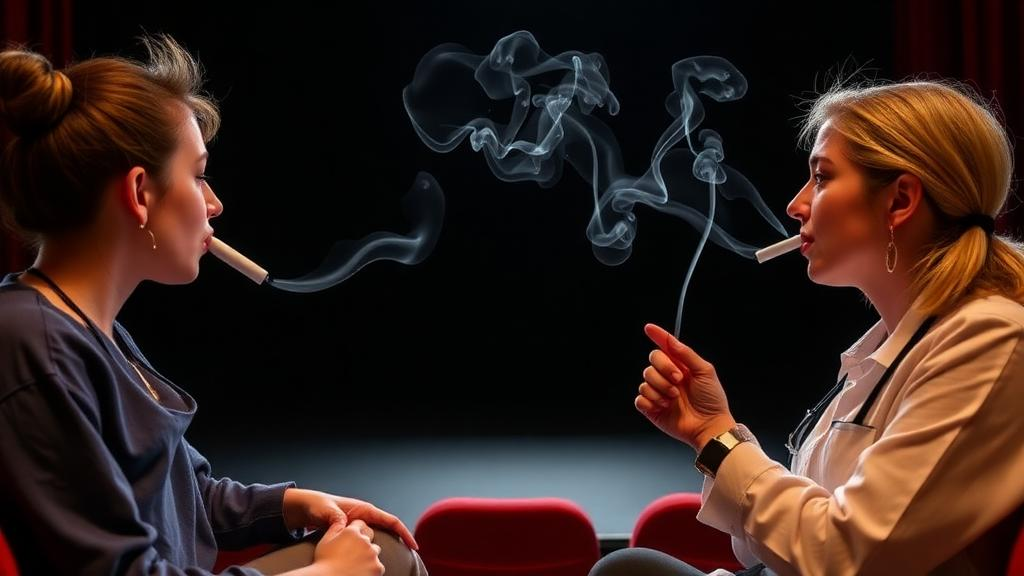
A single 50-minute stage performance about the dangers of breathing other people’s smoke measurably improved the knowledge of hundreds of nursing students in Turkey, according to a new study published in BMC Nursing. The research, led by Hümeyra Hançer Tok of Cumhuriyet University together with Makbule Tokur Kesgin of Bolu Abant Izzet Baysal University and Lütfiye Nur Uzun, tested whether community-based theater could serve as an educational tool for one of the most persistent problems in public health: secondhand smoke exposure. The answer, based on a large quasi-experimental trial, was a resounding yes, with students’ test scores rising sharply after they watched a play titled “Let’s Breathe Clean Air.”
Secondhand smoke, sometimes called passive smoke or tobacco smoke pollution, is the mixture of sidestream smoke released from the burning tip of a cigarette and mainstream smoke exhaled by smokers. Decades of epidemiological research have linked it to lung cancer, cardiovascular disease, respiratory infections, and worsened asthma in nonsmokers, with children and pregnant women among the most vulnerable groups. Because nurses are often the health professionals closest to patients and communities, their understanding of these risks has a direct bearing on the advice they give, the environments they help shape, and the prevention messages they deliver. The authors of the new study argue that innovative and engaging educational methods are needed to strengthen this knowledge base among the next generation of nurses.
The study took the form of a quasi-experimental, single-group pre-test and post-test design conducted at a health school in Turkey. A total of 322 nursing students participated. Before the intervention, each student completed a personal information form capturing demographic details such as sex and smoking status, along with a 13-item instrument called the Secondhand Smoke Exposure Knowledge Test. This test served as the study’s primary outcome measure, quantifying how much students knew about the sources, health consequences, and prevention of passive smoking exposure.
The intervention itself was deliberately unconventional. Rather than a lecture or a pamphlet, students attended a 50-minute community-based theater performance titled “Let’s Breathe Clean Air,” which was designed to educate audiences about the risks of passive smoking through dramatized scenarios. Community-based theater, sometimes described as applied theater or drama in health education, works by embedding health messages in narrative, character, and emotion, which proponents argue makes information more memorable and personally resonant than didactic instruction. The performance format also allows large audiences to be reached simultaneously, a practical advantage for crowded nursing programs.
Immediately after the performance, students retook the knowledge test, and the researchers compared the paired scores using the Wilcoxon Signed Ranks test, a non-parametric statistical method appropriate for comparing two related measurements when score distributions may not be normal. The results were striking. The mean knowledge score rose from 9.93, with a standard deviation of 2.4, before the play to 11.98, with a standard deviation of 1.6, afterward. Given that the test contains 13 items, the post-test mean of nearly 12 out of 13 indicates that most students answered almost every knowledge question correctly after the intervention, compared with roughly ten out of 13 beforehand.
The statistical significance of this change was reported at p less than 0.001, meaning the probability of observing such a large improvement by chance alone is extremely small. Equally important was the effect size, a measure of the magnitude of the change that is independent of sample size. The study reported an effect size of 1.00, which by conventional benchmarks in education and psychology is considered a large effect. In practical terms, the theater intervention did not merely nudge scores upward; it produced a substantial and meaningful gain in knowledge across the cohort.
The demographic profile of the participants adds context to the findings. Of the 322 students, 18.6 percent were male and 26.8 percent reported being smokers themselves. That more than a quarter of future nurses smoke is itself a noteworthy data point, since healthcare workers who smoke may face particular challenges in counseling patients about cessation and in advocating for smoke-free environments. The fact that knowledge scores improved significantly across the whole group suggests the theatrical format engaged smokers and nonsmokers alike, although the published analysis focused on the overall pre-post comparison rather than subgroup differences.
The authors are careful about the limits of their design. Because the study included only a single group measured before and after the intervention, with no concurrent control group, it cannot definitively establish that the theater performance alone caused the improvement. Other factors, such as test-retest effects, in which students simply remember and correct their earlier answers, or concurrent learning in their nursing coursework, could have contributed. The researchers explicitly note that the single-group design limits causal conclusions. Nevertheless, the size and consistency of the score increase, combined with the large effect size, support the interpretation that the performance played a meaningful role in enhancing knowledge.
Why might a play outperform more traditional teaching methods? Educational theorists have long argued that emotional engagement strengthens memory consolidation, and dramatization forces abstract health statistics into concrete human situations, such as a child breathing a parent’s smoke at home. Theater also operates simultaneously on cognitive and affective levels, delivering factual content while evoking empathy and prompting reflection about personal and community behavior. For topics like secondhand smoke, where the harm is invisible, delayed, and often inflicted on others rather than the smoker, this affective dimension may be especially valuable. The Turkish team’s results align with a broader movement in health professions education toward interactive, arts-based pedagogy.
The practical implications reach beyond one Turkish health school. The authors recommend incorporating theater-based and other interactive methods into nursing curricula to strengthen public health knowledge, pointing out that such approaches can be valuable and engaging tools for educating large groups at once. If replicated with controlled designs and longer-term follow-up, the approach could offer health schools a low-cost, scalable way to prepare future nurses to protect vulnerable populations from passive smoking. For now, the study offers a vivid demonstration that sometimes the most effective public health lecture comes not from a podium, but from a stage.
Subject of Research: The effect of community-based theater training on nursing students' knowledge of secondhand smoke exposure
Article Title: The effect of community-based theater training on nursing students’ knowledge of secondhand smoke exposure: a one-group pretest–posttest study
Article References: Tok, H. H., Kesgin, M. T., & Uzun, L. N. (2026). The effect of community-based theater training on nursing students’ knowledge of secondhand smoke exposure: a one-group pretest–posttest study. BMC Nursing. https://doi.org/10.1186/s12912-026-04864-w
Image Credits: AI Generated
DOI: 10.1186/s12912-026-04864-w
Keywords: secondhand smoke, nursing students, health education, community-based theater, applied drama, passive smoking, pretest-posttest study, knowledge test, public health, tobacco smoke pollution, nursing curriculum, Turkey
Cite Scienmag News
Ophelia Keating. (October 7, 2026). Theater Training Boosts Nursing Students’ Knowledge of Secondhand Smoke Risks. Scienmag. https://scienmag.com/theater-training-boosts-nursing-students-knowledge-of-secondhand-smoke-risks/
Ophelia Keating. "Theater Training Boosts Nursing Students’ Knowledge of Secondhand Smoke Risks." Scienmag, 7 October 2026, https://scienmag.com/theater-training-boosts-nursing-students-knowledge-of-secondhand-smoke-risks/. Accessed 7 October 2026.
Ophelia Keating. "Theater Training Boosts Nursing Students’ Knowledge of Secondhand Smoke Risks." Scienmag. October 7, 2026. https://scienmag.com/theater-training-boosts-nursing-students-knowledge-of-secondhand-smoke-risks/


