


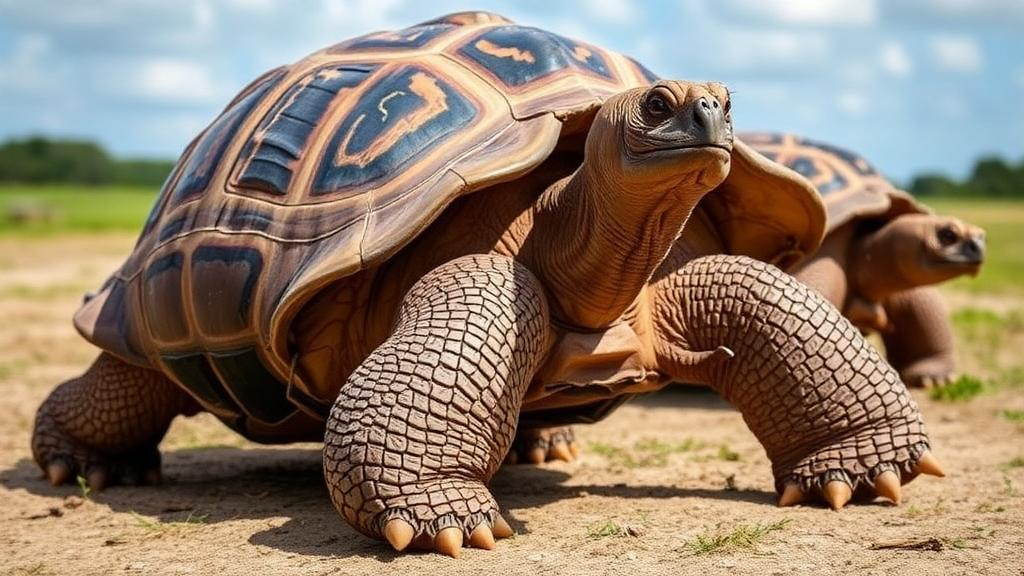
The world’s largest free-roaming population of giant tortoises is thriving, according to a landmark new survey that has produced the most rigorous population estimate ever attempted for the species. Researchers led by the Seychelles Islands Foundation and the University of Exeter report that approximately 180,000 Aldabra giant tortoises (Aldabrachelys gigantea) roam Aldabra Atoll, a remote coral atoll in the Indian Ocean and one of only two places on Earth where giant tortoises survive in the wild, the other being the Galapagos archipelago. The figure, published in the journal Ecology and Evolution, is the highest ever recorded for the species and represents the first atoll-wide assessment since the widely cited estimate of 100,000 tortoises produced in the late 1990s.
The new estimate was not a simple headcount. It emerged from five years of field data collected between 2018 and 2022 by research staff of the Seychelles Islands Foundation who live and work on the atoll, combined with a sophisticated statistical framework designed to account for the animals that surveyors could not see. The team applied Bayesian hierarchical distance sampling, a technique that models the probability of detecting tortoises across different habitats and corrects for missed individuals. This matters enormously on Aldabra, where dense scrub, mangrove thickets and Pemphis vegetation can conceal large numbers of animals from even experienced observers walking survey transects.
Dr Nancy Bunbury, a co-author of the study, explained the challenge of counting animals in such terrain. She noted that Aldabra’s giant tortoise monitoring programme is one of the longest running in the region, but that the atoll’s dense vegetation makes counting tortoises genuinely difficult in places. By modelling what the surveyors did not see as well as what they did, she said, the team produced the most reliable baseline yet for this iconic Seychelles species, establishing a benchmark that can be used to track the population for decades to come. That distinction between raw counts and modelled abundance is central to understanding the new results.
The researchers are careful to caution that the headline figure of 180,000 does not mean the population has nearly doubled since the late 1990s. Earlier surveys did not account for tortoises that were present but undetected, hidden in dense scrub or shade when counts were carried out. Because those methods likely missed a substantial fraction of the animals, previous figures were probably underestimates of true abundance. The new modelling suggests the population has nonetheless genuinely grown over the intervening decades and now appears healthy and stable. For the 2018 to 2022 survey period, the best estimate was almost 183,000 adult and sub-adult tortoises, a number that exceeds the entire human population of the Seychelles.
The recovery is all the more striking given the species’ history. During the 19th century, heavy exploitation by passing ships and settlers reduced Aldabra’s tortoise population to fewer than 1,000 individuals, pushing the species to the brink of extinction. Protection of the atoll, first as a strict nature reserve in 1981 and subsequently as a UNESCO World Heritage Site in 1982, allowed the population to rebuild over successive decades. Today, the Aldabra giant tortoise is widely regarded as one of the greatest conservation success stories of the Indian Ocean, and the new study provides quantitative confirmation of that legacy.
Beyond the total number, the survey revealed striking patterns in how tortoises are distributed across the atoll’s mosaic of habitats. The animals occur at their highest densities in Aldabra’s grasslands, known locally as ‘tortoise turf’, an open grazing lawn shaped in part by decades of tortoise feeding. Densities were next highest on open exposed surfaces and in open mixed scrub. In contrast, tortoises were much harder to detect in dense scrub, mangrove and Pemphis habitats, where reduced visibility would have led earlier counting methods to miss animals entirely. The hierarchical modelling framework explicitly corrects for these differences in detectability, producing habitat-specific estimates that reflect true abundance rather than simply what observers happened to record.
Dr Dave Hudson, a Postdoctoral Research Associate at the University of Exeter in Cornwall, supported the development of the statistical modelling framework used to analyse the long-term monitoring data. He described the results as great news for the tortoises and a testament to the fantastic work done in the field, but stressed that the numbers provide a baseline rather than an endpoint. He expressed hope that the study has given conservation managers the evidence they need to track future change and act early as the tortoises face increasing pressures from climate change, drought and invasive species. His comments underline a key theme of the research: a robust statistical baseline is what transforms decades of monitoring effort into actionable conservation science.
Dr Frauke Fleischer-Dogley, CEO of the Seychelles Islands Foundation, emphasised the human dimension behind the data. She noted that the monitoring data in the study were collected by SIF staff living and working on the atoll, year after year, and that more than 180,000 giant tortoises roaming freely is proof of what long-term commitment to conservation can achieve. She called the result wonderful news for Seychelles, for the world, and for everyone who has worked to protect Aldabra. The statement reflects the reality that reliable ecological data on remote atolls depends on sustained institutional presence, with field teams returning to the same transects season after season to build the datasets that make modern abundance modelling possible.
Despite the encouraging numbers, the study’s authors warn that vigilance is essential, because Aldabra’s environment is changing in ways that could threaten even a population of this size. The atoll’s climate is shifting, with longer and more frequent droughts predicted to reduce the shade and food available to tortoises, while rising sea levels threaten the low-lying parts of the atoll that the animals inhabit. As megaherbivores whose grazing shapes the vegetation itself, tortoises are sensitive to changes in plant productivity, and prolonged droughts could alter both their food supply and the habitat structure that the survey teams rely on for monitoring.
Invasive mammals remain the other major concern. Feral goats, which devastated the atoll’s vegetation before their successful eradication in 2012, are gone, but feral cats and black rats persist on Aldabra and prey on tortoise eggs and hatchlings. This predation pressure limits the recruitment of young tortoises into the population, even as adult and sub-adult numbers remain high. The study’s authors argue that the planned eradication of these remaining invasive mammals could lift the last barriers to further population growth and help the species withstand future climate pressures. For now, the new estimate stands as both a celebration and a warning: the largest giant tortoise population on Earth has been counted with unprecedented rigour, and protecting it will depend on the same long-term commitment that brought it back from the edge of extinction.
Subject of Research: Population estimation of the Aldabra giant tortoise on Aldabra Atoll using distance sampling
Article Title: New study reports largest-ever population estimate for Seychelles’ giant tortoises
Article References: New study reports largest-ever population estimate for Seychelles’ giant tortoises. (n.d.). Original publication
Image Credits: AI Generated
DOI: Not provided
Keywords: Aldabra giant tortoise, Aldabra Atoll, Seychelles, population estimate, Bayesian hierarchical distance sampling, conservation, Ecology and Evolution, Seychelles Islands Foundation, University of Exeter, invasive species, climate change, megaherbivore
Cite Scienmag News
Gavin Prescott. (October 7, 2026). Aldabra’s giant tortoises number 180,000 in largest population count ever recorded. Scienmag. https://scienmag.com/aldabras-giant-tortoises-number-180000-in-largest-population-count-ever-recorded/
Gavin Prescott. "Aldabra’s giant tortoises number 180,000 in largest population count ever recorded." Scienmag, 7 October 2026, https://scienmag.com/aldabras-giant-tortoises-number-180000-in-largest-population-count-ever-recorded/. Accessed 7 October 2026.
Gavin Prescott. "Aldabra’s giant tortoises number 180,000 in largest population count ever recorded." Scienmag. October 7, 2026. https://scienmag.com/aldabras-giant-tortoises-number-180000-in-largest-population-count-ever-recorded/


