


In 1998, a paper linking childhood vaccines with autism was published in prestigious journal, The Lancet, only to be retracted in 2010 when the science was debunked.

Credit: Judy Kay and authors, University of Sydney
In 1998, a paper linking childhood vaccines with autism was published in prestigious journal, The Lancet, only to be retracted in 2010 when the science was debunked.
Fourteen years since its retraction, the paper’s original claim continues to flourish on social media, fuelling misinformation and disinformation around vaccine safety and efficacy.
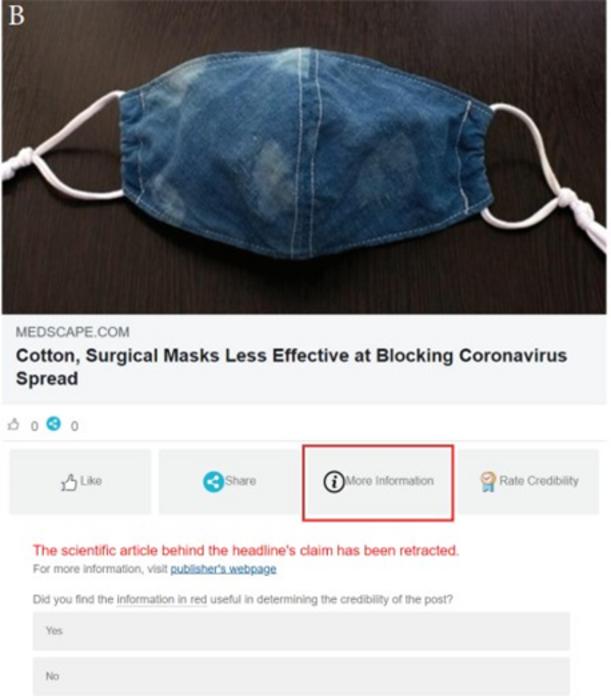
A University of Sydney team is hoping to help social media users identify posts featuring misinformation and disinformation arising from now-debunked science. They have developed and tested a new interface that helps users discover further information about potentially fraught claims on social media.
They created and tested the efficacy of adding a “more information” button to social media posts. The button links to a drop down which allows users to see more details about claims or information in news posts, including information on whether that news is based on retracted science. The reseachers say social media platforms could use an algorithm to link posts to details of retracted science.
Testing of the interface among a group of participants showed that when people understand the idea of retraction and can easily find when health news is based on a claim from retracted research, it can help reduce the impact and spread of misinformation as they are less likely to share it.
“Knowledge is power,” said Professor Judy Kay from the School of Computer Science who led the research. “During the height of the COVID-19 pandemic, myths around the efficacy and safety of vaccines abounded. We want to help people to better understand when science has been debunked or challenged so they can make informed decisions about their health,” she said.
“The ability to read and properly interpret often complex scientific papers is a very niche skill – not everybody has that literacy or is up to date on the latest science. Many people would have seen posts about now-debunked vaccine research and thought: ‘it was published in a medical journal, so it must be true’. Sadly, that isn’t the case for retracted publications.”
“Social media platforms could do much better than they do now,” said co-author and PhD student Waheeb Yaqub. “During the height of the COVID-19 pandemic, myths around the efficacy and safety of vaccines spread like wildfire.”
“Our approach shows that when people understand the idea of retraction and can find when health news is based on a retracted science article, it can reduce the impact and spread of misinformation,” he said.
Tool boosts literacy of processes behind scientific research
The research was conducted with 44 participants who started with little or no understanding of scientific retraction. After completing a five-minute tutorial, they rated how various reasons for retraction make a paper’s findings invalid.
The researchers then studied how participants used the “More Information” button. They found the new information altered the participants’ beliefs on three health claims based on retracted papers shared on social media.
These claims were: whether masks are effective in limiting the spread of coronavirus; that the Mediterranean diet is effective in reducing heart disease; and snacking while watching an action movie leads to overeating.
The first claim was based on two papers, one which had been retracted and one which hadn’t. The other two claims were based on retracted papers. The researchers specifically chose papers of which participants would have differing knowledge.
“Participants confidently considered masks were effective. Most didn’t know about the Mediterranean diet and so were unsure about whether it was true. Many people whose personal experience of snacking during films made them believe it was true.”
The button influenced participants when they knew little about a topic to begin with. When the participants discovered the post was based on a retracted paper, they were less likely to like or share it.
On social media, both misinformation (the inadvertent spread of false information) and disinformation (false information deliberately spread with malicious intent), are rising.
Papers can be retracted when problems with methodology, results or experiments are found.
The researchers say it would be feasible for social media platforms to develop back-end software that links databases of retracted papers.
“If social media platforms want to maintain their quality and integrity, they should look to implement simple methods like ours,” Professor Kay said.
The study was published in Proceedings of the ACM on Human-Computer Interaction.
DECLARATION
The authors declare no conflicts of interest. Waheeb Yaqub is the recipient of a research scholarship.
Journal
Proceedings of the ACM on Human-Computer Interaction
Method of Research
Survey
Subject of Research
People
Article Title
Foundations for Enabling People to Recognise Misinformation in Social Media News based on Retracted Science
Article Publication Date
26-Apr-2024
COI Statement
The authors declare no conflicts of interest. Waheeb Yaqub is the recipient of a research scholarship.
Cite Scienmag News
Courtney Benton. (May 17, 2024). The tentacles of retracted science reach deep into social media. A simple button could change that. Scienmag. https://scienmag.com/the-tentacles-of-retracted-science-reach-deep-into-social-media-a-simple-button-could-change-that/
Courtney Benton. "The tentacles of retracted science reach deep into social media. A simple button could change that." Scienmag, 17 May 2024, https://scienmag.com/the-tentacles-of-retracted-science-reach-deep-into-social-media-a-simple-button-could-change-that/. Accessed 3 September 2026.
Courtney Benton. "The tentacles of retracted science reach deep into social media. A simple button could change that." Scienmag. May 17, 2024. https://scienmag.com/the-tentacles-of-retracted-science-reach-deep-into-social-media-a-simple-button-could-change-that/

