


A new study conducted at Reichman University’s Baruch Ivcher Institute for Brain, Cognition, and Technology, led by Prof. Amir Amedi, demonstrates how the external representation of physiological signals (interoception) can affect our perception of them and teach us how to improve them in order to balance the body in stressful situations, for example. The study was recently published in the prestigious journal Nature Portfolios Scientific Reports.

Credit: Reichman University
A new study conducted at Reichman University’s Baruch Ivcher Institute for Brain, Cognition, and Technology, led by Prof. Amir Amedi, demonstrates how the external representation of physiological signals (interoception) can affect our perception of them and teach us how to improve them in order to balance the body in stressful situations, for example. The study was recently published in the prestigious journal Nature Portfolios Scientific Reports.
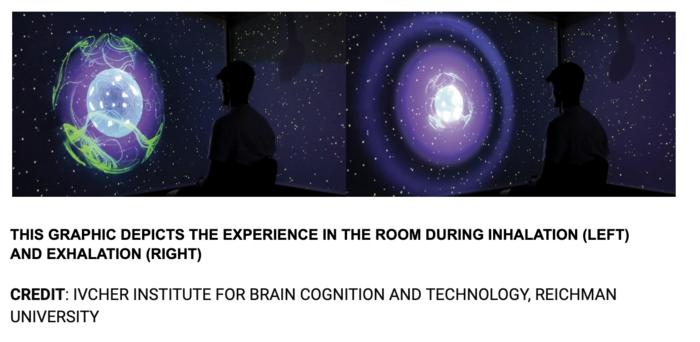
The researchers focused on breathing for this study, and created an audiovisual representation of the user’s breathing pattern in the form of a spherical object that appears on three screens surrounding the user. The movement of the object mirrors the user’s breath, expanding in synchrony with each inhale and contracting upon exhalation, creating a sensory connection through the use of many layers that respond to pauses in breath. The user is also surrounded by a spatial audio system that produces ambient sounds, while an additional sound from the core of the spherical object mimics the rise and fall of ocean waves, both of which also respond to the user’s breath. This sensory experience was designed in collaboration with video art creator and director Yoav Cohen.
The research team used a variety of tests to assess mind wandering, interoceptive sensibility, and flow, and found that the experience led to a significant improvement in interoceptive sensibility and flow among the users, with a strong correlation between the two results.
Founder and Director of the Baruch Ivcher Institute for Brain, Cognition, and Technology at Reichman University, Prof. Amir Amedi: “These findings tell us that there is quite a strong bidirectional relationship between the external representation of our respiratory signals and our awareness of our internal bodily signals. The external stimuli help redirect the user’s attention back to their internal sensations, improving bodily awareness. The findings support the idea that sensory substitution can be used to integrate internal and external attention systems, and harnessed to improve mental health. They also highlight the relationship between the brain and body, which — for example in the case of breath — is intertwined with the function of our immune system via the sympathetic and parasympathetic branches of the nervous system.”
Amedi explains: “The user’s respiratory signals are translated into dynamic visual and auditory stimuli in real-time. This creates a totally immersive multisensory environment, which takes internal bodily signals and externalizes them to enhance your awareness of these internal processes. The experience also includes elements that encourage a more desirable breath pattern. For example, a light from the center of the sphere grows when the user exhales, encouraging longer exhalations, known to have a relaxing effect. Together, the auditory and visual cues create an experience that engulfs and immerses the user. This level of engagement enhances the user’s awareness of internal bodily sensations through external signals.”
“What we’re doing is trying to improve interoception,” explains Oran Goral, co-first author of the paper. “Interoception, your ability to perceive and interpret your own internal bodily signals and sensations, is often impaired in numerous psychological disorders and even neurodegenerative diseases (diseases that damage the brain’s neurons such as Alzheimer’s and Parkinson’s). Improving interoception is associated with improvements in mental health, emotional regulation, and overall well-being.”
Journal
Scientific Reports
Method of Research
Experimental study
Subject of Research
People
Article Title
“Enhancing interoceptive sensibility through exteroceptive–interoceptive sensory substitution”
Article Publication Date
27-Jun-2024
Cite Scienmag News
Ophelia Keating. (July 24, 2024). The secret to finding balance: improving interoception. Scienmag. https://scienmag.com/the-secret-to-finding-balance-improving-interoception/
Ophelia Keating. "The secret to finding balance: improving interoception." Scienmag, 24 July 2024, https://scienmag.com/the-secret-to-finding-balance-improving-interoception/. Accessed 5 September 2026.
Ophelia Keating. "The secret to finding balance: improving interoception." Scienmag. July 24, 2024. https://scienmag.com/the-secret-to-finding-balance-improving-interoception/

