


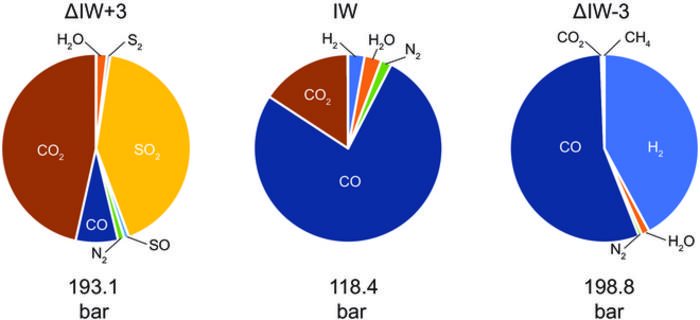
First, this paper discusses the impact of the concentration and distribution of volatile elements on the habitability of planets. During the planet formation process, volatile elements exhibit randomness, leading to a decrease in the abundance of elements on terrestrial planets as volatility increases. However, analysis of the composition of the Earth’s mantle can help estimate the concentration of volatile elements on planets. Volatile elements may originate from the dissolution of nebular gas or from materials associated with comets and carbonaceous chondrites, and the isotopes of different elements provide a basis for distinguishing their sources. Furthermore, the distribution of elements within a planet is influenced by factors such as planetary mass and atmospheric pressure. The determination of atmospheric composition depends on the distribution of elements within the planet and the dissolution relationship between gases and silicate liquids. As shown in Fig 3, under reducing conditions, there may be prebiotic molecules such as CH4 and NH3 in the atmosphere, while under oxidative atmospheres, there are more SO2 and N2. These findings indicate that the formation and evolution of planets have a significant impact on their atmospheric composition and habitability.First, this paper discusses the impact of the concentration and distribution of volatile elements on the habitability of planets. During the planet formation process, volatile elements exhibit randomness, leading to a decrease in the abundance of elements on terrestrial planets as volatility increases. However, analysis of the composition of the Earth’s mantle can help estimate the concentration of volatile elements on planets. Volatile elements may originate from the dissolution of nebular gas or from materials associated with comets and carbonaceous chondrites, and the isotopes of different elements provide a basis for distinguishing their sources. Furthermore, the distribution of elements within a planet is influenced by factors such as planetary mass and atmospheric pressure. The determination of atmospheric composition depends on the distribution of elements within the planet and the dissolution relationship between gases and silicate liquids. As shown in Fig 3, under reducing conditions, there may be prebiotic molecules such as CH4 and NH3 in the atmosphere, while under oxidative atmospheres, there are more SO2 and N2. These findings indicate that the formation and evolution of planets have a significant impact on their atmospheric composition and habitability.

Credit: Space: Science & Technology
First, this paper discusses the impact of the concentration and distribution of volatile elements on the habitability of planets. During the planet formation process, volatile elements exhibit randomness, leading to a decrease in the abundance of elements on terrestrial planets as volatility increases. However, analysis of the composition of the Earth’s mantle can help estimate the concentration of volatile elements on planets. Volatile elements may originate from the dissolution of nebular gas or from materials associated with comets and carbonaceous chondrites, and the isotopes of different elements provide a basis for distinguishing their sources. Furthermore, the distribution of elements within a planet is influenced by factors such as planetary mass and atmospheric pressure. The determination of atmospheric composition depends on the distribution of elements within the planet and the dissolution relationship between gases and silicate liquids. As shown in Fig 3, under reducing conditions, there may be prebiotic molecules such as CH4 and NH3 in the atmosphere, while under oxidative atmospheres, there are more SO2 and N2. These findings indicate that the formation and evolution of planets have a significant impact on their atmospheric composition and habitability.First, this paper discusses the impact of the concentration and distribution of volatile elements on the habitability of planets. During the planet formation process, volatile elements exhibit randomness, leading to a decrease in the abundance of elements on terrestrial planets as volatility increases. However, analysis of the composition of the Earth’s mantle can help estimate the concentration of volatile elements on planets. Volatile elements may originate from the dissolution of nebular gas or from materials associated with comets and carbonaceous chondrites, and the isotopes of different elements provide a basis for distinguishing their sources. Furthermore, the distribution of elements within a planet is influenced by factors such as planetary mass and atmospheric pressure. The determination of atmospheric composition depends on the distribution of elements within the planet and the dissolution relationship between gases and silicate liquids. As shown in Fig 3, under reducing conditions, there may be prebiotic molecules such as CH4 and NH3 in the atmosphere, while under oxidative atmospheres, there are more SO2 and N2. These findings indicate that the formation and evolution of planets have a significant impact on their atmospheric composition and habitability.
The author then analyzes the impact of convective mechanisms. The convection mechanisms of Earth and other planets play a crucial role in the formation and evolution of their surfaces. After rocky planets cool, mantle convection begins, affecting the planetary thermal evolution and surface conditions. Mantle dynamics not only connect the surface and atmosphere through heat transfer and magnetic field effects but also influence atmospheric mass and the greenhouse effect through volcanic activity and the release of related volatile substances. Different tectonic regimes (such as plate tectonics and episodic lid trends) determine the geological characteristics and habitability of the planetary surface. Earth’s plate tectonics play a crucial role in the origin and development of life by regulating nutrient cycles and promoting biological evolution. Although the origin of life may occur under conditions without plate tectonics, plate tectonics is still considered a key factor in maintaining life. On other planets (such as Fig.4), different tectonic regimes influence the formation and evolution of the atmosphere, while the magnetic field protects the planetary surface from harmful radiation and atmospheric loss, thus affecting planetary habitability and the evolution of life.The author then analyzes the impact of convective mechanisms. The convection mechanisms of Earth and other planets play a crucial role in the formation and evolution of their surfaces. After rocky planets cool, mantle convection begins, affecting the planetary thermal evolution and surface conditions. Mantle dynamics not only connect the surface and atmosphere through heat transfer and magnetic field effects but also influence atmospheric mass and the greenhouse effect through volcanic activity and the release of related volatile substances. Different tectonic regimes (such as plate tectonics and episodic lid trends) determine the geological characteristics and habitability of the planetary surface. Earth’s plate tectonics play a crucial role in the origin and development of life by regulating nutrient cycles and promoting biological evolution. Although the origin of life may occur under conditions without plate tectonics, plate tectonics is still considered a key factor in maintaining life. On other planets (such as Fig.4), different tectonic regimes influence the formation and evolution of the atmosphere, while the magnetic field protects the planetary surface from harmful radiation and atmospheric loss, thus affecting planetary habitability and the evolution of life.
Furthermore, maintaining Earth’s habitable conditions also involves the impact of liquid water and carbon cycles. Liquid water, energy, geochemical conditions, and a stable magnetic field driven by the Earth’s core maintain Earth’s biosphere. The carbonate-silicate cycle regulates CO2, ensuring a moderate climate; silicate weathering limits the rate of increase of CO2 in the atmosphere. Weathering intensity depends on the availability of reactants and is subject to multiple constraints such as rock supply, transport, and water. Observational tests at the edges of habitable zones reveal a bimodal distribution of CO2 concentrations, indicating a regulatory mechanism for the planetary greenhouse effect. In the future, further understanding of the evolution of CO2 cycling and the greenhouse effect can be achieved by exploring the edges of habitable zones on moist planets. However, research on the volatile history processes, water cycle, landforms, climate, and the interactions and feedback mechanisms between life and these factors is still in its infancy, and further exploration is needed to reveal how these complex processes together shape the habitability of planets.Furthermore, maintaining Earth’s habitable conditions also involves the impact of liquid water and carbon cycles. Liquid water, energy, geochemical conditions, and a stable magnetic field driven by the Earth’s core maintain Earth’s biosphere. The carbonate-silicate cycle regulates CO2, ensuring a moderate climate; silicate weathering limits the rate of increase of CO2 in the atmosphere. Weathering intensity depends on the availability of reactants and is subject to multiple constraints such as rock supply, transport, and water. Observational tests at the edges of habitable zones reveal a bimodal distribution of CO2 concentrations, indicating a regulatory mechanism for the planetary greenhouse effect. In the future, further understanding of the evolution of CO2 cycling and the greenhouse effect can be achieved by exploring the edges of habitable zones on moist planets. However, research on the volatile history processes, water cycle, landforms, climate, and the interactions and feedback mechanisms between life and these factors is still in its infancy, and further exploration is needed to reveal how these complex processes together shape the habitability of planets.Furthermore, maintaining Earth’s habitable conditions also involves the impact of liquid water and carbon cycles. Liquid water, energy, geochemical conditions, and a stable magnetic field driven by the Earth’s core maintain Earth’s biosphere. The carbonate-silicate cycle regulates CO2, ensuring a moderate climate; silicate weathering limits the rate of increase of CO2 in the atmosphere. Weathering intensity depends on the availability of reactants and is subject to multiple constraints such as rock supply, transport, and water. Observational tests at the edges of habitable zones reveal a bimodal distribution of CO2 concentrations, indicating a regulatory mechanism for the planetary greenhouse effect. In the future, further understanding of the evolution of CO2 cycling and the greenhouse effect can be achieved by exploring the edges of habitable zones on moist planets. However, research on the volatile history processes, water cycle, landforms, climate, and the interactions and feedback mechanisms between life and these factors is still in its infancy, and further exploration is needed to reveal how these complex processes together shape the habitability of planets.Furthermore, maintaining Earth’s habitable conditions also involves the impact of liquid water and carbon cycles. Liquid water, energy, geochemical conditions, and a stable magnetic field driven by the Earth’s core maintain Earth’s biosphere. The carbonate-silicate cycle regulates CO2, ensuring a moderate climate; silicate weathering limits the rate of increase of CO2 in the atmosphere. Weathering intensity depends on the availability of reactants and is subject to multiple constraints such as rock supply, transport, and water. Observational tests at the edges of habitable zones reveal a bimodal distribution of CO2 concentrations, indicating a regulatory mechanism for the planetary greenhouse effect. In the future, further understanding of the evolution of CO2 cycling and the greenhouse effect can be achieved by exploring the edges of habitable zones on moist planets. However, research on the volatile history processes, water cycle, landforms, climate, and the interactions and feedback mechanisms between life and these factors is still in its infancy, and further exploration is needed to reveal how these complex processes together shape the habitability of planets.Furthermore, maintaining Earth’s habitable conditions also involves the impact of liquid water and carbon cycles. Liquid water, energy, geochemical conditions, and a stable magnetic field driven by the Earth’s core maintain Earth’s biosphere. The carbonate-silicate cycle regulates CO2, ensuring a moderate climate; silicate weathering limits the rate of increase of CO2 in the atmosphere. Weathering intensity depends on the availability of reactants and is subject to multiple constraints such as rock supply, transport, and water. Observational tests at the edges of habitable zones reveal a bimodal distribution of CO2 concentrations, indicating a regulatory mechanism for the planetary greenhouse effect. In the future, further understanding of the evolution of CO2 cycling and the greenhouse effect can be achieved by exploring the edges of habitable zones on moist planets. However, research on the volatile history processes, water cycle, landforms, climate, and the interactions and feedback mechanisms between life and these factors is still in its infancy, and further exploration is needed to reveal how these complex processes together shape the habitability of planets.Furthermore, maintaining Earth’s habitable conditions also involves the impact of liquid water and carbon cycles. Liquid water, energy, geochemical conditions, and a stable magnetic field driven by the Earth’s core maintain Earth’s biosphere. The carbonate-silicate cycle regulates CO2, ensuring a moderate climate; silicate weathering limits the rate of increase of CO2 in the atmosphere. Weathering intensity depends on the availability of reactants and is subject to multiple constraints such as rock supply, transport, and water. Observational tests at the edges of habitable zones reveal a bimodal distribution of CO2 concentrations, indicating a regulatory mechanism for the planetary greenhouse effect. In the future, further understanding of the evolution of CO2 cycling and the greenhouse effect can be achieved by exploring the edges of habitable zones on moist planets. However, research on the volatile history processes, water cycle, landforms, climate, and the interactions and feedback mechanisms between life and these factors is still in its infancy, and further exploration is needed to reveal how these complex processes together shape the habitability of planets.Furthermore, maintaining Earth’s habitable conditions also involves the impact of liquid water and carbon cycles. Liquid water, energy, geochemical conditions, and a stable magnetic field driven by the Earth’s core maintain Earth’s biosphere. The carbonate-silicate cycle regulates CO2, ensuring a moderate climate; silicate weathering limits the rate of increase of CO2 in the atmosphere. Weathering intensity depends on the availability of reactants and is subject to multiple constraints such as rock supply, transport, and water. Observational tests at the edges of habitable zones reveal a bimodal distribution of CO2 concentrations, indicating a regulatory mechanism for the planetary greenhouse effect. In the future, further understanding of the evolution of CO2 cycling and the greenhouse effect can be achieved by exploring the edges of habitable zones on moist planets. However, research on the volatile history processes, water cycle, landforms, climate, and the interactions and feedback mechanisms between life and these factors is still in its infancy, and further exploration is needed to reveal how these complex processes together shape the habitability of planets.Furthermore, maintaining Earth’s habitable conditions also involves the impact of liquid water and carbon cycles. Liquid water, energy, geochemical conditions, and a stable magnetic field driven by the Earth’s core maintain Earth’s biosphere. The carbonate-silicate cycle regulates CO2, ensuring a moderate climate; silicate weathering limits the rate of increase of CO2 in the atmosphere. Weathering intensity depends on the availability of reactants and is subject to multiple constraints such as rock supply, transport, and water. Observational tests at the edges of habitable zones reveal a bimodal distribution of CO2 concentrations, indicating a regulatory mechanism for the planetary greenhouse effect. In the future, further understanding of the evolution of CO2 cycling and the greenhouse effect can be achieved by exploring the edges of habitable zones on moist planets. However, research on the volatile history processes, water cycle, landforms, climate, and the interactions and feedback mechanisms between life and these factors is still in its infancy, and further exploration is needed to reveal how these complex processes together shape the habitability of planets.
The author also analyzed current and future interstellar missions aimed at exploring planets within and beyond the solar system to search for signs and conditions suitable for life. In terms of missions within the solar system, the focus is primarily on Mars and Venus. Although Mars may have had suitable conditions in the past, its current environment does not support life. However, investigations into traces of past water and geological features on Mars are ongoing. For Venus, while there is controversy over its past and present habitability, future missions plan to provide more information about its internal structure and evolution. The moons of Jupiter and Saturn are also important targets for research, as they both may have distributions of liquid water suitable for life. Future missions will explore the geological features and internal structures of these moons to search for signs of life. In terms of interstellar planet detection missions, the main focus is on planets around M-type and solar-type stars, requiring new observational techniques. These missions will determine the atmospheric characteristics and habitability of Earth-like exoplanets by collecting data on reflected light and thermal radiation. Although currently limited by technology, future endeavors with large astronomical telescopes and multiple space missions will provide a better understanding of habitable worlds beyond the solar system.The author also analyzed current and future interstellar missions aimed at exploring planets within and beyond the solar system to search for signs and conditions suitable for life. In terms of missions within the solar system, the focus is primarily on Mars and Venus. Although Mars may have had suitable conditions in the past, its current environment does not support life. However, investigations into traces of past water and geological features on Mars are ongoing. For Venus, while there is controversy over its past and present habitability, future missions plan to provide more information about its internal structure and evolution. The moons of Jupiter and Saturn are also important targets for research, as they both may have distributions of liquid water suitable for life. Future missions will explore the geological features and internal structures of these moons to search for signs of life. In terms of interstellar planet detection missions, the main focus is on planets around M-type and solar-type stars, requiring new observational techniques. These missions will determine the atmospheric characteristics and habitability of Earth-like exoplanets by collecting data on reflected light and thermal radiation. Although currently limited by technology, future endeavors with large astronomical telescopes and multiple space missions will provide a better understanding of habitable worlds beyond the solar system.The author also analyzed current and future interstellar missions aimed at exploring planets within and beyond the solar system to search for signs and conditions suitable for life. In terms of missions within the solar system, the focus is primarily on Mars and Venus. Although Mars may have had suitable conditions in the past, its current environment does not support life. However, investigations into traces of past water and geological features on Mars are ongoing. For Venus, while there is controversy over its past and present habitability, future missions plan to provide more information about its internal structure and evolution. The moons of Jupiter and Saturn are also important targets for research, as they both may have distributions of liquid water suitable for life. Future missions will explore the geological features and internal structures of these moons to search for signs of life. In terms of interstellar planet detection missions, the main focus is on planets around M-type and solar-type stars, requiring new observational techniques. These missions will determine the atmospheric characteristics and habitability of Earth-like exoplanets by collecting data on reflected light and thermal radiation. Although currently limited by technology, future endeavors with large astronomical telescopes and multiple space missions will provide a better understanding of habitable worlds beyond the solar system.The author also analyzed current and future interstellar missions aimed at exploring planets within and beyond the solar system to search for signs and conditions suitable for life. In terms of missions within the solar system, the focus is primarily on Mars and Venus. Although Mars may have had suitable conditions in the past, its current environment does not support life. However, investigations into traces of past water and geological features on Mars are ongoing. For Venus, while there is controversy over its past and present habitability, future missions plan to provide more information about its internal structure and evolution. The moons of Jupiter and Saturn are also important targets for research, as they both may have distributions of liquid water suitable for life. Future missions will explore the geological features and internal structures of these moons to search for signs of life. In terms of interstellar planet detection missions, the main focus is on planets around M-type and solar-type stars, requiring new observational techniques. These missions will determine the atmospheric characteristics and habitability of Earth-like exoplanets by collecting data on reflected light and thermal radiation. Although currently limited by technology, future endeavors with large astronomical telescopes and multiple space missions will provide a better understanding of habitable worlds beyond the solar system.The author also analyzed current and future interstellar missions aimed at exploring planets within and beyond the solar system to search for signs and conditions suitable for life. In terms of missions within the solar system, the focus is primarily on Mars and Venus. Although Mars may have had suitable conditions in the past, its current environment does not support life. However, investigations into traces of past water and geological features on Mars are ongoing. For Venus, while there is controversy over its past and present habitability, future missions plan to provide more information about its internal structure and evolution. The moons of Jupiter and Saturn are also important targets for research, as they both may have distributions of liquid water suitable for life. Future missions will explore the geological features and internal structures of these moons to search for signs of life. In terms of interstellar planet detection missions, the main focus is on planets around M-type and solar-type stars, requiring new observational techniques. These missions will determine the atmospheric characteristics and habitability of Earth-like exoplanets by collecting data on reflected light and thermal radiation. Although currently limited by technology, future endeavors with large astronomical telescopes and multiple space missions will provide a better understanding of habitable worlds beyond the solar system.The author also analyzed current and future interstellar missions aimed at exploring planets within and beyond the solar system to search for signs and conditions suitable for life. In terms of missions within the solar system, the focus is primarily on Mars and Venus. Although Mars may have had suitable conditions in the past, its current environment does not support life. However, investigations into traces of past water and geological features on Mars are ongoing. For Venus, while there is controversy over its past and present habitability, future missions plan to provide more information about its internal structure and evolution. The moons of Jupiter and Saturn are also important targets for research, as they both may have distributions of liquid water suitable for life. Future missions will explore the geological features and internal structures of these moons to search for signs of life. In terms of interstellar planet detection missions, the main focus is on planets around M-type and solar-type stars, requiring new observational techniques. These missions will determine the atmospheric characteristics and habitability of Earth-like exoplanets by collecting data on reflected light and thermal radiation. Although currently limited by technology, future endeavors with large astronomical telescopes and multiple space missions will provide a better understanding of habitable worlds beyond the solar system.The author also analyzed current and future interstellar missions aimed at exploring planets within and beyond the solar system to search for signs and conditions suitable for life. In terms of missions within the solar system, the focus is primarily on Mars and Venus. Although Mars may have had suitable conditions in the past, its current environment does not support life. However, investigations into traces of past water and geological features on Mars are ongoing. For Venus, while there is controversy over its past and present habitability, future missions plan to provide more information about its internal structure and evolution. The moons of Jupiter and Saturn are also important targets for research, as they both may have distributions of liquid water suitable for life. Future missions will explore the geological features and internal structures of these moons to search for signs of life. In terms of interstellar planet detection missions, the main focus is on planets around M-type and solar-type stars, requiring new observational techniques. These missions will determine the atmospheric characteristics and habitability of Earth-like exoplanets by collecting data on reflected light and thermal radiation. Although currently limited by technology, future endeavors with large astronomical telescopes and multiple space missions will provide a better understanding of habitable worlds beyond the solar system.The author also analyzed current and future interstellar missions aimed at exploring planets within and beyond the solar system to search for signs and conditions suitable for life. In terms of missions within the solar system, the focus is primarily on Mars and Venus. Although Mars may have had suitable conditions in the past, its current environment does not support life. However, investigations into traces of past water and geological features on Mars are ongoing. For Venus, while there is controversy over its past and present habitability, future missions plan to provide more information about its internal structure and evolution. The moons of Jupiter and Saturn are also important targets for research, as they both may have distributions of liquid water suitable for life. Future missions will explore the geological features and internal structures of these moons to search for signs of life. In terms of interstellar planet detection missions, the main focus is on planets around M-type and solar-type stars, requiring new observational techniques. These missions will determine the atmospheric characteristics and habitability of Earth-like exoplanets by collecting data on reflected light and thermal radiation. Although currently limited by technology, future endeavors with large astronomical telescopes and multiple space missions will provide a better understanding of habitable worlds beyond the solar system.The author also analyzed current and future interstellar missions aimed at exploring planets within and beyond the solar system to search for signs and conditions suitable for life. In terms of missions within the solar system, the focus is primarily on Mars and Venus. Although Mars may have had suitable conditions in the past, its current environment does not support life. However, investigations into traces of past water and geological features on Mars are ongoing. For Venus, while there is controversy over its past and present habitability, future missions plan to provide more information about its internal structure and evolution. The moons of Jupiter and Saturn are also important targets for research, as they both may have distributions of liquid water suitable for life. Future missions will explore the geological features and internal structures of these moons to search for signs of life. In terms of interstellar planet detection missions, the main focus is on planets around M-type and solar-type stars, requiring new observational techniques. These missions will determine the atmospheric characteristics and habitability of Earth-like exoplanets by collecting data on reflected light and thermal radiation. Although currently limited by technology, future endeavors with large astronomical telescopes and multiple space missions will provide a better understanding of habitable worlds beyond the solar system.The author also analyzed current and future interstellar missions aimed at exploring planets within and beyond the solar system to search for signs and conditions suitable for life. In terms of missions within the solar system, the focus is primarily on Mars and Venus. Although Mars may have had suitable conditions in the past, its current environment does not support life. However, investigations into traces of past water and geological features on Mars are ongoing. For Venus, while there is controversy over its past and present habitability, future missions plan to provide more information about its internal structure and evolution. The moons of Jupiter and Saturn are also important targets for research, as they both may have distributions of liquid water suitable for life. Future missions will explore the geological features and internal structures of these moons to search for signs of life. In terms of interstellar planet detection missions, the main focus is on planets around M-type and solar-type stars, requiring new observational techniques. These missions will determine the atmospheric characteristics and habitability of Earth-like exoplanets by collecting data on reflected light and thermal radiation. Although currently limited by technology, future endeavors with large astronomical telescopes and multiple space missions will provide a better understanding of habitable worlds beyond the solar system.The author also analyzed current and future interstellar missions aimed at exploring planets within and beyond the solar system to search for signs and conditions suitable for life. In terms of missions within the solar system, the focus is primarily on Mars and Venus. Although Mars may have had suitable conditions in the past, its current environment does not support life. However, investigations into traces of past water and geological features on Mars are ongoing. For Venus, while there is controversy over its past and present habitability, future missions plan to provide more information about its internal structure and evolution. The moons of Jupiter and Saturn are also important targets for research, as they both may have distributions of liquid water suitable for life. Future missions will explore the geological features and internal structures of these moons to search for signs of life. In terms of interstellar planet detection missions, the main focus is on planets around M-type and solar-type stars, requiring new observational techniques. These missions will determine the atmospheric characteristics and habitability of Earth-like exoplanets by collecting data on reflected light and thermal radiation. Although currently limited by technology, future endeavors with large astronomical telescopes and multiple space missions will provide a better understanding of habitable worlds beyond the solar system.The author also analyzed current and future interstellar missions aimed at exploring planets within and beyond the solar system to search for signs and conditions suitable for life. In terms of missions within the solar system, the focus is primarily on Mars and Venus. Although Mars may have had suitable conditions in the past, its current environment does not support life. However, investigations into traces of past water and geological features on Mars are ongoing. For Venus, while there is controversy over its past and present habitability, future missions plan to provide more information about its internal structure and evolution. The moons of Jupiter and Saturn are also important targets for research, as they both may have distributions of liquid water suitable for life. Future missions will explore the geological features and internal structures of these moons to search for signs of life. In terms of interstellar planet detection missions, the main focus is on planets around M-type and solar-type stars, requiring new observational techniques. These missions will determine the atmospheric characteristics and habitability of Earth-like exoplanets by collecting data on reflected light and thermal radiation. Although currently limited by technology, future endeavors with large astronomical telescopes and multiple space missions will provide a better understanding of habitable worlds beyond the solar system.The author also analyzed current and future interstellar missions aimed at exploring planets within and beyond the solar system to search for signs and conditions suitable for life. In terms of missions within the solar system, the focus is primarily on Mars and Venus. Although Mars may have had suitable conditions in the past, its current environment does not support life. However, investigations into traces of past water and geological features on Mars are ongoing. For Venus, while there is controversy over its past and present habitability, future missions plan to provide more information about its internal structure and evolution. The moons of Jupiter and Saturn are also important targets for research, as they both may have distributions of liquid water suitable for life. Future missions will explore the geological features and internal structures of these moons to search for signs of life. In terms of interstellar planet detection missions, the main focus is on planets around M-type and solar-type stars, requiring new observational techniques. These missions will determine the atmospheric characteristics and habitability of Earth-like exoplanets by collecting data on reflected light and thermal radiation. Although currently limited by technology, future endeavors with large astronomical telescopes and multiple space missions will provide a better understanding of habitable worlds beyond the solar system.The author also analyzed current and future interstellar missions aimed at exploring planets within and beyond the solar system to search for signs and conditions suitable for life. In terms of missions within the solar system, the focus is primarily on Mars and Venus. Although Mars may have had suitable conditions in the past, its current environment does not support life. However, investigations into traces of past water and geological features on Mars are ongoing. For Venus, while there is controversy over its past and present habitability, future missions plan to provide more information about its internal structure and evolution. The moons of Jupiter and Saturn are also important targets for research, as they both may have distributions of liquid water suitable for life. Future missions will explore the geological features and internal structures of these moons to search for signs of life. In terms of interstellar planet detection missions, the main focus is on planets around M-type and solar-type stars, requiring new observational techniques. These missions will determine the atmospheric characteristics and habitability of Earth-like exoplanets by collecting data on reflected light and thermal radiation. Although currently limited by technology, future endeavors with large astronomical telescopes and multiple space missions will provide a better understanding of habitable worlds beyond the solar system.The author also analyzed current and future interstellar missions aimed at exploring planets within and beyond the solar system to search for signs and conditions suitable for life. In terms of missions within the solar system, the focus is primarily on Mars and Venus. Although Mars may have had suitable conditions in the past, its current environment does not support life. However, investigations into traces of past water and geological features on Mars are ongoing. For Venus, while there is controversy over its past and present habitability, future missions plan to provide more information about its internal structure and evolution. The moons of Jupiter and Saturn are also important targets for research, as they both may have distributions of liquid water suitable for life. Future missions will explore the geological features and internal structures of these moons to search for signs of life. In terms of interstellar planet detection missions, the main focus is on planets around M-type and solar-type stars, requiring new observational techniques. These missions will determine the atmospheric characteristics and habitability of Earth-like exoplanets by collecting data on reflected light and thermal radiation. Although currently limited by technology, future endeavors with large astronomical telescopes and multiple space missions will provide a better understanding of habitable worlds beyond the solar system.The author also analyzed current and future interstellar missions aimed at exploring planets within and beyond the solar system to search for signs and conditions suitable for life. In terms of missions within the solar system, the focus is primarily on Mars and Venus. Although Mars may have had suitable conditions in the past, its current environment does not support life. However, investigations into traces of past water and geological features on Mars are ongoing. For Venus, while there is controversy over its past and present habitability, future missions plan to provide more information about its internal structure and evolution. The moons of Jupiter and Saturn are also important targets for research, as they both may have distributions of liquid water suitable for life. Future missions will explore the geological features and internal structures of these moons to search for signs of life. In terms of interstellar planet detection missions, the main focus is on planets around M-type and solar-type stars, requiring new observational techniques. These missions will determine the atmospheric characteristics and habitability of Earth-like exoplanets by collecting data on reflected light and thermal radiation. Although currently limited by technology, future endeavors with large astronomical telescopes and multiple space missions will provide a better understanding of habitable worlds beyond the solar system.The author also analyzed current and future interstellar missions aimed at exploring planets within and beyond the solar system to search for signs and conditions suitable for life. In terms of missions within the solar system, the focus is primarily on Mars and Venus. Although Mars may have had suitable conditions in the past, its current environment does not support life. However, investigations into traces of past water and geological features on Mars are ongoing. For Venus, while there is controversy over its past and present habitability, future missions plan to provide more information about its internal structure and evolution. The moons of Jupiter and Saturn are also important targets for research, as they both may have distributions of liquid water suitable for life. Future missions will explore the geological features and internal structures of these moons to search for signs of life. In terms of interstellar planet detection missions, the main focus is on planets around M-type and solar-type stars, requiring new observational techniques. These missions will determine the atmospheric characteristics and habitability of Earth-like exoplanets by collecting data on reflected light and thermal radiation. Although currently limited by technology, future endeavors with large astronomical telescopes and multiple space missions will provide a better understanding of habitable worlds beyond the solar system.The author also analyzed current and future interstellar missions aimed at exploring planets within and beyond the solar system to search for signs and conditions suitable for life. In terms of missions within the solar system, the focus is primarily on Mars and Venus. Although Mars may have had suitable conditions in the past, its current environment does not support life. However, investigations into traces of past water and geological features on Mars are ongoing. For Venus, while there is controversy over its past and present habitability, future missions plan to provide more information about its internal structure and evolution. The moons of Jupiter and Saturn are also important targets for research, as they both may have distributions of liquid water suitable for life. Future missions will explore the geological features and internal structures of these moons to search for signs of life. In terms of interstellar planet detection missions, the main focus is on planets around M-type and solar-type stars, requiring new observational techniques. These missions will determine the atmospheric characteristics and habitability of Earth-like exoplanets by collecting data on reflected light and thermal radiation. Although currently limited by technology, future endeavors with large astronomical telescopes and multiple space missions will provide a better understanding of habitable worlds beyond the solar system.The author also analyzed current and future interstellar missions aimed at exploring planets within and beyond the solar system to search for signs and conditions suitable for life. In terms of missions within the solar system, the focus is primarily on Mars and Venus. Although Mars may have had suitable conditions in the past, its current environment does not support life. However, investigations into traces of past water and geological features on Mars are ongoing. For Venus, while there is controversy over its past and present habitability, future missions plan to provide more information about its internal structure and evolution. The moons of Jupiter and Saturn are also important targets for research, as they both may have distributions of liquid water suitable for life. Future missions will explore the geological features and internal structures of these moons to search for signs of life. In terms of interstellar planet detection missions, the main focus is on planets around M-type and solar-type stars, requiring new observational techniques. These missions will determine the atmospheric characteristics and habitability of Earth-like exoplanets by collecting data on reflected light and thermal radiation. Although currently limited by technology, future endeavors with large astronomical telescopes and multiple space missions will provide a better understanding of habitable worlds beyond the solar system.The author also analyzed current and future interstellar missions aimed at exploring planets within and beyond the solar system to search for signs and conditions suitable for life. In terms of missions within the solar system, the focus is primarily on Mars and Venus. Although Mars may have had suitable conditions in the past, its current environment does not support life. However, investigations into traces of past water and geological features on Mars are ongoing. For Venus, while there is controversy over its past and present habitability, future missions plan to provide more information about its internal structure and evolution. The moons of Jupiter and Saturn are also important targets for research, as they both may have distributions of liquid water suitable for life. Future missions will explore the geological features and internal structures of these moons to search for signs of life. In terms of interstellar planet detection missions, the main focus is on planets around M-type and solar-type stars, requiring new observational techniques. These missions will determine the atmospheric characteristics and habitability of Earth-like exoplanets by collecting data on reflected light and thermal radiation. Although currently limited by technology, future endeavors with large astronomical telescopes and multiple space missions will provide a better understanding of habitable worlds beyond the solar system.The author also analyzed current and future interstellar missions aimed at exploring planets within and beyond the solar system to search for signs and conditions suitable for life. In terms of missions within the solar system, the focus is primarily on Mars and Venus. Although Mars may have had suitable conditions in the past, its current environment does not support life. However, investigations into traces of past water and geological features on Mars are ongoing. For Venus, while there is controversy over its past and present habitability, future missions plan to provide more information about its internal structure and evolution. The moons of Jupiter and Saturn are also important targets for research, as they both may have distributions of liquid water suitable for life. Future missions will explore the geological features and internal structures of these moons to search for signs of life. In terms of interstellar planet detection missions, the main focus is on planets around M-type and solar-type stars, requiring new observational techniques. These missions will determine the atmospheric characteristics and habitability of Earth-like exoplanets by collecting data on reflected light and thermal radiation. Although currently limited by technology, future endeavors with large astronomical telescopes and multiple space missions will provide a better understanding of habitable worlds beyond the solar system.The author also analyzed current and future interstellar missions aimed at exploring planets within and beyond the solar system to search for signs and conditions suitable for life. In terms of missions within the solar system, the focus is primarily on Mars and Venus. Although Mars may have had suitable conditions in the past, its current environment does not support life. However, investigations into traces of past water and geological features on Mars are ongoing. For Venus, while there is controversy over its past and present habitability, future missions plan to provide more information about its internal structure and evolution. The moons of Jupiter and Saturn are also important targets for research, as they both may have distributions of liquid water suitable for life. Future missions will explore the geological features and internal structures of these moons to search for signs of life. In terms of interstellar planet detection missions, the main focus is on planets around M-type and solar-type stars, requiring new observational techniques. These missions will determine the atmospheric characteristics and habitability of Earth-like exoplanets by collecting data on reflected light and thermal radiation. Although currently limited by technology, future endeavors with large astronomical telescopes and multiple space missions will provide a better understanding of habitable worlds beyond the solar system.The author also analyzed current and future interstellar missions aimed at exploring planets within and beyond the solar system to search for signs and conditions suitable for life. In terms of missions within the solar system, the focus is primarily on Mars and Venus. Although Mars may have had suitable conditions in the past, its current environment does not support life. However, investigations into traces of past water and geological features on Mars are ongoing. For Venus, while there is controversy over its past and present habitability, future missions plan to provide more information about its internal structure and evolution. The moons of Jupiter and Saturn are also important targets for research, as they both may have distributions of liquid water suitable for life. Future missions will explore the geological features and internal structures of these moons to search for signs of life. In terms of interstellar planet detection missions, the main focus is on planets around M-type and solar-type stars, requiring new observational techniques. These missions will determine the atmospheric characteristics and habitability of Earth-like exoplanets by collecting data on reflected light and thermal radiation. Although currently limited by technology, future endeavors with large astronomical telescopes and multiple space missions will provide a better understanding of habitable worlds beyond the solar system.The author also analyzed current and future interstellar missions aimed at exploring planets within and beyond the solar system to search for signs and conditions suitable for life. In terms of missions within the solar system, the focus is primarily on Mars and Venus. Although Mars may have had suitable conditions in the past, its current environment does not support life. However, investigations into traces of past water and geological features on Mars are ongoing. For Venus, while there is controversy over its past and present habitability, future missions plan to provide more information about its internal structure and evolution. The moons of Jupiter and Saturn are also important targets for research, as they both may have distributions of liquid water suitable for life. Future missions will explore the geological features and internal structures of these moons to search for signs of life. In terms of interstellar planet detection missions, the main focus is on planets around M-type and solar-type stars, requiring new observational techniques. These missions will determine the atmospheric characteristics and habitability of Earth-like exoplanets by collecting data on reflected light and thermal radiation. Although currently limited by technology, future endeavors with large astronomical telescopes and multiple space missions will provide a better understanding of habitable worlds beyond the solar system.The author also analyzed current and future interstellar missions aimed at exploring planets within and beyond the solar system to search for signs and conditions suitable for life. In terms of missions within the solar system, the focus is primarily on Mars and Venus. Although Mars may have had suitable conditions in the past, its current environment does not support life. However, investigations into traces of past water and geological features on Mars are ongoing. For Venus, while there is controversy over its past and present habitability, future missions plan to provide more information about its internal structure and evolution. The moons of Jupiter and Saturn are also important targets for research, as they both may have distributions of liquid water suitable for life. Future missions will explore the geological features and internal structures of these moons to search for signs of life. In terms of interstellar planet detection missions, the main focus is on planets around M-type and solar-type stars, requiring new observational techniques. These missions will determine the atmospheric characteristics and habitability of Earth-like exoplanets by collecting data on reflected light and thermal radiation. Although currently limited by technology, future endeavors with large astronomical telescopes and multiple space missions will provide a better understanding of habitable worlds beyond the solar system.The author also analyzed current and future interstellar missions aimed at exploring planets within and beyond the solar system to search for signs and conditions suitable for life. In terms of missions within the solar system, the focus is primarily on Mars and Venus. Although Mars may have had suitable conditions in the past, its current environment does not support life. However, investigations into traces of past water and geological features on Mars are ongoing. For Venus, while there is controversy over its past and present habitability, future missions plan to provide more information about its internal structure and evolution. The moons of Jupiter and Saturn are also important targets for research, as they both may have distributions of liquid water suitable for life. Future missions will explore the geological features and internal structures of these moons to search for signs of life. In terms of interstellar planet detection missions, the main focus is on planets around M-type and solar-type stars, requiring new observational techniques. These missions will determine the atmospheric characteristics and habitability of Earth-like exoplanets by collecting data on reflected light and thermal radiation. Although currently limited by technology, future endeavors with large astronomical telescopes and multiple space missions will provide a better understanding of habitable worlds beyond the solar system.The author also analyzed current and future interstellar missions aimed at exploring planets within and beyond the solar system to search for signs and conditions suitable for life. In terms of missions within the solar system, the focus is primarily on Mars and Venus. Although Mars may have had suitable conditions in the past, its current environment does not support life. However, investigations into traces of past water and geological features on Mars are ongoing. For Venus, while there is controversy over its past and present habitability, future missions plan to provide more information about its internal structure and evolution. The moons of Jupiter and Saturn are also important targets for research, as they both may have distributions of liquid water suitable for life. Future missions will explore the geological features and internal structures of these moons to search for signs of life. In terms of interstellar planet detection missions, the main focus is on planets around M-type and solar-type stars, requiring new observational techniques. These missions will determine the atmospheric characteristics and habitability of Earth-like exoplanets by collecting data on reflected light and thermal radiation. Although currently limited by technology, future endeavors with large astronomical telescopes and multiple space missions will provide a better understanding of habitable worlds beyond the solar system.The author also analyzed current and future interstellar missions aimed at exploring planets within and beyond the solar system to search for signs and conditions suitable for life. In terms of missions within the solar system, the focus is primarily on Mars and Venus. Although Mars may have had suitable conditions in the past, its current environment does not support life. However, investigations into traces of past water and geological features on Mars are ongoing. For Venus, while there is controversy over its past and present habitability, future missions plan to provide more information about its internal structure and evolution. The moons of Jupiter and Saturn are also important targets for research, as they both may have distributions of liquid water suitable for life. Future missions will explore the geological features and internal structures of these moons to search for signs of life. In terms of interstellar planet detection missions, the main focus is on planets around M-type and solar-type stars, requiring new observational techniques. These missions will determine the atmospheric characteristics and habitability of Earth-like exoplanets by collecting data on reflected light and thermal radiation. Although currently limited by technology, future endeavors with large astronomical telescopes and multiple space missions will provide a better understanding of habitable worlds beyond the solar system.The author also analyzed current and future interstellar missions aimed at exploring planets within and beyond the solar system to search for signs and conditions suitable for life. In terms of missions within the solar system, the focus is primarily on Mars and Venus. Although Mars may have had suitable conditions in the past, its current environment does not support life. However, investigations into traces of past water and geological features on Mars are ongoing. For Venus, while there is controversy over its past and present habitability, future missions plan to provide more information about its internal structure and evolution. The moons of Jupiter and Saturn are also important targets for research, as they both may have distributions of liquid water suitable for life. Future missions will explore the geological features and internal structures of these moons to search for signs of life. In terms of interstellar planet detection missions, the main focus is on planets around M-type and solar-type stars, requiring new observational techniques. These missions will determine the atmospheric characteristics and habitability of Earth-like exoplanets by collecting data on reflected light and thermal radiation. Although currently limited by technology, future endeavors with large astronomical telescopes and multiple space missions will provide a better understanding of habitable worlds beyond the solar system.The author also analyzed current and future interstellar missions aimed at exploring planets within and beyond the solar system to search for signs and conditions suitable for life. In terms of missions within the solar system, the focus is primarily on Mars and Venus. Although Mars may have had suitable conditions in the past, its current environment does not support life. However, investigations into traces of past water and geological features on Mars are ongoing. For Venus, while there is controversy over its past and present habitability, future missions plan to provide more information about its internal structure and evolution. The moons of Jupiter and Saturn are also important targets for research, as they both may have distributions of liquid water suitable for life. Future missions will explore the geological features and internal structures of these moons to search for signs of life. In terms of interstellar planet detection missions, the main focus is on planets around M-type and solar-type stars, requiring new observational techniques. These missions will determine the atmospheric characteristics and habitability of Earth-like exoplanets by collecting data on reflected light and thermal radiation. Although currently limited by technology, future endeavors with large astronomical telescopes and multiple space missions will provide a better understanding of habitable worlds beyond the solar system.The author also analyzed current and future interstellar missions aimed at exploring planets within and beyond the solar system to search for signs and conditions suitable for life. In terms of missions within the solar system, the focus is primarily on Mars and Venus. Although Mars may have had suitable conditions in the past, its current environment does not support life. However, investigations into traces of past water and geological features on Mars are ongoing. For Venus, while there is controversy over its past and present habitability, future missions plan to provide more information about its internal structure and evolution. The moons of Jupiter and Saturn are also important targets for research, as they both may have distributions of liquid water suitable for life. Future missions will explore the geological features and internal structures of these moons to search for signs of life. In terms of interstellar planet detection missions, the main focus is on planets around M-type and solar-type stars, requiring new observational techniques. These missions will determine the atmospheric characteristics and habitability of Earth-like exoplanets by collecting data on reflected light and thermal radiation. Although currently limited by technology, future endeavors with large astronomical telescopes and multiple space missions will provide a better understanding of habitable worlds beyond the solar system.The author also analyzed current and future interstellar missions aimed at exploring planets within and beyond the solar system to search for signs and conditions suitable for life. In terms of missions within the solar system, the focus is primarily on Mars and Venus. Although Mars may have had suitable conditions in the past, its current environment does not support life. However, investigations into traces of past water and geological features on Mars are ongoing. For Venus, while there is controversy over its past and present habitability, future missions plan to provide more information about its internal structure and evolution. The moons of Jupiter and Saturn are also important targets for research, as they both may have distributions of liquid water suitable for life. Future missions will explore the geological features and internal structures of these moons to search for signs of life. In terms of interstellar planet detection missions, the main focus is on planets around M-type and solar-type stars, requiring new observational techniques. These missions will determine the atmospheric characteristics and habitability of Earth-like exoplanets by collecting data on reflected light and thermal radiation. Although currently limited by technology, future endeavors with large astronomical telescopes and multiple space missions will provide a better understanding of habitable worlds beyond the solar system.
Finally, the author summarized the article: Habitability is a complex concept that relies on multiple intertwined processes. Defining “habitability” simply as a set of conditions favorable for life is not accurate and cannot be precisely assessed or predicted. The habitability of a planet is influenced by its atmosphere’s response to energy input, which mainly depends on whether its surface conditions are suitable for self-sustaining biological reactions. The internal structure and composition of a planet play a crucial role in the long-term evolution of its atmosphere, involving numerous interactions and feedback processes. Research in this field is still in its early stages, and current scientific efforts should focus more on exploration missions related to habitability and extensively observe planets beyond Earth to explore the possible foundations for planetary evolution studies.Finally, the author summarized the article: Habitability is a complex concept that relies on multiple intertwined processes. Defining “habitability” simply as a set of conditions favorable for life is not accurate and cannot be precisely assessed or predicted. The habitability of a planet is influenced by its atmosphere’s response to energy input, which mainly depends on whether its surface conditions are suitable for self-sustaining biological reactions. The internal structure and composition of a planet play a crucial role in the long-term evolution of its atmosphere, involving numerous interactions and feedback processes. Research in this field is still in its early stages, and current scientific efforts should focus more on exploration missions related to habitability and extensively observe planets beyond Earth to explore the possible foundations for planetary evolution studies.Finally, the author summarized the article: Habitability is a complex concept that relies on multiple intertwined processes. Defining “habitability” simply as a set of conditions favorable for life is not accurate and cannot be precisely assessed or predicted. The habitability of a planet is influenced by its atmosphere’s response to energy input, which mainly depends on whether its surface conditions are suitable for self-sustaining biological reactions. The internal structure and composition of a planet play a crucial role in the long-term evolution of its atmosphere, involving numerous interactions and feedback processes. Research in this field is still in its early stages, and current scientific efforts should focus more on exploration missions related to habitability and extensively observe planets beyond Earth to explore the possible foundations for planetary evolution studies.Finally, the author summarized the article: Habitability is a complex concept that relies on multiple intertwined processes. Defining “habitability” simply as a set of conditions favorable for life is not accurate and cannot be precisely assessed or predicted. The habitability of a planet is influenced by its atmosphere’s response to energy input, which mainly depends on whether its surface conditions are suitable for self-sustaining biological reactions. The internal structure and composition of a planet play a crucial role in the long-term evolution of its atmosphere, involving numerous interactions and feedback processes. Research in this field is still in its early stages, and current scientific efforts should focus more on exploration missions related to habitability and extensively observe planets beyond Earth to explore the possible foundations for planetary evolution studies.Finally, the author summarized the article: Habitability is a complex concept that relies on multiple intertwined processes. Defining “habitability” simply as a set of conditions favorable for life is not accurate and cannot be precisely assessed or predicted. The habitability of a planet is influenced by its atmosphere’s response to energy input, which mainly depends on whether its surface conditions are suitable for self-sustaining biological reactions. The internal structure and composition of a planet play a crucial role in the long-term evolution of its atmosphere, involving numerous interactions and feedback processes. Research in this field is still in its early stages, and current scientific efforts should focus more on exploration missions related to habitability and extensively observe planets beyond Earth to explore the possible foundations for planetary evolution studies.Finally, the author summarized the article: Habitability is a complex concept that relies on multiple intertwined processes. Defining “habitability” simply as a set of conditions favorable for life is not accurate and cannot be precisely assessed or predicted. The habitability of a planet is influenced by its atmosphere’s response to energy input, which mainly depends on whether its surface conditions are suitable for self-sustaining biological reactions. The internal structure and composition of a planet play a crucial role in the long-term evolution of its atmosphere, involving numerous interactions and feedback processes. Research in this field is still in its early stages, and current scientific efforts should focus more on exploration missions related to habitability and extensively observe planets beyond Earth to explore the possible foundations for planetary evolution studies.Finally, the author summarized the article: Habitability is a complex concept that relies on multiple intertwined processes. Defining “habitability” simply as a set of conditions favorable for life is not accurate and cannot be precisely assessed or predicted. The habitability of a planet is influenced by its atmosphere’s response to energy input, which mainly depends on whether its surface conditions are suitable for self-sustaining biological reactions. The internal structure and composition of a planet play a crucial role in the long-term evolution of its atmosphere, involving numerous interactions and feedback processes. Research in this field is still in its early stages, and current scientific efforts should focus more on exploration missions related to habitability and extensively observe planets beyond Earth to explore the possible foundations for planetary evolution studies.Finally, the author summarized the article: Habitability is a complex concept that relies on multiple intertwined processes. Defining “habitability” simply as a set of conditions favorable for life is not accurate and cannot be precisely assessed or predicted. The habitability of a planet is influenced by its atmosphere’s response to energy input, which mainly depends on whether its surface conditions are suitable for self-sustaining biological reactions. The internal structure and composition of a planet play a crucial role in the long-term evolution of its atmosphere, involving numerous interactions and feedback processes. Research in this field is still in its early stages, and current scientific efforts should focus more on exploration missions related to habitability and extensively observe planets beyond Earth to explore the possible foundations for planetary evolution studies.Finally, the author summarized the article: Habitability is a complex concept that relies on multiple intertwined processes. Defining “habitability” simply as a set of conditions favorable for life is not accurate and cannot be precisely assessed or predicted. The habitability of a planet is influenced by its atmosphere’s response to energy input, which mainly depends on whether its surface conditions are suitable for self-sustaining biological reactions. The internal structure and composition of a planet play a crucial role in the long-term evolution of its atmosphere, involving numerous interactions and feedback processes. Research in this field is still in its early stages, and current scientific efforts should focus more on exploration missions related to habitability and extensively observe planets beyond Earth to explore the possible foundations for planetary evolution studies.Finally, the author summarized the article: Habitability is a complex concept that relies on multiple intertwined processes. Defining “habitability” simply as a set of conditions favorable for life is not accurate and cannot be precisely assessed or predicted. The habitability of a planet is influenced by its atmosphere’s response to energy input, which mainly depends on whether its surface conditions are suitable for self-sustaining biological reactions. The internal structure and composition of a planet play a crucial role in the long-term evolution of its atmosphere, involving numerous interactions and feedback processes. Research in this field is still in its early stages, and current scientific efforts should focus more on exploration missions related to habitability and extensively observe planets beyond Earth to explore the possible foundations for planetary evolution studies.Finally, the author summarized the article: Habitability is a complex concept that relies on multiple intertwined processes. Defining “habitability” simply as a set of conditions favorable for life is not accurate and cannot be precisely assessed or predicted. The habitability of a planet is influenced by its atmosphere’s response to energy input, which mainly depends on whether its surface conditions are suitable for self-sustaining biological reactions. The internal structure and composition of a planet play a crucial role in the long-term evolution of its atmosphere, involving numerous interactions and feedback processes. Research in this field is still in its early stages, and current scientific efforts should focus more on exploration missions related to habitability and extensively observe planets beyond Earth to explore the possible foundations for planetary evolution studies.Finally, the author summarized the article: Habitability is a complex concept that relies on multiple intertwined processes. Defining “habitability” simply as a set of conditions favorable for life is not accurate and cannot be precisely assessed or predicted. The habitability of a planet is influenced by its atmosphere’s response to energy input, which mainly depends on whether its surface conditions are suitable for self-sustaining biological reactions. The internal structure and composition of a planet play a crucial role in the long-term evolution of its atmosphere, involving numerous interactions and feedback processes. Research in this field is still in its early stages, and current scientific efforts should focus more on exploration missions related to habitability and extensively observe planets beyond Earth to explore the possible foundations for planetary evolution studies.Finally, the author summarized the article: Habitability is a complex concept that relies on multiple intertwined processes. Defining “habitability” simply as a set of conditions favorable for life is not accurate and cannot be precisely assessed or predicted. The habitability of a planet is influenced by its atmosphere’s response to energy input, which mainly depends on whether its surface conditions are suitable for self-sustaining biological reactions. The internal structure and composition of a planet play a crucial role in the long-term evolution of its atmosphere, involving numerous interactions and feedback processes. Research in this field is still in its early stages, and current scientific efforts should focus more on exploration missions related to habitability and extensively observe planets beyond Earth to explore the possible foundations for planetary evolution studies.Finally, the author summarized the article: Habitability is a complex concept that relies on multiple intertwined processes. Defining “habitability” simply as a set of conditions favorable for life is not accurate and cannot be precisely assessed or predicted. The habitability of a planet is influenced by its atmosphere’s response to energy input, which mainly depends on whether its surface conditions are suitable for self-sustaining biological reactions. The internal structure and composition of a planet play a crucial role in the long-term evolution of its atmosphere, involving numerous interactions and feedback processes. Research in this field is still in its early stages, and current scientific efforts should focus more on exploration missions related to habitability and extensively observe planets beyond Earth to explore the possible foundations for planetary evolution studies.Finally, the author summarized the article: Habitability is a complex concept that relies on multiple intertwined processes. Defining “habitability” simply as a set of conditions favorable for life is not accurate and cannot be precisely assessed or predicted. The habitability of a planet is influenced by its atmosphere’s response to energy input, which mainly depends on whether its surface conditions are suitable for self-sustaining biological reactions. The internal structure and composition of a planet play a crucial role in the long-term evolution of its atmosphere, involving numerous interactions and feedback processes. Research in this field is still in its early stages, and current scientific efforts should focus more on exploration missions related to habitability and extensively observe planets beyond Earth to explore the possible foundations for planetary evolution studies.Finally, the author summarized the article: Habitability is a complex concept that relies on multiple intertwined processes. Defining “habitability” simply as a set of conditions favorable for life is not accurate and cannot be precisely assessed or predicted. The habitability of a planet is influenced by its atmosphere’s response to energy input, which mainly depends on whether its surface conditions are suitable for self-sustaining biological reactions. The internal structure and composition of a planet play a crucial role in the long-term evolution of its atmosphere, involving numerous interactions and feedback processes. Research in this field is still in its early stages, and current scientific efforts should focus more on exploration missions related to habitability and extensively observe planets beyond Earth to explore the possible foundations for planetary evolution studies.Finally, the author summarized the article: Habitability is a complex concept that relies on multiple intertwined processes. Defining “habitability” simply as a set of conditions favorable for life is not accurate and cannot be precisely assessed or predicted. The habitability of a planet is influenced by its atmosphere’s response to energy input, which mainly depends on whether its surface conditions are suitable for self-sustaining biological reactions. The internal structure and composition of a planet play a crucial role in the long-term evolution of its atmosphere, involving numerous interactions and feedback processes. Research in this field is still in its early stages, and current scientific efforts should focus more on exploration missions related to habitability and extensively observe planets beyond Earth to explore the possible foundations for planetary evolution studies.Finally, the author summarized the article: Habitability is a complex concept that relies on multiple intertwined processes. Defining “habitability” simply as a set of conditions favorable for life is not accurate and cannot be precisely assessed or predicted. The habitability of a planet is influenced by its atmosphere’s response to energy input, which mainly depends on whether its surface conditions are suitable for self-sustaining biological reactions. The internal structure and composition of a planet play a crucial role in the long-term evolution of its atmosphere, involving numerous interactions and feedback processes. Research in this field is still in its early stages, and current scientific efforts should focus more on exploration missions related to habitability and extensively observe planets beyond Earth to explore the possible foundations for planetary evolution studies.Finally, the author summarized the article: Habitability is a complex concept that relies on multiple intertwined processes. Defining “habitability” simply as a set of conditions favorable for life is not accurate and cannot be precisely assessed or predicted. The habitability of a planet is influenced by its atmosphere’s response to energy input, which mainly depends on whether its surface conditions are suitable for self-sustaining biological reactions. The internal structure and composition of a planet play a crucial role in the long-term evolution of its atmosphere, involving numerous interactions and feedback processes. Research in this field is still in its early stages, and current scientific efforts should focus more on exploration missions related to habitability and extensively observe planets beyond Earth to explore the possible foundations for planetary evolution studies.Finally, the author summarized the article: Habitability is a complex concept that relies on multiple intertwined processes. Defining “habitability” simply as a set of conditions favorable for life is not accurate and cannot be precisely assessed or predicted. The habitability of a planet is influenced by its atmosphere’s response to energy input, which mainly depends on whether its surface conditions are suitable for self-sustaining biological reactions. The internal structure and composition of a planet play a crucial role in the long-term evolution of its atmosphere, involving numerous interactions and feedback processes. Research in this field is still in its early stages, and current scientific efforts should focus more on exploration missions related to habitability and extensively observe planets beyond Earth to explore the possible foundations for planetary evolution studies.Finally, the author summarized the article: Habitability is a complex concept that relies on multiple intertwined processes. Defining “habitability” simply as a set of conditions favorable for life is not accurate and cannot be precisely assessed or predicted. The habitability of a planet is influenced by its atmosphere’s response to energy input, which mainly depends on whether its surface conditions are suitable for self-sustaining biological reactions. The internal structure and composition of a planet play a crucial role in the long-term evolution of its atmosphere, involving numerous interactions and feedback processes. Research in this field is still in its early stages, and current scientific efforts should focus more on exploration missions related to habitability and extensively observe planets beyond Earth to explore the possible foundations for planetary evolution studies.Finally, the author summarized the article: Habitability is a complex concept that relies on multiple intertwined processes. Defining “habitability” simply as a set of conditions favorable for life is not accurate and cannot be precisely assessed or predicted. The habitability of a planet is influenced by its atmosphere’s response to energy input, which mainly depends on whether its surface conditions are suitable for self-sustaining biological reactions. The internal structure and composition of a planet play a crucial role in the long-term evolution of its atmosphere, involving numerous interactions and feedback processes. Research in this field is still in its early stages, and current scientific efforts should focus more on exploration missions related to habitability and extensively observe planets beyond Earth to explore the possible foundations for planetary evolution studies.Finally, the author summarized the article: Habitability is a complex concept that relies on multiple intertwined processes. Defining “habitability” simply as a set of conditions favorable for life is not accurate and cannot be precisely assessed or predicted. The habitability of a planet is influenced by its atmosphere’s response to energy input, which mainly depends on whether its surface conditions are suitable for self-sustaining biological reactions. The internal structure and composition of a planet play a crucial role in the long-term evolution of its atmosphere, involving numerous interactions and feedback processes. Research in this field is still in its early stages, and current scientific efforts should focus more on exploration missions related to habitability and extensively observe planets beyond Earth to explore the possible foundations for planetary evolution studies.Finally, the author summarized the article: Habitability is a complex concept that relies on multiple intertwined processes. Defining “habitability” simply as a set of conditions favorable for life is not accurate and cannot be precisely assessed or predicted. The habitability of a planet is influenced by its atmosphere’s response to energy input, which mainly depends on whether its surface conditions are suitable for self-sustaining biological reactions. The internal structure and composition of a planet play a crucial role in the long-term evolution of its atmosphere, involving numerous interactions and feedback processes. Research in this field is still in its early stages, and current scientific efforts should focus more on exploration missions related to habitability and extensively observe planets beyond Earth to explore the possible foundations for planetary evolution studies.Finally, the author summarized the article: Habitability is a complex concept that relies on multiple intertwined processes. Defining “habitability” simply as a set of conditions favorable for life is not accurate and cannot be precisely assessed or predicted. The habitability of a planet is influenced by its atmosphere’s response to energy input, which mainly depends on whether its surface conditions are suitable for self-sustaining biological reactions. The internal structure and composition of a planet play a crucial role in the long-term evolution of its atmosphere, involving numerous interactions and feedback processes. Research in this field is still in its early stages, and current scientific efforts should focus more on exploration missions related to habitability and extensively observe planets beyond Earth to explore the possible foundations for planetary evolution studies.Finally, the author summarized the article: Habitability is a complex concept that relies on multiple intertwined processes. Defining “habitability” simply as a set of conditions favorable for life is not accurate and cannot be precisely assessed or predicted. The habitability of a planet is influenced by its atmosphere’s response to energy input, which mainly depends on whether its surface conditions are suitable for self-sustaining biological reactions. The internal structure and composition of a planet play a crucial role in the long-term evolution of its atmosphere, involving numerous interactions and feedback processes. Research in this field is still in its early stages, and current scientific efforts should focus more on exploration missions related to habitability and extensively observe planets beyond Earth to explore the possible foundations for planetary evolution studies.Finally, the author summarized the article: Habitability is a complex concept that relies on multiple intertwined processes. Defining “habitability” simply as a set of conditions favorable for life is not accurate and cannot be precisely assessed or predicted. The habitability of a planet is influenced by its atmosphere’s response to energy input, which mainly depends on whether its surface conditions are suitable for self-sustaining biological reactions. The internal structure and composition of a planet play a crucial role in the long-term evolution of its atmosphere, involving numerous interactions and feedback processes. Research in this field is still in its early stages, and current scientific efforts should focus more on exploration missions related to habitability and extensively observe planets beyond Earth to explore the possible foundations for planetary evolution studies.Finally, the author summarized the article: Habitability is a complex concept that relies on multiple intertwined processes. Defining “habitability” simply as a set of conditions favorable for life is not accurate and cannot be precisely assessed or predicted. The habitability of a planet is influenced by its atmosphere’s response to energy input, which mainly depends on whether its surface conditions are suitable for self-sustaining biological reactions. The internal structure and composition of a planet play a crucial role in the long-term evolution of its atmosphere, involving numerous interactions and feedback processes. Research in this field is still in its early stages, and current scientific efforts should focus more on exploration missions related to habitability and extensively observe planets beyond Earth to explore the possible foundations for planetary evolution studies.Finally, the author summarized the article: Habitability is a complex concept that relies on multiple intertwined processes. Defining “habitability” simply as a set of conditions favorable for life is not accurate and cannot be precisely assessed or predicted. The habitability of a planet is influenced by its atmosphere’s response to energy input, which mainly depends on whether its surface conditions are suitable for self-sustaining biological reactions. The internal structure and composition of a planet play a crucial role in the long-term evolution of its atmosphere, involving numerous interactions and feedback processes. Research in this field is still in its early stages, and current scientific efforts should focus more on exploration missions related to habitability and extensively observe planets beyond Earth to explore the possible foundations for planetary evolution studies.Finally, the author summarized the article: Habitability is a complex concept that relies on multiple intertwined processes. Defining “habitability” simply as a set of conditions favorable for life is not accurate and cannot be precisely assessed or predicted. The habitability of a planet is influenced by its atmosphere’s response to energy input, which mainly depends on whether its surface conditions are suitable for self-sustaining biological reactions. The internal structure and composition of a planet play a crucial role in the long-term evolution of its atmosphere, involving numerous interactions and feedback processes. Research in this field is still in its early stages, and current scientific efforts should focus more on exploration missions related to habitability and extensively observe planets beyond Earth to explore the possible foundations for planetary evolution studies.Finally, the author summarized the article: Habitability is a complex concept that relies on multiple intertwined processes. Defining “habitability” simply as a set of conditions favorable for life is not accurate and cannot be precisely assessed or predicted. The habitability of a planet is influenced by its atmosphere’s response to energy input, which mainly depends on whether its surface conditions are suitable for self-sustaining biological reactions. The internal structure and composition of a planet play a crucial role in the long-term evolution of its atmosphere, involving numerous interactions and feedback processes. Research in this field is still in its early stages, and current scientific efforts should focus more on exploration missions related to habitability and extensively observe planets beyond Earth to explore the possible foundations for planetary evolution studies.Finally, the author summarized the article: Habitability is a complex concept that relies on multiple intertwined processes. Defining “habitability” simply as a set of conditions favorable for life is not accurate and cannot be precisely assessed or predicted. The habitability of a planet is influenced by its atmosphere’s response to energy input, which mainly depends on whether its surface conditions are suitable for self-sustaining biological reactions. The internal structure and composition of a planet play a crucial role in the long-term evolution of its atmosphere, involving numerous interactions and feedback processes. Research in this field is still in its early stages, and current scientific efforts should focus more on exploration missions related to habitability and extensively observe planets beyond Earth to explore the possible foundations for planetary evolution studies.Finally, the author summarized the article: Habitability is a complex concept that relies on multiple intertwined processes. Defining “habitability” simply as a set of conditions favorable for life is not accurate and cannot be precisely assessed or predicted. The habitability of a planet is influenced by its atmosphere’s response to energy input, which mainly depends on whether its surface conditions are suitable for self-sustaining biological reactions. The internal structure and composition of a planet play a crucial role in the long-term evolution of its atmosphere, involving numerous interactions and feedback processes. Research in this field is still in its early stages, and current scientific efforts should focus more on exploration missions related to habitability and extensively observe planets beyond Earth to explore the possible foundations for planetary evolution studies.Finally, the author summarized the article: Habitability is a complex concept that relies on multiple intertwined processes. Defining “habitability” simply as a set of conditions favorable for life is not accurate and cannot be precisely assessed or predicted. The habitability of a planet is influenced by its atmosphere’s response to energy input, which mainly depends on whether its surface conditions are suitable for self-sustaining biological reactions. The internal structure and composition of a planet play a crucial role in the long-term evolution of its atmosphere, involving numerous interactions and feedback processes. Research in this field is still in its early stages, and current scientific efforts should focus more on exploration missions related to habitability and extensively observe planets beyond Earth to explore the possible foundations for planetary evolution studies.Finally, the author summarized the article: Habitability is a complex concept that relies on multiple intertwined processes. Defining “habitability” simply as a set of conditions favorable for life is not accurate and cannot be precisely assessed or predicted. The habitability of a planet is influenced by its atmosphere’s response to energy input, which mainly depends on whether its surface conditions are suitable for self-sustaining biological reactions. The internal structure and composition of a planet play a crucial role in the long-term evolution of its atmosphere, involving numerous interactions and feedback processes. Research in this field is still in its early stages, and current scientific efforts should focus more on exploration missions related to habitability and extensively observe planets beyond Earth to explore the possible foundations for planetary evolution studies.Finally, the author summarized the article: Habitability is a complex concept that relies on multiple intertwined processes. Defining “habitability” simply as a set of conditions favorable for life is not accurate and cannot be precisely assessed or predicted. The habitability of a planet is influenced by its atmosphere’s response to energy input, which mainly depends on whether its surface conditions are suitable for self-sustaining biological reactions. The internal structure and composition of a planet play a crucial role in the long-term evolution of its atmosphere, involving numerous interactions and feedback processes. Research in this field is still in its early stages, and current scientific efforts should focus more on exploration missions related to habitability and extensively observe planets beyond Earth to explore the possible foundations for planetary evolution studies.Finally, the author summarized the article: Habitability is a complex concept that relies on multiple intertwined processes. Defining “habitability” simply as a set of conditions favorable for life is not accurate and cannot be precisely assessed or predicted. The habitability of a planet is influenced by its atmosphere’s response to energy input, which mainly depends on whether its surface conditions are suitable for self-sustaining biological reactions. The internal structure and composition of a planet play a crucial role in the long-term evolution of its atmosphere, involving numerous interactions and feedback processes. Research in this field is still in its early stages, and current scientific efforts should focus more on exploration missions related to habitability and extensively observe planets beyond Earth to explore the possible foundations for planetary evolution studies.Finally, the author summarized the article: Habitability is a complex concept that relies on multiple intertwined processes. Defining “habitability” simply as a set of conditions favorable for life is not accurate and cannot be precisely assessed or predicted. The habitability of a planet is influenced by its atmosphere’s response to energy input, which mainly depends on whether its surface conditions are suitable for self-sustaining biological reactions. The internal structure and composition of a planet play a crucial role in the long-term evolution of its atmosphere, involving numerous interactions and feedback processes. Research in this field is still in its early stages, and current scientific efforts should focus more on exploration missions related to habitability and extensively observe planets beyond Earth to explore the possible foundations for planetary evolution studies.Finally, the author summarized the article: Habitability is a complex concept that relies on multiple intertwined processes. Defining “habitability” simply as a set of conditions favorable for life is not accurate and cannot be precisely assessed or predicted. The habitability of a planet is influenced by its atmosphere’s response to energy input, which mainly depends on whether its surface conditions are suitable for self-sustaining biological reactions. The internal structure and composition of a planet play a crucial role in the long-term evolution of its atmosphere, involving numerous interactions and feedback processes. Research in this field is still in its early stages, and current scientific efforts should focus more on exploration missions related to habitability and extensively observe planets beyond Earth to explore the possible foundations for planetary evolution studies.Finally, the author summarized the article: Habitability is a complex concept that relies on multiple intertwined processes. Defining “habitability” simply as a set of conditions favorable for life is not accurate and cannot be precisely assessed or predicted. The habitability of a planet is influenced by its atmosphere’s response to energy input, which mainly depends on whether its surface conditions are suitable for self-sustaining biological reactions. The internal structure and composition of a planet play a crucial role in the long-term evolution of its atmosphere, involving numerous interactions and feedback processes. Research in this field is still in its early stages, and current scientific efforts should focus more on exploration missions related to habitability and extensively observe planets beyond Earth to explore the possible foundations for planetary evolution studies.Finally, the author summarized the article: Habitability is a complex concept that relies on multiple intertwined processes. Defining “habitability” simply as a set of conditions favorable for life is not accurate and cannot be precisely assessed or predicted. The habitability of a planet is influenced by its atmosphere’s response to energy input, which mainly depends on whether its surface conditions are suitable for self-sustaining biological reactions. The internal structure and composition of a planet play a crucial role in the long-term evolution of its atmosphere, involving numerous interactions and feedback processes. Research in this field is still in its early stages, and current scientific efforts should focus more on exploration missions related to habitability and extensively observe planets beyond Earth to explore the possible foundations for planetary evolution studies.Finally, the author summarized the article: Habitability is a complex concept that relies on multiple intertwined processes. Defining “habitability” simply as a set of conditions favorable for life is not accurate and cannot be precisely assessed or predicted. The habitability of a planet is influenced by its atmosphere’s response to energy input, which mainly depends on whether its surface conditions are suitable for self-sustaining biological reactions. The internal structure and composition of a planet play a crucial role in the long-term evolution of its atmosphere, involving numerous interactions and feedback processes. Research in this field is still in its early stages, and current scientific efforts should focus more on exploration missions related to habitability and extensively observe planets beyond Earth to explore the possible foundations for planetary evolution studies.Finally, the author summarized the article: Habitability is a complex concept that relies on multiple intertwined processes. Defining “habitability” simply as a set of conditions favorable for life is not accurate and cannot be precisely assessed or predicted. The habitability of a planet is influenced by its atmosphere’s response to energy input, which mainly depends on whether its surface conditions are suitable for self-sustaining biological reactions. The internal structure and composition of a planet play a crucial role in the long-term evolution of its atmosphere, involving numerous interactions and feedback processes. Research in this field is still in its early stages, and current scientific efforts should focus more on exploration missions related to habitability and extensively observe planets beyond Earth to explore the possible foundations for planetary evolution studies.Finally, the author summarized the article: Habitability is a complex concept that relies on multiple intertwined processes. Defining “habitability” simply as a set of conditions favorable for life is not accurate and cannot be precisely assessed or predicted. The habitability of a planet is influenced by its atmosphere’s response to energy input, which mainly depends on whether its surface conditions are suitable for self-sustaining biological reactions. The internal structure and composition of a planet play a crucial role in the long-term evolution of its atmosphere, involving numerous interactions and feedback processes. Research in this field is still in its early stages, and current scientific efforts should focus more on exploration missions related to habitability and extensively observe planets beyond Earth to explore the possible foundations for planetary evolution studies.Finally, the author summarized the article: Habitability is a complex concept that relies on multiple intertwined processes. Defining “habitability” simply as a set of conditions favorable for life is not accurate and cannot be precisely assessed or predicted. The habitability of a planet is influenced by its atmosphere’s response to energy input, which mainly depends on whether its surface conditions are suitable for self-sustaining biological reactions. The internal structure and composition of a planet play a crucial role in the long-term evolution of its atmosphere, involving numerous interactions and feedback processes. Research in this field is still in its early stages, and current scientific efforts should focus more on exploration missions related to habitability and extensively observe planets beyond Earth to explore the possible foundations for planetary evolution studies.Finally, the author summarized the article: Habitability is a complex concept that relies on multiple intertwined processes. Defining “habitability” simply as a set of conditions favorable for life is not accurate and cannot be precisely assessed or predicted. The habitability of a planet is influenced by its atmosphere’s response to energy input, which mainly depends on whether its surface conditions are suitable for self-sustaining biological reactions. The internal structure and composition of a planet play a crucial role in the long-term evolution of its atmosphere, involving numerous interactions and feedback processes. Research in this field is still in its early stages, and current scientific efforts should focus more on exploration missions related to habitability and extensively observe planets beyond Earth to explore the possible foundations for planetary evolution studies.Finally, the author summarized the article: Habitability is a complex concept that relies on multiple intertwined processes. Defining “habitability” simply as a set of conditions favorable for life is not accurate and cannot be precisely assessed or predicted. The habitability of a planet is influenced by its atmosphere’s response to energy input, which mainly depends on whether its surface conditions are suitable for self-sustaining biological reactions. The internal structure and composition of a planet play a crucial role in the long-term evolution of its atmosphere, involving numerous interactions and feedback processes. Research in this field is still in its early stages, and current scientific efforts should focus more on exploration missions related to habitability and extensively observe planets beyond Earth to explore the possible foundations for planetary evolution studies.Finally, the author summarized the article: Habitability is a complex concept that relies on multiple intertwined processes. Defining “habitability” simply as a set of conditions favorable for life is not accurate and cannot be precisely assessed or predicted. The habitability of a planet is influenced by its atmosphere’s response to energy input, which mainly depends on whether its surface conditions are suitable for self-sustaining biological reactions. The internal structure and composition of a planet play a crucial role in the long-term evolution of its atmosphere, involving numerous interactions and feedback processes. Research in this field is still in its early stages, and current scientific efforts should focus more on exploration missions related to habitability and extensively observe planets beyond Earth to explore the possible foundations for planetary evolution studies.Finally, the author summarized the article: Habitability is a complex concept that relies on multiple intertwined processes. Defining “habitability” simply as a set of conditions favorable for life is not accurate and cannot be precisely assessed or predicted. The habitability of a planet is influenced by its atmosphere’s response to energy input, which mainly depends on whether its surface conditions are suitable for self-sustaining biological reactions. The internal structure and composition of a planet play a crucial role in the long-term evolution of its atmosphere, involving numerous interactions and feedback processes. Research in this field is still in its early stages, and current scientific efforts should focus more on exploration missions related to habitability and extensively observe planets beyond Earth to explore the possible foundations for planetary evolution studies.Finally, the author summarized the article: Habitability is a complex concept that relies on multiple intertwined processes. Defining “habitability” simply as a set of conditions favorable for life is not accurate and cannot be precisely assessed or predicted. The habitability of a planet is influenced by its atmosphere’s response to energy input, which mainly depends on whether its surface conditions are suitable for self-sustaining biological reactions. The internal structure and composition of a planet play a crucial role in the long-term evolution of its atmosphere, involving numerous interactions and feedback processes. Research in this field is still in its early stages, and current scientific efforts should focus more on exploration missions related to habitability and extensively observe planets beyond Earth to explore the possible foundations for planetary evolution studies.Finally, the author summarized the article: Habitability is a complex concept that relies on multiple intertwined processes. Defining “habitability” simply as a set of conditions favorable for life is not accurate and cannot be precisely assessed or predicted. The habitability of a planet is influenced by its atmosphere’s response to energy input, which mainly depends on whether its surface conditions are suitable for self-sustaining biological reactions. The internal structure and composition of a planet play a crucial role in the long-term evolution of its atmosphere, involving numerous interactions and feedback processes. Research in this field is still in its early stages, and current scientific efforts should focus more on exploration missions related to habitability and extensively observe planets beyond Earth to explore the possible foundations for planetary evolution studies.Finally, the author summarized the article: Habitability is a complex concept that relies on multiple intertwined processes. Defining “habitability” simply as a set of conditions favorable for life is not accurate and cannot be precisely assessed or predicted. The habitability of a planet is influenced by its atmosphere’s response to energy input, which mainly depends on whether its surface conditions are suitable for self-sustaining biological reactions. The internal structure and composition of a planet play a crucial role in the long-term evolution of its atmosphere, involving numerous interactions and feedback processes. Research in this field is still in its early stages, and current scientific efforts should focus more on exploration missions related to habitability and extensively observe planets beyond Earth to explore the possible foundations for planetary evolution studies.Finally, the author summarized the article: Habitability is a complex concept that relies on multiple intertwined processes. Defining “habitability” simply as a set of conditions favorable for life is not accurate and cannot be precisely assessed or predicted. The habitability of a planet is influenced by its atmosphere’s response to energy input, which mainly depends on whether its surface conditions are suitable for self-sustaining biological reactions. The internal structure and composition of a planet play a crucial role in the long-term evolution of its atmosphere, involving numerous interactions and feedback processes. Research in this field is still in its early stages, and current scientific efforts should focus more on exploration missions related to habitability and extensively observe planets beyond Earth to explore the possible foundations for planetary evolution studies.Finally, the author summarized the article: Habitability is a complex concept that relies on multiple intertwined processes. Defining “habitability” simply as a set of conditions favorable for life is not accurate and cannot be precisely assessed or predicted. The habitability of a planet is influenced by its atmosphere’s response to energy input, which mainly depends on whether its surface conditions are suitable for self-sustaining biological reactions. The internal structure and composition of a planet play a crucial role in the long-term evolution of its atmosphere, involving numerous interactions and feedback processes. Research in this field is still in its early stages, and current scientific efforts should focus more on exploration missions related to habitability and extensively observe planets beyond Earth to explore the possible foundations for planetary evolution studies.Finally, the author summarized the article: Habitability is a complex concept that relies on multiple intertwined processes. Defining “habitability” simply as a set of conditions favorable for life is not accurate and cannot be precisely assessed or predicted. The habitability of a planet is influenced by its atmosphere’s response to energy input, which mainly depends on whether its surface conditions are suitable for self-sustaining biological reactions. The internal structure and composition of a planet play a crucial role in the long-term evolution of its atmosphere, involving numerous interactions and feedback processes. Research in this field is still in its early stages, and current scientific efforts should focus more on exploration missions related to habitability and extensively observe planets beyond Earth to explore the possible foundations for planetary evolution studies.Finally, the author summarized the article: Habitability is a complex concept that relies on multiple intertwined processes. Defining “habitability” simply as a set of conditions favorable for life is not accurate and cannot be precisely assessed or predicted. The habitability of a planet is influenced by its atmosphere’s response to energy input, which mainly depends on whether its surface conditions are suitable for self-sustaining biological reactions. The internal structure and composition of a planet play a crucial role in the long-term evolution of its atmosphere, involving numerous interactions and feedback processes. Research in this field is still in its early stages, and current scientific efforts should focus more on exploration missions related to habitability and extensively observe planets beyond Earth to explore the possible foundations for planetary evolution studies.Finally, the author summarized the article: Habitability is a complex concept that relies on multiple intertwined processes. Defining “habitability” simply as a set of conditions favorable for life is not accurate and cannot be precisely assessed or predicted. The habitability of a planet is influenced by its atmosphere’s response to energy input, which mainly depends on whether its surface conditions are suitable for self-sustaining biological reactions. The internal structure and composition of a planet play a crucial role in the long-term evolution of its atmosphere, involving numerous interactions and feedback processes. Research in this field is still in its early stages, and current scientific efforts should focus more on exploration missions related to habitability and extensively observe planets beyond Earth to explore the possible foundations for planetary evolution studies.Finally, the author summarized the article: Habitability is a complex concept that relies on multiple intertwined processes. Defining “habitability” simply as a set of conditions favorable for life is not accurate and cannot be precisely assessed or predicted. The habitability of a planet is influenced by its atmosphere’s response to energy input, which mainly depends on whether its surface conditions are suitable for self-sustaining biological reactions. The internal structure and composition of a planet play a crucial role in the long-term evolution of its atmosphere, involving numerous interactions and feedback processes. Research in this field is still in its early stages, and current scientific efforts should focus more on exploration missions related to habitability and extensively observe planets beyond Earth to explore the possible foundations for planetary evolution studies.Finally, the author summarized the article: Habitability is a complex concept that relies on multiple intertwined processes. Defining “habitability” simply as a set of conditions favorable for life is not accurate and cannot be precisely assessed or predicted. The habitability of a planet is influenced by its atmosphere’s response to energy input, which mainly depends on whether its surface conditions are suitable for self-sustaining biological reactions. The internal structure and composition of a planet play a crucial role in the long-term evolution of its atmosphere, involving numerous interactions and feedback processes. Research in this field is still in its early stages, and current scientific efforts should focus more on exploration missions related to habitability and extensively observe planets beyond Earth to explore the possible foundations for planetary evolution studies.Finally, the author summarized the article: Habitability is a complex concept that relies on multiple intertwined processes. Defining “habitability” simply as a set of conditions favorable for life is not accurate and cannot be precisely assessed or predicted. The habitability of a planet is influenced by its atmosphere’s response to energy input, which mainly depends on whether its surface conditions are suitable for self-sustaining biological reactions. The internal structure and composition of a planet play a crucial role in the long-term evolution of its atmosphere, involving numerous interactions and feedback processes. Research in this field is still in its early stages, and current scientific efforts should focus more on exploration missions related to habitability and extensively observe planets beyond Earth to explore the possible foundations for planetary evolution studies.Finally, the author summarized the article: Habitability is a complex concept that relies on multiple intertwined processes. Defining “habitability” simply as a set of conditions favorable for life is not accurate and cannot be precisely assessed or predicted. The habitability of a planet is influenced by its atmosphere’s response to energy input, which mainly depends on whether its surface conditions are suitable for self-sustaining biological reactions. The internal structure and composition of a planet play a crucial role in the long-term evolution of its atmosphere, involving numerous interactions and feedback processes. Research in this field is still in its early stages, and current scientific efforts should focus more on exploration missions related to habitability and extensively observe planets beyond Earth to explore the possible foundations for planetary evolution studies.Finally, the author summarized the article: Habitability is a complex concept that relies on multiple intertwined processes. Defining “habitability” simply as a set of conditions favorable for life is not accurate and cannot be precisely assessed or predicted. The habitability of a planet is influenced by its atmosphere’s response to energy input, which mainly depends on whether its surface conditions are suitable for self-sustaining biological reactions. The internal structure and composition of a planet play a crucial role in the long-term evolution of its atmosphere, involving numerous interactions and feedback processes. Research in this field is still in its early stages, and current scientific efforts should focus more on exploration missions related to habitability and extensively observe planets beyond Earth to explore the possible foundations for planetary evolution studies.Finally, the author summarized the article: Habitability is a complex concept that relies on multiple intertwined processes. Defining “habitability” simply as a set of conditions favorable for life is not accurate and cannot be precisely assessed or predicted. The habitability of a planet is influenced by its atmosphere’s response to energy input, which mainly depends on whether its surface conditions are suitable for self-sustaining biological reactions. The internal structure and composition of a planet play a crucial role in the long-term evolution of its atmosphere, involving numerous interactions and feedback processes. Research in this field is still in its early stages, and current scientific efforts should focus more on exploration missions related to habitability and extensively observe planets beyond Earth to explore the possible foundations for planetary evolution studies.Finally, the author summarized the article: Habitability is a complex concept that relies on multiple intertwined processes. Defining “habitability” simply as a set of conditions favorable for life is not accurate and cannot be precisely assessed or predicted. The habitability of a planet is influenced by its atmosphere’s response to energy input, which mainly depends on whether its surface conditions are suitable for self-sustaining biological reactions. The internal structure and composition of a planet play a crucial role in the long-term evolution of its atmosphere, involving numerous interactions and feedback processes. Research in this field is still in its early stages, and current scientific efforts should focus more on exploration missions related to habitability and extensively observe planets beyond Earth to explore the possible foundations for planetary evolution studies.Finally, the author summarized the article: Habitability is a complex concept that relies on multiple intertwined processes. Defining “habitability” simply as a set of conditions favorable for life is not accurate and cannot be precisely assessed or predicted. The habitability of a planet is influenced by its atmosphere’s response to energy input, which mainly depends on whether its surface conditions are suitable for self-sustaining biological reactions. The internal structure and composition of a planet play a crucial role in the long-term evolution of its atmosphere, involving numerous interactions and feedback processes. Research in this field is still in its early stages, and current scientific efforts should focus more on exploration missions related to habitability and extensively observe planets beyond Earth to explore the possible foundations for planetary evolution studies.Finally, the author summarized the article: Habitability is a complex concept that relies on multiple intertwined processes. Defining “habitability” simply as a set of conditions favorable for life is not accurate and cannot be precisely assessed or predicted. The habitability of a planet is influenced by its atmosphere’s response to energy input, which mainly depends on whether its surface conditions are suitable for self-sustaining biological reactions. The internal structure and composition of a planet play a crucial role in the long-term evolution of its atmosphere, involving numerous interactions and feedback processes. Research in this field is still in its early stages, and current scientific efforts should focus more on exploration missions related to habitability and extensively observe planets beyond Earth to explore the possible foundations for planetary evolution studies.Finally, the author summarized the article: Habitability is a complex concept that relies on multiple intertwined processes. Defining “habitability” simply as a set of conditions favorable for life is not accurate and cannot be precisely assessed or predicted. The habitability of a planet is influenced by its atmosphere’s response to energy input, which mainly depends on whether its surface conditions are suitable for self-sustaining biological reactions. The internal structure and composition of a planet play a crucial role in the long-term evolution of its atmosphere, involving numerous interactions and feedback processes. Research in this field is still in its early stages, and current scientific efforts should focus more on exploration missions related to habitability and extensively observe planets beyond Earth to explore the possible foundations for planetary evolution studies.Finally, the author summarized the article: Habitability is a complex concept that relies on multiple intertwined processes. Defining “habitability” simply as a set of conditions favorable for life is not accurate and cannot be precisely assessed or predicted. The habitability of a planet is influenced by its atmosphere’s response to energy input, which mainly depends on whether its surface conditions are suitable for self-sustaining biological reactions. The internal structure and composition of a planet play a crucial role in the long-term evolution of its atmosphere, involving numerous interactions and feedback processes. Research in this field is still in its early stages, and current scientific efforts should focus more on exploration missions related to habitability and extensively observe planets beyond Earth to explore the possible foundations for planetary evolution studies.Finally, the author summarized the article: Habitability is a complex concept that relies on multiple intertwined processes. Defining “habitability” simply as a set of conditions favorable for life is not accurate and cannot be precisely assessed or predicted. The habitability of a planet is influenced by its atmosphere’s response to energy input, which mainly depends on whether its surface conditions are suitable for self-sustaining biological reactions. The internal structure and composition of a planet play a crucial role in the long-term evolution of its atmosphere, involving numerous interactions and feedback processes. Research in this field is still in its early stages, and current scientific efforts should focus more on exploration missions related to habitability and extensively observe planets beyond Earth to explore the possible foundations for planetary evolution studies.Finally, the author summarized the article: Habitability is a complex concept that relies on multiple intertwined processes. Defining “habitability” simply as a set of conditions favorable for life is not accurate and cannot be precisely assessed or predicted. The habitability of a planet is influenced by its atmosphere’s response to energy input, which mainly depends on whether its surface conditions are suitable for self-sustaining biological reactions. The internal structure and composition of a planet play a crucial role in the long-term evolution of its atmosphere, involving numerous interactions and feedback processes. Research in this field is still in its early stages, and current scientific efforts should focus more on exploration missions related to habitability and extensively observe planets beyond Earth to explore the possible foundations for planetary evolution studies.Finally, the author summarized the article: Habitability is a complex concept that relies on multiple intertwined processes. Defining “habitability” simply as a set of conditions favorable for life is not accurate and cannot be precisely assessed or predicted. The habitability of a planet is influenced by its atmosphere’s response to energy input, which mainly depends on whether its surface conditions are suitable for self-sustaining biological reactions. The internal structure and composition of a planet play a crucial role in the long-term evolution of its atmosphere, involving numerous interactions and feedback processes. Research in this field is still in its early stages, and current scientific efforts should focus more on exploration missions related to habitability and extensively observe planets beyond Earth to explore the possible foundations for planetary evolution studies.Finally, the author summarized the article: Habitability is a complex concept that relies on multiple intertwined processes. Defining “habitability” simply as a set of conditions favorable for life is not accurate and cannot be precisely assessed or predicted. The habitability of a planet is influenced by its atmosphere’s response to energy input, which mainly depends on whether its surface conditions are suitable for self-sustaining biological reactions. The internal structure and composition of a planet play a crucial role in the long-term evolution of its atmosphere, involving numerous interactions and feedback processes. Research in this field is still in its early stages, and current scientific efforts should focus more on exploration missions related to habitability and extensively observe planets beyond Earth to explore the possible foundations for planetary evolution studies.Finally, the author summarized the article: Habitability is a complex concept that relies on multiple intertwined processes. Defining “habitability” simply as a set of conditions favorable for life is not accurate and cannot be precisely assessed or predicted. The habitability of a planet is influenced by its atmosphere’s response to energy input, which mainly depends on whether its surface conditions are suitable for self-sustaining biological reactions. The internal structure and composition of a planet play a crucial role in the long-term evolution of its atmosphere, involving numerous interactions and feedback processes. Research in this field is still in its early stages, and current scientific efforts should focus more on exploration missions related to habitability and extensively observe planets beyond Earth to explore the possible foundations for planetary evolution studies.Finally, the author summarized the article: Habitability is a complex concept that relies on multiple intertwined processes. Defining “habitability” simply as a set of conditions favorable for life is not accurate and cannot be precisely assessed or predicted. The habitability of a planet is influenced by its atmosphere’s response to energy input, which mainly depends on whether its surface conditions are suitable for self-sustaining biological reactions. The internal structure and composition of a planet play a crucial role in the long-term evolution of its atmosphere, involving numerous interactions and feedback processes. Research in this field is still in its early stages, and current scientific efforts should focus more on exploration missions related to habitability and extensively observe planets beyond Earth to explore the possible foundations for planetary evolution studies.Finally, the author summarized the article: Habitability is a complex concept that relies on multiple intertwined processes. Defining “habitability” simply as a set of conditions favorable for life is not accurate and cannot be precisely assessed or predicted. The habitability of a planet is influenced by its atmosphere’s response to energy input, which mainly depends on whether its surface conditions are suitable for self-sustaining biological reactions. The internal structure and composition of a planet play a crucial role in the long-term evolution of its atmosphere, involving numerous interactions and feedback processes. Research in this field is still in its early stages, and current scientific efforts should focus more on exploration missions related to habitability and extensively observe planets beyond Earth to explore the possible foundations for planetary evolution studies.Finally, the author summarized the article: Habitability is a complex concept that relies on multiple intertwined processes. Defining “habitability” simply as a set of conditions favorable for life is not accurate and cannot be precisely assessed or predicted. The habitability of a planet is influenced by its atmosphere’s response to energy input, which mainly depends on whether its surface conditions are suitable for self-sustaining biological reactions. The internal structure and composition of a planet play a crucial role in the long-term evolution of its atmosphere, involving numerous interactions and feedback processes. Research in this field is still in its early stages, and current scientific efforts should focus more on exploration missions related to habitability and extensively observe planets beyond Earth to explore the possible foundations for planetary evolution studies.Finally, the author summarized the article: Habitability is a complex concept that relies on multiple intertwined processes. Defining “habitability” simply as a set of conditions favorable for life is not accurate and cannot be precisely assessed or predicted. The habitability of a planet is influenced by its atmosphere’s response to energy input, which mainly depends on whether its surface conditions are suitable for self-sustaining biological reactions. The internal structure and composition of a planet play a crucial role in the long-term evolution of its atmosphere, involving numerous interactions and feedback processes. Research in this field is still in its early stages, and current scientific efforts should focus more on exploration missions related to habitability and extensively observe planets beyond Earth to explore the possible foundations for planetary evolution studies.Finally, the author summarized the article: Habitability is a complex concept that relies on multiple intertwined processes. Defining “habitability” simply as a set of conditions favorable for life is not accurate and cannot be precisely assessed or predicted. The habitability of a planet is influenced by its atmosphere’s response to energy input, which mainly depends on whether its surface conditions are suitable for self-sustaining biological reactions. The internal structure and composition of a planet play a crucial role in the long-term evolution of its atmosphere, involving numerous interactions and feedback processes. Research in this field is still in its early stages, and current scientific efforts should focus more on exploration missions related to habitability and extensively observe planets beyond Earth to explore the possible foundations for planetary evolution studies.Finally, the author summarized the article: Habitability is a complex concept that relies on multiple intertwined processes. Defining “habitability” simply as a set of conditions favorable for life is not accurate and cannot be precisely assessed or predicted. The habitability of a planet is influenced by its atmosphere’s response to energy input, which mainly depends on whether its surface conditions are suitable for self-sustaining biological reactions. The internal structure and composition of a planet play a crucial role in the long-term evolution of its atmosphere, involving numerous interactions and feedback processes. Research in this field is still in its early stages, and current scientific efforts should focus more on exploration missions related to habitability and extensively observe planets beyond Earth to explore the possible foundations for planetary evolution studies.Finally, the author summarized the article: Habitability is a complex concept that relies on multiple intertwined processes. Defining “habitability” simply as a set of conditions favorable for life is not accurate and cannot be precisely assessed or predicted. The habitability of a planet is influenced by its atmosphere’s response to energy input, which mainly depends on whether its surface conditions are suitable for self-sustaining biological reactions. The internal structure and composition of a planet play a crucial role in the long-term evolution of its atmosphere, involving numerous interactions and feedback processes. Research in this field is still in its early stages, and current scientific efforts should focus more on exploration missions related to habitability and extensively observe planets beyond Earth to explore the possible foundations for planetary evolution studies.Finally, the author summarized the article: Habitability is a complex concept that relies on multiple intertwined processes. Defining “habitability” simply as a set of conditions favorable for life is not accurate and cannot be precisely assessed or predicted. The habitability of a planet is influenced by its atmosphere’s response to energy input, which mainly depends on whether its surface conditions are suitable for self-sustaining biological reactions. The internal structure and composition of a planet play a crucial role in the long-term evolution of its atmosphere, involving numerous interactions and feedback processes. Research in this field is still in its early stages, and current scientific efforts should focus more on exploration missions related to habitability and extensively observe planets beyond Earth to explore the possible foundations for planetary evolution studies.Finally, the author summarized the article: Habitability is a complex concept that relies on multiple intertwined processes. Defining “habitability” simply as a set of conditions favorable for life is not accurate and cannot be precisely assessed or predicted. The habitability of a planet is influenced by its atmosphere’s response to energy input, which mainly depends on whether its surface conditions are suitable for self-sustaining biological reactions. The internal structure and composition of a planet play a crucial role in the long-term evolution of its atmosphere, involving numerous interactions and feedback processes. Research in this field is still in its early stages, and current scientific efforts should focus more on exploration missions related to habitability and extensively observe planets beyond Earth to explore the possible foundations for planetary evolution studies.Finally, the author summarized the article: Habitability is a complex concept that relies on multiple intertwined processes. Defining “habitability” simply as a set of conditions favorable for life is not accurate and cannot be precisely assessed or predicted. The habitability of a planet is influenced by its atmosphere’s response to energy input, which mainly depends on whether its surface conditions are suitable for self-sustaining biological reactions. The internal structure and composition of a planet play a crucial role in the long-term evolution of its atmosphere, involving numerous interactions and feedback processes. Research in this field is still in its early stages, and current scientific efforts should focus more on exploration missions related to habitability and extensively observe planets beyond Earth to explore the possible foundations for planetary evolution studies.Finally, the author summarized the article: Habitability is a complex concept that relies on multiple intertwined processes. Defining “habitability” simply as a set of conditions favorable for life is not accurate and cannot be precisely assessed or predicted. The habitability of a planet is influenced by its atmosphere’s response to energy input, which mainly depends on whether its surface conditions are suitable for self-sustaining biological reactions. The internal structure and composition of a planet play a crucial role in the long-term evolution of its atmosphere, involving numerous interactions and feedback processes. Research in this field is still in its early stages, and current scientific efforts should focus more on exploration missions related to habitability and extensively observe planets beyond Earth to explore the possible foundations for planetary evolution studies.Finally, the author summarized the article: Habitability is a complex concept that relies on multiple intertwined processes. Defining “habitability” simply as a set of conditions favorable for life is not accurate and cannot be precisely assessed or predicted. The habitability of a planet is influenced by its atmosphere’s response to energy input, which mainly depends on whether its surface conditions are suitable for self-sustaining biological reactions. The internal structure and composition of a planet play a crucial role in the long-term evolution of its atmosphere, involving numerous interactions and feedback processes. Research in this field is still in its early stages, and current scientific efforts should focus more on exploration missions related to habitability and extensively observe planets beyond Earth to explore the possible foundations for planetary evolution studies.Finally, the author summarized the article: Habitability is a complex concept that relies on multiple intertwined processes. Defining “habitability” simply as a set of conditions favorable for life is not accurate and cannot be precisely assessed or predicted. The habitability of a planet is influenced by its atmosphere’s response to energy input, which mainly depends on whether its surface conditions are suitable for self-sustaining biological reactions. The internal structure and composition of a planet play a crucial role in the long-term evolution of its atmosphere, involving numerous interactions and feedback processes. Research in this field is still in its early stages, and current scientific efforts should focus more on exploration missions related to habitability and extensively observe planets beyond Earth to explore the possible foundations for planetary evolution studies.Finally, the author summarized the article: Habitability is a complex concept that relies on multiple intertwined processes. Defining “habitability” simply as a set of conditions favorable for life is not accurate and cannot be precisely assessed or predicted. The habitability of a planet is influenced by its atmosphere’s response to energy input, which mainly depends on whether its surface conditions are suitable for self-sustaining biological reactions. The internal structure and composition of a planet play a crucial role in the long-term evolution of its atmosphere, involving numerous interactions and feedback processes. Research in this field is still in its early stages, and current scientific efforts should focus more on exploration missions related to habitability and extensively observe planets beyond Earth to explore the possible foundations for planetary evolution studies.Finally, the author summarized the article: Habitability is a complex concept that relies on multiple intertwined processes. Defining “habitability” simply as a set of conditions favorable for life is not accurate and cannot be precisely assessed or predicted. The habitability of a planet is influenced by its atmosphere’s response to energy input, which mainly depends on whether its surface conditions are suitable for self-sustaining biological reactions. The internal structure and composition of a planet play a crucial role in the long-term evolution of its atmosphere, involving numerous interactions and feedback processes. Research in this field is still in its early stages, and current scientific efforts should focus more on exploration missions related to habitability and extensively observe planets beyond Earth to explore the possible foundations for planetary evolution studies.Finally, the author summarized the article: Habitability is a complex concept that relies on multiple intertwined processes. Defining “habitability” simply as a set of conditions favorable for life is not accurate and cannot be precisely assessed or predicted. The habitability of a planet is influenced by its atmosphere’s response to energy input, which mainly depends on whether its surface conditions are suitable for self-sustaining biological reactions. The internal structure and composition of a planet play a crucial role in the long-term evolution of its atmosphere, involving numerous interactions and feedback processes. Research in this field is still in its early stages, and current scientific efforts should focus more on exploration missions related to habitability and extensively observe planets beyond Earth to explore the possible foundations for planetary evolution studies.Finally, the author summarized the article: Habitability is a complex concept that relies on multiple intertwined processes. Defining “habitability” simply as a set of conditions favorable for life is not accurate and cannot be precisely assessed or predicted. The habitability of a planet is influenced by its atmosphere’s response to energy input, which mainly depends on whether its surface conditions are suitable for self-sustaining biological reactions. The internal structure and composition of a planet play a crucial role in the long-term evolution of its atmosphere, involving numerous interactions and feedback processes. Research in this field is still in its early stages, and current scientific efforts should focus more on exploration missions related to habitability and extensively observe planets beyond Earth to explore the possible foundations for planetary evolution studies.Finally, the author summarized the article: Habitability is a complex concept that relies on multiple intertwined processes. Defining “habitability” simply as a set of conditions favorable for life is not accurate and cannot be precisely assessed or predicted. The habitability of a planet is influenced by its atmosphere’s response to energy input, which mainly depends on whether its surface conditions are suitable for self-sustaining biological reactions. The internal structure and composition of a planet play a crucial role in the long-term evolution of its atmosphere, involving numerous interactions and feedback processes. Research in this field is still in its early stages, and current scientific efforts should focus more on exploration missions related to habitability and extensively observe planets beyond Earth to explore the possible foundations for planetary evolution studies.Finally, the author summarized the article: Habitability is a complex concept that relies on multiple intertwined processes. Defining “habitability” simply as a set of conditions favorable for life is not accurate and cannot be precisely assessed or predicted. The habitability of a planet is influenced by its atmosphere’s response to energy input, which mainly depends on whether its surface conditions are suitable for self-sustaining biological reactions. The internal structure and composition of a planet play a crucial role in the long-term evolution of its atmosphere, involving numerous interactions and feedback processes. Research in this field is still in its early stages, and current scientific efforts should focus more on exploration missions related to habitability and extensively observe planets beyond Earth to explore the possible foundations for planetary evolution studies.Finally, the author summarized the article: Habitability is a complex concept that relies on multiple intertwined processes. Defining “habitability” simply as a set of conditions favorable for life is not accurate and cannot be precisely assessed or predicted. The habitability of a planet is influenced by its atmosphere’s response to energy input, which mainly depends on whether its surface conditions are suitable for self-sustaining biological reactions. The internal structure and composition of a planet play a crucial role in the long-term evolution of its atmosphere, involving numerous interactions and feedback processes. Research in this field is still in its early stages, and current scientific efforts should focus more on exploration missions related to habitability and extensively observe planets beyond Earth to explore the possible foundations for planetary evolution studies.Finally, the author summarized the article: Habitability is a complex concept that relies on multiple intertwined processes. Defining “habitability” simply as a set of conditions favorable for life is not accurate and cannot be precisely assessed or predicted. The habitability of a planet is influenced by its atmosphere’s response to energy input, which mainly depends on whether its surface conditions are suitable for self-sustaining biological reactions. The internal structure and composition of a planet play a crucial role in the long-term evolution of its atmosphere, involving numerous interactions and feedback processes. Research in this field is still in its early stages, and current scientific efforts should focus more on exploration missions related to habitability and extensively observe planets beyond Earth to explore the possible foundations for planetary evolution studies.Finally, the author summarized the article: Habitability is a complex concept that relies on multiple intertwined processes. Defining “habitability” simply as a set of conditions favorable for life is not accurate and cannot be precisely assessed or predicted. The habitability of a planet is influenced by its atmosphere’s response to energy input, which mainly depends on whether its surface conditions are suitable for self-sustaining biological reactions. The internal structure and composition of a planet play a crucial role in the long-term evolution of its atmosphere, involving numerous interactions and feedback processes. Research in this field is still in its early stages, and current scientific efforts should focus more on exploration missions related to habitability and extensively observe planets beyond Earth to explore the possible foundations for planetary evolution studies.Finally, the author summarized the article: Habitability is a complex concept that relies on multiple intertwined processes. Defining “habitability” simply as a set of conditions favorable for life is not accurate and cannot be precisely assessed or predicteFinally, the author summarized the article: Habitability is a complex concept that relies on multiple intertwined processes. Defining “habitability” simply as a set of conditions favorable for life is not accurate and cannot be precisely assessed or predicted. The habitability of a planet is influenced by its atmosphere’s response to energy input, which mainly depends on whether its surface conditions are suitable for self-sustaining biological reactions. The internal structure and composition of a planet play a crucial role in the long-term evolution of its atmosphere, involving numerous interactions and feedback processes. Research in this field is still in its early stages, and current scientific efforts should focus more on exploration missions related to habitability and extensively observe planets beyond Earth to explore the possible foundations for planetary evolution studies.Finally, the author summarized the article: Habitability is a complex concept that relies on multiple intertwined processes. Defining “habitability” simply as a set of conditions favorable for life is not accurate and cannot be precisely assessed or predicted. The habitability of a planet is influenced by its atmosphere’s response to energy input, which mainly depends on whether its surface conditions are suitable for self-sustaining biological reactions. The internal structure and composition of a planet play a crucial role in the long-term evolution of its atmosphere, involving numerous interactions and feedback processes. Research in this field is still in its early stages, and current scientific efforts should focus more on exploration missions related to habitability and extensively observe planets beyond Earth to explore the possible foundations for planetary evolution studies.Finally, the author summarized the article: Habitability is a complex concept that relies on multiple intertwined processes. Defining “habitability” simply as a set of conditions favorable for life is not accurate and cannot be precisely assessed or predicted. The habitability of a planet is influenced by its atmosphere’s response to energy input, which mainly depends on whether its surface conditions are suitable for self-sustaining biological reactions. The internal structure and composition of a planet play a crucial role in the long-term evolution of its atmosphere, involving numerous interactions and feedback processes. Research in this field is still in its early stages, and current scientific efforts should focus more on exploration missions related to habitability and extensively observe planets beyond Earth to explore the possible foundations for planetary evolution studies.Finally, the author summarized the article: Habitability is a complex concept that relies on multiple intertwined processes. Defining “habitability” simply as a set of conditions favorable for life is not accurate and cannot be precisely assessed or predicted. The habitability of a planet is influenced by its atmosphere’s response to energy input, which mainly depends on whether its surface conditions are suitable for self-sustaining biological reactions. The internal structure and composition of a planet play a crucial role in the long-term evolution of its atmosphere, involving numerous interactions and feedback processes. Research in this field is still in its early stages, and current scientific efforts should focus more on exploration missions related to habitability and extensively observe planets beyond Earth to explore the possible foundations for planetary evolution studies.Finally, the author summarized the article: Habitability is a complex concept that relies on multiple intertwined processes. Defining “habitability” simply as a set of conditions favorable for life is not accurate and cannot be precisely assessed or predicted. The habitability of a planet is influenced by its atmosphere’s response to energy input, which mainly depends on whether its surface conditions are suitable for self-sustaining biological reactions. The internal structure and composition of a planet play a crucial role in the long-term evolution of its atmosphere, involving numerous interactions and feedback processes. Research in this field is still in its early stages, and current scientific efforts should focus more on exploration missions related to habitability and extensively observe planets beyond Earth to explore the possible foundations for planetary evolution studies.Finally, the author summarized the article: Habitability is a complex concept that relies on multiple intertwined processes. Defining “habitability” simply as a set of conditions favorable for life is not accurate and cannot be precisely assessed or predicted. The habitability of a planet is influenced by its atmosphere’s response to energy input, which mainly depends on whether its surface conditions are suitable for self-sustaining biological reactions. The internal structure and composition of a planet play a crucial role in the long-term evolution of its atmosphere, involving numerous interactions and feedback processes. Research in this field is still in its early stages, and current scientific efforts should focus more on exploration missions related to habitability and extensively observe planets beyond Earth to explore the possible foundations for planetary evolution studies.Finally, the author summarized the article: Habitability is a complex concept that relies on multiple intertwined processes. Defining “habitability” simply as a set of conditions favorable for life is not accurate and cannot be precisely assessed or predicted. The habitability of a planet is influenced by its atmosphere’s response to energy input, which mainly depends on whether its surface conditions are suitable for self-sustaining biological reactions. The internal structure and composition of a planet play a crucial role in the long-term evolution of its atmosphere, involving numerous interactions and feedback processes. Research in this field is still in its early stages, and current scientific efforts should focus more on exploration missions related to habitability and extensively observe planets beyond Earth to explore the possible foundations for planetary evolution studies.Finally, the author summarized the article: Habitability is a complex concept that relies on multiple intertwined processes. Defining “habitability” simply as a set of conditions favorable for life is not accurate and cannot be precisely assessed or predicted. The habitability of a planet is influenced by its atmosphere’s response to energy input, which mainly depends on whether its surface conditions are suitable for self-sustaining biological reactions. The internal structure and composition of a planet play a crucial role in the long-term evolution of its atmosphere, involving numerous interactions and feedback processes. Research in this field is still in its early stages, and current scientific efforts should focus more on exploration missions related to habitability and extensively observe planets beyond Earth to explore the possible foundations for planetary evolution studies.Finally, the author summarized the article: Habitability is a complex concept that relies on multiple intertwined processes. Defining “habitability” simply as a set of conditions favorable for life is not accurate and cannot be precisely assessed or predicted. The habitability of a planet is influenced by its atmosphere’s response to energy input, which mainly depends on whether its surface conditions are suitable for self-sustaining biological reactions. The internal structure and composition of a planet play a crucial role in the long-term evolution of its atmosphere, involving numerous interactions and feedback processes. Research in this field is still in its early stages, and current scientific efforts should focus more on exploration missions related to habitability and extensively observe planets beyond Earth to explore the possible foundations for planetary evolution studies.Finally, the author summarized the article: Habitability is a complex concept that relies on multiple intertwined processes. Defining “habitability” simply as a set of conditions favorable for life is not accurate and cannot be precisely assessed or predicted. The habitability of a planet is influenced by its atmosphere’s response to energy input, which mainly depends on whether its surface conditions are suitable for self-sustaining biological reactions. The internal structure and composition of a planet play a crucial role in the long-term evolution of its atmosphere, involving numerous interactions and feedback processes. Research in this field is still in its early stages, and current scientific efforts should focus more on exploration missions related to habitability and extensively observe planets beyond Earth to explore the possible foundations for planetary evolution studies.Finally, the author summarized the article: Habitability is a complex concept that relies on multiple intertwined processes. Defining “habitability” simply as a set of conditions favorable for life is not accurate and cannot be precisely assessed or predicted. The habitability of a planet is influenced by its atmosphere’s response to energy input, which mainly depends on whether its surface conditions are suitable for self-sustaining biological reactions. The internal structure and composition of a planet play a crucial role in the long-term evolution of its atmosphere, involving numerous interactions and feedback processes. Research in this field is still in its early stages, and current scientific efforts should focus more on exploration missions related to habitability and extensively observe planets beyond Earth to explore the possible foundations for planetary evolution studies.Finally, the author summarized the article: Habitability is a complex concept that relies on multiple intertwined processes. Defining “habitability” simply as a set of conditions favorable for life is not accurate and cannot be precisely assessed or predicted. The habitability of a planet is influenced by its atmosphere’s response to energy input, which mainly depends on whether its surface conditions are suitable for self-sustaining biological reactions. The internal structure and composition of a planet play a crucial role in the long-term evolution of its atmosphere, involving numerous interactions and feedback processes. Research in this field is still in its early stages, and current scientific efforts should focus more on exploration missions related to habitability and extensively observe planets beyond Earth to explore the possible foundations for planetary evolution studies.Finally, the author summarized the article: Habitability is a complex concept that relies on multiple intertwined processes. Defining “habitability” simply as a set of conditions favorable for life is not accurate and cannot be precisely assessed or predicted. The habitability of a planet is influenced by its atmosphere’s response to energy input, which mainly depends on whether its surface conditions are suitable for self-sustaining biological reactions. The internal structure and composition of a planet play a crucial role in the long-term evolution of its atmosphere, involving numerous interactions and feedback processes. Research in this field is still in its early stages, and current scientific efforts should focus more on exploration missions related to habitability and extensively observe planets beyond Earth to explore the possible foundations for planetary evolution studies.Finally, the author summarized the article: Habitability is a complex concept that relies on multiple intertwined processes. Defining “habitability” simply as a set of conditions favorable for life is not accurate and cannot be precisely assessed or predicted. The habitability of a planet is influenced by its atmosphere’s response to energy input, which mainly depends on whether its surface conditions are suitable for self-sustaining biological reactions. The internal structure and composition of a planet play a crucial role in the long-term evolution of its atmosphere, involving numerous interactions and feedback processes. Research in this field is still in its early stages, and current scientific efforts should focus more on exploration missions related to habitability and extensively observe planets beyond Earth to explore the possible foundations for planetary evolution studies.Finally, the author summarized the article: Habitability is a complex concept that relies on multiple intertwined processes. Defining “habitability” simply as a set of conditions favorable for life is not accurate and cannot be precisely assessed or predicted. The habitability of a planet is influenced by its atmosphere’s response to energy input, which mainly depends on whether its surface conditions are suitable for self-sustaining biological reactions. The internal structure and composition of a planet play a crucial role in the long-term evolution of its atmosphere, involving numerous interactions and feedback processes. Research in this field is still in its early stages, and current scientific efforts should focus more on exploration missions related to habitability and extensively observe planets beyond Earth to explore the possible foundations for planetary evolution studies.Finally, the author summarized the article: Habitability is a complex concept that relies on multiple intertwined processes. Defining “habitability” simply as a set of conditions favorable for life is not accurate and cannot be precisely assessed or predicted. The habitability of a planet is influenced by its atmosphere’s response to energy input, which mainly depends on whether its surface conditions are suitable for self-sustaining biological reactions. The internal structure and composition of a planet play a crucial role in the long-term evolution of its atmosphere, involving numerous interactions and feedback processes. Research in this field is still in its early stages, and current scientific efforts should focus more on exploration missions related to habitability and extensively observe planets beyond Earth to explore the possible foundations for planetary evolution studies.Finally, the author summarized the article: Habitability is a complex concept that relies on multiple intertwined processes. Defining “habitability” simply as a set of conditions favorable for life is not accurate and cannot be precisely assessed or predicted. The habitability of a planet is influenced by its atmosphere’s response to energy input, which mainly depends on whether its surface conditions are suitable for self-sustaining biological reactions. The internal structure and composition of a planet play a crucial role in the long-term evolution of its atmosphere, involving numerous interactions and feedback processes. Research in this field is still in its early stages, and current scientific efforts should focus more on exploration missions related to habitability and extensively observe planets beyond Earth to explore the possible foundations for planetary evolution studies.Finally, the author summarized the article: Habitability is a complex concept that relies on multiple intertwined processes. Defining “habitability” simply as a set of conditions favorable for life is not accurate and cannot be precisely assessed or predicted. The habitability of a planet is influenced by its atmosphere’s response to energy input, which mainly depends on whether its surface conditions are suitable for self-sustaining biological reactions. The internal structure and composition of a planet play a crucial role in the long-term evolution of its atmosphere, involving numerous interactions and feedback processes. Research in this field is still in its early stages, and current scientific efforts should focus more on exploration missions related to habitability and extensively observe planets beyond Earth to explore the possible foundations for planetary evolution studies.Finally, the author summarized the article: Habitability is a complex concept that relies on multiple intertwined processes. Defining “habitability” simply as a set of conditions favorable for life is not accurate and cannot be precisely assessed or predicted. The habitability of a planet is influenced by its atmosphere’s response to energy input, which mainly depends on whether its surface conditions are suitable for self-sustaining biological reactions. The internal structure and composition of a planet play a crucial role in the long-term evolution of its atmosphere, involving numerous interactions and feedback processes. Research in this field is still in its early stages, and current scientific efforts should focus more on exploration missions related to habitability and extensively observe planets beyond Earth to explore the possible foundations for planetary evolution studies.Finally, the author summarized the article: Habitability is a complex concept that relies on multiple intertwined processes. Defining “habitability” simply as a set of conditions favorable for life is not accurate and cannot be precisely assessed or predicted. The habitability of a planet is influenced by its atmosphere’s response to energy input, which mainly depends on whether its surface conditions are suitable for self-sustaining biological reactions. The internal structure and composition of a planet play a crucial role in the long-term evolution of its atmosphere, involving numerous interactions and feedback processes. Research in this field is still in its early stages, and current scientific efforts should focus more on exploration missions related to habitability and extensively observe planets beyond Earth to explore the possible foundations for planetary evolution studies.Finally, the author summarized the article: Habitability is a complex concept that relies on multiple intertwined processes. Defining “habitability” simply as a set of conditions favorable for life is not accurate and cannot be precisely assessed or predicted. The habitability of a planet is influenced by its atmosphere’s response to energy input, which mainly depends on whether its surface conditions are suitable for self-sustaining biological reactions. The internal structure and composition of a planet play a crucial role in the long-term evolution of its atmosphere, involving numerous interactions and feedback processes. Research in this field is still in its early stages, and current scientific efforts should focus more on exploration missions related to habitability and extensively observe planets beyond Earth to explore the possible foundations for planetary evolution studies.Finally, the author summarized the article: Habitability is a complex concept that relies on multiple intertwined processes. Defining “habitability” simply as a set of conditions favorable for life is not accurate and cannot be precisely assessed or predicted. The habitability of a planet is influenced by its atmosphere’s response to energy input, which mainly depends on whether its surface conditions are suitable for self-sustaining biological reactions. The internal structure and composition of a planet play a crucial role in the long-term evolution of its atmosphere, involving numerous interactions and feedback processes. Research in this field is still in its early stages, and current scientific efforts should focus more on exploration missions related to habitability and extensively observe planets beyond Earth to explore the possible foundations for planetary evolution studies.Finally, the author summarized the article: Habitability is a complex concept that relies on multiple intertwined processes. Defining “habitability” simply as a set of conditions favorable for life is not accurate and cannot be precisely assessed or predicted. The habitability of a planet is influenced by its atmosphere’s response to energy input, which mainly depends on whether its surface conditions are suitable for self-sustaining biological reactions. The internal structure and composition of a planet play a crucial role in the long-term evolution of its atmosphere, involving numerous interactions and feedback processes. Research in this field is still in its early stages, and current scientific efforts should focus more on exploration missions related to habitability and extensively observe planets beyond Earth to explore the possible foundations for planetary evolution studies.Finally, the author summarized the article: Habitability is a complex concept that relies on multiple intertwined processes. Defining “habitability” simply as a set of conditions favorable for life is not accurate and cannot be precisely assessed or predicted. The habitability of a planet is influenced by its atmosphere’s response to energy input, which mainly depends on whether its surface conditions are suitable for self-sustaining biological reactions. The internal structure and composition of a planet play a crucial role in the long-term evolution of its atmosphere, involving numerous interactions and feedback processes. Research in this field is still in its early stages, and current scientific efforts should focus more on exploration missions related to habitability and extensively observe planets beyond Earth to explore the possible foundations for planetary evolution studies.Finally, the author summarized the article: Habitability is a complex concept that relies on multiple intertwined processes. Defining “habitability” simply as a set of conditions favorable for life is not accurate and cannot be precisely assessed or predicted. The habitability of a planet is influenced by its atmosphere’s response to energy input, which mainly depends on whether its surface conditions are suitable for self-sustaining biological reactions. The internal structure and composition of a planet play a crucial role in the long-term evolution of its atmosphere, involving numerous interactions and feedback processes. Research in this field is still in its early stages, and current scientific efforts should focus more on exploration missions related to habitability and extensively observe planets beyond Earth to explore the possible foundations for planetary evolution studies.Finally, the author summarized the article: Habitability is a complex concept that relies on multiple intertwined processes. Defining “habitability” simply as a set of conditions favorable for life is not accurate and cannot be precisely assessed or predicted. The habitability of a planet is influenced by its atmosphere’s response to energy input, which mainly depends on whether its surface conditions are suitable for self-sustaining biological reactions. The internal structure and composition of a planet play a crucial role in the long-term evolution of its atmosphere, involving numerous interactions and feedback processes. Research in this field is still in its early stages, and current scientific efforts should focus more on exploration missions related to habitability and extensively observe planets beyond Earth to explore the possible foundations for planetary evolution studies.Finally, the author summarized the article: Habitability is a complex concept that relies on multiple intertwined processes. Defining “habitability” simply as a set of conditions favorable for life is not accurate and cannot be precisely assessed or predicted. The habitability of a planet is influenced by its atmosphere’s response to energy input, which mainly depends on whether its surface conditions are suitable for self-sustaining biological reactions. The internal structure and composition of a planet play a crucial role in the long-term evolution of its atmosphere, involving numerous interactions and feedback processes. Research in this field is still in its early stages, and current scientific efforts should focus more on exploration missions related to habitability and extensively observe planets beyond Earth to explore the possible foundations for planetary evolution studies.Finally, the author summarized the article: Habitability is a complex concept that relies on multiple intertwined processes. Defining “habitability” simply as a set of conditions favorable for life is not accurate and cannot be precisely assessed or predicted. The habitability of a planet is influenced by its atmosphere’s response to energy input, which mainly depends on whether its surface conditions are suitable for self-sustaining biological reactions. The internal structure and composition of a planet play a crucial role in the long-term evolution of its atmosphere, involving numerous interactions and feedback processes. Research in this field is still in its early stages, and current scientific efforts should focus more on exploration missions related to habitability and extensively observe planets beyond Earth to explore the possible foundations for planetary evolution studies.Finally, the author summarized the article: Habitability is a complex concept that relies on multiple intertwined processes. Defining “habitability” simply as a set of conditions favorable for life is not accurate and cannot be precisely assessed or predicted. The habitability of a planet is influenced by its atmosphere’s response to energy input, which mainly depends on whether its surface conditions are suitable for self-sustaining biological reactions. The internal structure and composition of a planet play a crucial role in the long-term evolution of its atmosphere, involving numerous interactions and feedback processes. Research in this field is still in its early stages, and current scientific efforts should focus more on exploration missions related to habitability and extensively observe planets beyond Earth to explore the possible foundations for planetary evolution studies.Finally, the author summarized the article: Habitability is a complex concept that relies on multiple intertwined processes. Defining “habitability” simply as a set of conditions favorable for life is not accurate and cannot be precisely assessed or predicted. The habitability of a planet is influenced by its atmosphere’s response to energy input, which mainly depends on whether its surface conditions are suitable for self-sustaining biological reactions. The internal structure and composition of a planet play a crucial role in the long-term evolution of its atmosphere, involving numerous interactions and feedback processes. Research in this field is still in its early stages, and current scientific efforts should focus more on exploration missions related to habitability and extensively observe planets beyond Earth to explore the possible foundations for planetary evolution studies.Finally, the author summarized the article: Habitability is a complex concept that relies on multiple intertwined processes. Defining “habitability” simply as a set of conditions favorable for life is not accurate and cannot be precisely assessed or predicted. The habitability of a planet is influenced by its atmosphere’s response to energy input, which mainly depends on whether its surface conditions are suitable for self-sustaining biological reactions. The internal structure and composition of a planet play a crucial role in the long-term evolution of its atmosphere, involving numerous interactions and feedback processes. Research in this field is still in its early stages, and current scientific efforts should focus more on exploration missions related to habitability and extensively observe planets beyond Earth to explore the possible foundations for planetary evolution studies.Finally, the author summarized the article: Habitability is a complex concept that relies on multiple intertwined processes. Defining “habitability” simply as a set of conditions favorable for life is not accurate and cannot be precisely assessed or predicted. The habitability of a planet is influenced by its atmosphere’s response to energy input, which mainly depends on whether its surface conditions are suitable for self-sustaining biological reactions. The internal structure and composition of a planet play a crucial role in the long-term evolution of its atmosphere, involving numerous interactions and feedback processes. Research in this field is still in its early stages, and current scientific efforts should focus more on exploration missions related to habitability and extensively observe planets beyond Earth to explore the possible foundations for planetary evolution studies.d. The habitability of a planet is influenced by its atmosphere’s response to energy input, which mainly depends on whether its surface conditions are suitable for self-sustaining biological reactions. The internal structure and composition of a planet play a crucial role in the long-term evolution of its atmosphere, involving numerous interactions and feedback processes. Research in this field is still in its early stages, and current scientific efforts should focus more on exploration missions related to habitability and extensively observe planets beyond Earth to explore the possible foundations for planetary evolution studies.
Cite Scienmag News
Russell Cooper. (May 13, 2024). The search for habitable planets beyond Earth remains a complex and ongoing endeavor, requiring a deep understanding of planetary evolution and the intricate interplay of atmospheric and surface conditions. Scienmag. https://scienmag.com/the-search-for-habitable-planets-beyond-earth-remains-a-complex-and-ongoing-endeavor-requiring-a-deep-understanding-of-planetary-evolution-and-the-intricate-interplay-of-atmospheric-and-surface-condi/
Russell Cooper. "The search for habitable planets beyond Earth remains a complex and ongoing endeavor, requiring a deep understanding of planetary evolution and the intricate interplay of atmospheric and surface conditions." Scienmag, 13 May 2024, https://scienmag.com/the-search-for-habitable-planets-beyond-earth-remains-a-complex-and-ongoing-endeavor-requiring-a-deep-understanding-of-planetary-evolution-and-the-intricate-interplay-of-atmospheric-and-surface-condi/. Accessed 4 September 2026.
Russell Cooper. "The search for habitable planets beyond Earth remains a complex and ongoing endeavor, requiring a deep understanding of planetary evolution and the intricate interplay of atmospheric and surface conditions." Scienmag. May 13, 2024. https://scienmag.com/the-search-for-habitable-planets-beyond-earth-remains-a-complex-and-ongoing-endeavor-requiring-a-deep-understanding-of-planetary-evolution-and-the-intricate-interplay-of-atmospheric-and-surface-condi/

