


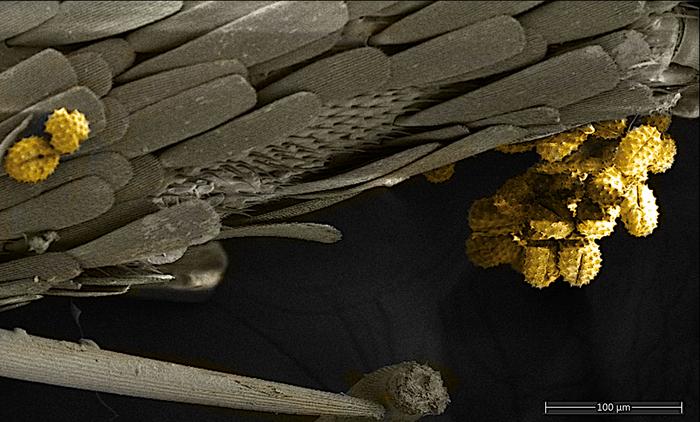
A new peer-reviewed study from researchers at The University of Texas at Arlington; the University of Nevada, Reno; and Virginia Tech shows that climate change has led to decreased pollen production from plants and less pollen more diversity than previously thought, which could have a significant impact on food production.

Credit: Photo courtesy UT Arlington
A new peer-reviewed study from researchers at The University of Texas at Arlington; the University of Nevada, Reno; and Virginia Tech shows that climate change has led to decreased pollen production from plants and less pollen more diversity than previously thought, which could have a significant impact on food production.
“This research is crucial as it examines the long-term impacts of climate change on plant-pollinator interactions,” said Behnaz Balmaki, lead author of the study and an assistant professor of research in biology at UTA. “This study investigates how shifts in flowering times and extreme weather events affect the availability of critical food sources for insect pollinators.”
The research team, which included UTA’s Masoud A. Rostami, focused its study on the Great Basin and Sierra Nevada mountains. The Great Basin, which includes about 95% of Nevada as well as portions of California, Oregon, Idaho and Wyoming, is an ideal place for this type of research because the mountains shield the region from Pacific storms, rain and snow.
The Great Basin region is home to more than 200 butterfly species, many of which act as pollinators. Pollinators are important in agriculture because they carry pollen from the male to the female parts of flowers so they can become fertilized and produce fruit.
The research team created 19 sampling sites throughout the region, collecting a wide sample of butterflies to study how they distribute pollen to plants. In addition to the newly collected samples, the team also examined previously captured butterfly samples obtained between 2000 and 2021 that are stored at the University of Nevada, Reno Museum of Natural History.
“By analyzing 21 years of historical data, a very long period that provides clear views, the research offers detailed perspectives on the consequences of habitat loss, fragmented landscapes and changes in plant assemblages on pollination services,” Balmaki said. “Our innovative use of museum specimens to track changes in pollen adds a new dimension to understanding these dynamics. These findings are vital for informing conservation efforts aimed at reducing biodiversity loss and preserving ecological balance, which are essential for sustaining natural ecosystems and human agriculture.”
Another important aspect of this study is that it highlights the deep importance of pollinators in maintaining food production vital for human consumption and survival.
“Without effective pollination, many crops vital to the global food supply could fail,” Balmaki said. “Our research underscores the necessity of developing targeted conservation policies to protect pollinators and maintain essential pollination services during global warming, thereby addressing some of the most significant environmental challenges of our time.”
***
This work was supported by the National Science Foundation.
Journal
Oecologia
Method of Research
Observational study
Subject of Research
Animals
Article Title
Effects of climate change on Lepidoptera pollen loads and their pollination services in space and time
Article Publication Date
25-Mar-2024
COI Statement
The authors have no conflicts of interest to declare.
Cite Scienmag News
Sloane Callahan. (May 20, 2024). The impacts of climate change on food production. Scienmag. https://scienmag.com/the-impacts-of-climate-change-on-food-production/
Sloane Callahan. "The impacts of climate change on food production." Scienmag, 20 May 2024, https://scienmag.com/the-impacts-of-climate-change-on-food-production/. Accessed 4 September 2026.
Sloane Callahan. "The impacts of climate change on food production." Scienmag. May 20, 2024. https://scienmag.com/the-impacts-of-climate-change-on-food-production/

