

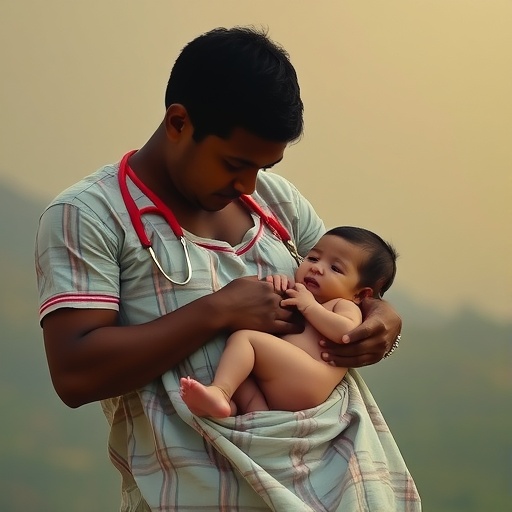
In a groundbreaking development at the intersection of climate science and human demography, recent research published in the prestigious journal Proceedings of the National Academy of Sciences (PNAS) unveils a complex and unsettling effect of rising global temperatures on the human birth sex ratio. Beyond the well-documented impacts of climate change on ecosystems and weather extremes, this comprehensive meta-analysis reveals that exposure to extreme heat during pregnancy is reshaping the fundamental biological and social fabric of populations, leading to a notable decline in the proportion of male births.
This extensive study, examining over 5 million live births across 33 countries in sub-Saharan Africa and India, integrates high-resolution meteorological data with demographic information to pinpoint how temperature extremes correlate with fluctuations in sex ratios at birth. The research team, which includes leading demographers such as Joshua Wilde from Portland State University, identifies a critical threshold—days exceeding maximum temperatures of 20°C (68°F)—above which the prevalence of male newborns declines significantly. However, what makes this finding particularly compelling is the regional divergence in underlying mechanisms driving this pattern, which spans a complex interplay of biological vulnerabilities and culturally mediated human behaviors.
In sub-Saharan Africa, the study confirms a predominantly biological mechanism underpinning the decline in male births during heat extremes. Scientific understanding, anchored in the “frail male” hypothesis, suggests that male fetuses require more substantial maternal investment to sustain development due to their heightened biological fragility. Consequently, when expectant mothers experience heat stress during the first trimester—a critical period of fetal development—there is an elevated risk of miscarriage disproportionately affecting male fetuses. This physiological filtering effect accentuates itself within vulnerable communities, notably rural populations where access to healthcare and overall maternal well-being may be compromised, as well as among women with lower levels of formal education.
Scientific discourse on fetal development emphasizes that male embryos exhibit a greater sensitivity to environmental stressors, including heat, which can disrupt placental function and fetal growth. The thermoregulatory burden on the pregnant mother, when challenged by excessive ambient temperatures, triggers systemic physiological responses such as dehydration and cardiovascular strain. These compounded stressors can jeopardize pregnancy viability, with evolutionary biology suggesting a natural selection-type mechanism preferring the survival of the biologically more resilient female fetuses under extreme conditions. This nuanced understanding aligns with empirical patterns observed in the demographic data collected.
Conversely, in the culturally complex context of India, the reduction in male births in response to heat waves is not primarily biological but behavioral, intricately linked to entrenched social customs. Historically, regions of northern India have exhibited a pronounced son preference, manifesting in skewed sex ratios driven by sex-selective abortions that disproportionately terminate female fetuses. However, the researchers document that during periods of extreme heat occurring predominantly in the second trimester—the gestational window when fetal sex can be accurately identified via ultrasound—these social practices are interrupted. Heat waves impose severe limitations on mobility and economic stability, constraining access to healthcare facilities and reducing families’ capacity to afford or obtain sex-selective abortions.
This behavioral disruption induced by climate stress inadvertently leads to a recalibration of the sex ratio. The temporary inability to pursue sex-selective terminations results in a higher survival rate of female fetuses, balancing the historically male-skewed birth ratio. The data thereby reveal that climate-induced limitations on daily life can override deeply embedded social preferences and interventions, showcasing an unexpected intersection where environmental factors influence cultural outcomes at the level of population biology. Such findings add a new dimension to the understanding of demographic responses to climate variability.
The implications of this study are profound and multifaceted. While much of the discourse on climate change focuses on tangible impacts such as agricultural productivity loss, infrastructure damage, and increased health burdens, this research casts light on the subtler biological and sociological transformations driven by extreme heat exposure. These transformations bear consequences not merely for individual pregnancies but also for the demographic composition of societies, potentially altering gender balances in ways previously unaccounted for in population models.
This emergent evidence underscores the critical importance of integrating climatic variables into demographic and public health planning. The biological sensitivity of male fetuses to heat-induced stress highlights a pressing need for enhanced maternal healthcare infrastructure, especially in vulnerable sub-Saharan African regions where climatic conditions are projected to deteriorate further. Climate adaptation strategies must include safeguarding maternal health to mitigate heat-related miscarriages and reduce long-term demographic imbalances that could exacerbate socioeconomic disparities.
In India, the findings carry nuanced implications for public health policy and social equity. The inadvertent mitigation of sex-selective abortion during heat waves raises critical questions about access to reproductive health services and the interplay between cultural practices and environmental constraints. Policymakers could leverage this knowledge to design interventions that address son preference and gender bias while recognizing the complex role of environmental factors in shaping social behaviors.
Moreover, this investigation opens a pivotal research frontier on the feedback mechanisms between climate change and human demographic processes. As global temperatures rise, the frequency and intensity of extreme heat events are expected to climb, potentially amplifying these biological and behavioral shifts in birth sex ratios. Understanding how these dynamics unfold will be vital for anticipating changes in population structure, planning for future social service needs, and enhancing resilience in both healthcare and community development.
The intersection of environmental science, biology, and social anthropology revealed by these findings challenges traditional disciplinary boundaries. It highlights the value of interdisciplinary research frameworks in unpacking the complex pathways through which climate impacts human populations. Such integrative approaches are essential to comprehensively address the multifaceted challenges posed by climate change.
In conclusion, the study heralds a significant paradigm shift, demonstrating that global warming’s reach extends deeply into the intimate processes of human reproduction and social practice. It calls for heightened scientific attention and policy response to these “hidden” demographic effects that unfold quietly yet inexorably in the shadows of climate crises. As humanity grapples with the escalating realities of planetary change, these insights invite a profound reconsideration of how environmental factors are interwoven with the core aspects of human diversity and survival.
Subject of Research: Temperature effects on human birth sex ratios and demographic shifts due to climate change
Article Title: Temperature and sex ratios at birth
News Publication Date: 19-Feb-2026
Web References: http://dx.doi.org/10.1073/pnas.2422625123
References: Proceedings of the National Academy of Sciences, DOI: 10.1073/pnas.2422625123
Keywords: climate change, extreme heat, sex ratio at birth, male fetal vulnerability, maternal heat stress, son preference, sex-selective abortion, demographic shifts, sub-Saharan Africa, India, maternal health, reproductive behavior


