


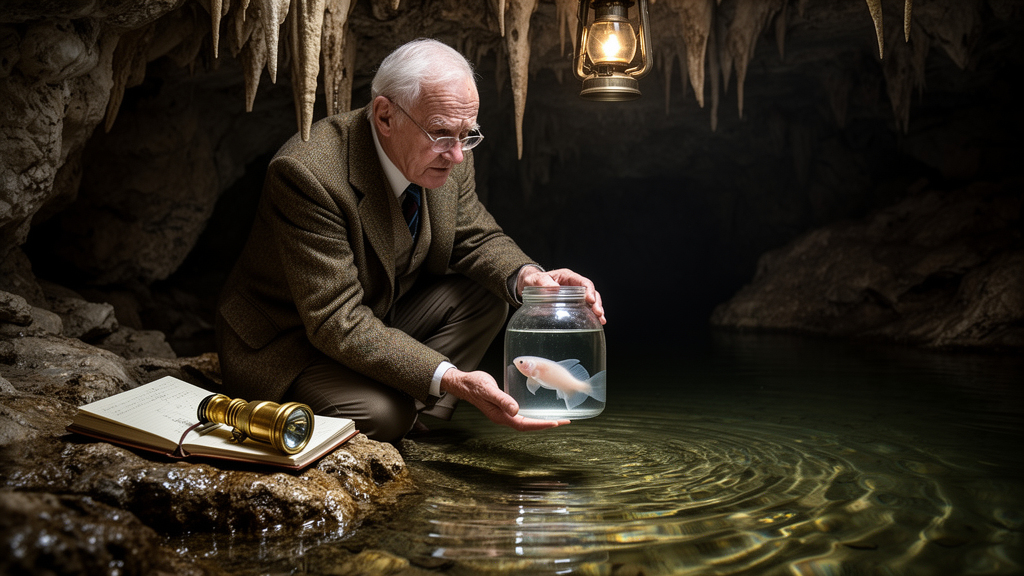
Carl Leavitt Hubbs (1894–1979) was one of the most prolific American biologists of the twentieth century, an internationally renowned ichthyologist who authored or co-authored more than seven hundred publications between 1915 and his death in 1979. Yet a new appraisal of his archived personal papers, held at the University of California in San Diego, reveals that a substantial and largely forgotten part of his career was devoted to the biology and evolutionary origins of blind and cave-dwelling fishes. The study, published in the journal Subterranean Biology, draws on 668 documents selected from the UCSD archive, including letters, cards, handwritten notes, telegrams and newspaper clippings, and shows that Hubbs’s published papers on blind fishes only partly reflect the full scope of his interest in the topic.
Hubbs’s first encounter with a blind fish came not in a cave but on the Pacific coast. In December 1922, while collecting with his wife Laura, he took a single specimen of a previously unknown goby living in kelp forests. The fish, later described as the Halfblind Goby Lethops connectens, has functional but almost rudimentary eyes in the adult, no color pattern despite retained chromatophores, well-developed tactile organs and no scales. It shares with the California Blind Goby Typhlogobius californiensis, an eyeless commensal of crustacean burrows, the convergent morphological features common to many cavefishes. This discovery appears to have been the initial spur of Hubbs’s lifelong interest in eyelessness in fishes, including subterranean forms, burrow inhabitants, fish of silty tropical waters and deep-sea species, and he collected notes and references for decades with the intention of writing a monograph on them that he never completed.
In the spring of 1924, based at the University of Michigan, Hubbs led a small party to Indiana to collect amblyopsid cavefishes on behalf of the university’s zoology museum. Over four days in mid-May the party explored several caves in the southern limestone district, including Marengo Cave, Siberts Well Cave, Rhoad’s Cave and parts of the Wyandotte system, securing specimens of the cavefish Amblyopsis spelaeus. Crucially, Hubbs also collected and observed every other fish he found underground: sculpins living permanently deep inside a cave, some exceptionally large, and minnows taken in lightless regions that he judged to be strays rather than residents. He speculated that the large size of the cave-dwelling sculpins was due to protection from predators. His notes also record frogs, salamanders, crayfish and other invertebrates, early evidence of a wider interest in cave fauna. Over the following two decades he visited a dozen or more caves across the United States, and although he found only known fish species, his material sent to specialists led to the description of several previously unknown subterranean invertebrates, including two spiders, a millipede, a crayfish, an amphipod and a flatworm, several of which bear his name.
The archive shows that Hubbs approached cave animals with the broad viewpoint of a naturalist rather than that of a specialist caver. The authors of the new study note that he was unusually free of what they call “troglocentrism”, the tendency in biospeleology to focus on blind, depigmented animals as the only “true” cavernicoles. He observed and noted that some normally surface-dwelling fish species appeared to derive benefits from living inside caves. At a time when general cave fauna collecting in the United States was almost nonexistent, with biospeleology there described as “effectively dead” during the inter-war years, his work was pioneering, even though he published only on fishes and sent his invertebrate material to taxonomic specialists.
Hubbs’s most famous contribution came through a chain of events in Mexico. In 1932 he had been responsible for the fishes in a multidisciplinary expedition to the Yucatán Peninsula, describing cave populations of the catfish Rhamdia guatemalensis as subspecies with slightly reduced eyes and pigmentation. In 1936, Professor Arthur Pearse of Duke University, searching specifically in caves rather than open cenotes, captured a blind brotulid and other blind fishes in Yucatán caves and sent the material to Hubbs. Then, in November 1936, specimens arrived of a completely unexpected blind characin from La Cueva Chica in San Luis Potosí state, collected by Salvador Coronado, who caught a hundred fish and live-shipped seventy-five of them to the Texas aquarium fish dealer Charles Basil Jordan, who in turn passed them to the aquarist William Innes, who sent them to Hubbs. Hubbs rushed the description into print within weeks, abandoning his usual perfectionism, basing it on a single type specimen and naming the new genus and species Anoptichthys jordani. The publication date of 17 December 1936 came a mere six or seven weeks after the discovery.
The rush was no accident. Hubbs had learned by letter that Charles Breder of the New York Zoological Society was also preparing a description of the same fish, and he moved quickly to secure priority, telling Breder that the description was already in press and that he had “very great interest in blind fishes and Middle American fishes”. Breder courteously stood down. The episode also revealed a less flattering side of Hubbs: he delayed the Yucatán report for some twenty months despite Pearse’s increasingly frustrated pleas, and he later claimed to have made “recent discoveries of five new blind fishes” although, in the loosest sense, he had not discovered any of them. He also brusquely dismissed Pearse’s reminder that the Mexican collecting permit required specimens to be reserved for the national museum.
The discovery of Anoptichthys jordani proved a milestone in hypogean fish research. The fish was abundant, easy to collect, survived transport, thrived in captivity and differed from its likely ancestor Astyanax fasciatus only in lacking eyes and pigmentation. Early crossings reported by Jordan showed that hybridization studies were feasible, and researchers in Mexico and New York, including Myron Gordon and the ophthalmologist Edward Gresser, took up the subject. Breder became the most active researcher, publishing seventeen papers on the fish between 1940 and 1954, and was the first to strongly suspect, based on free interbreeding between cave and surface forms and on individuals showing all stages of eye development, that the blind cave fish was nothing more than a locally adapted population, or ecotype, of the surface species. By the 1970s genetic analyses, including a 1972 study by Avise and Selander, had convinced most biologists that the cave and surface populations were conspecific.
Hubbs never accepted this. He had built his career on Neo-Darwinian principles, championing natural selection in his influential reviews in The American Naturalist, pioneering mass-collecting methods and biometrics, and demonstrating, with his wife Laura, the existence of viable natural hybridization in fishes. Yet he rejected the biological species concept, a pillar of the Modern Evolutionary Synthesis, throughout his life. In a 1972 letter to John Avise he called the lumping of the cave and surface species a “travesty on biology and commonsense” and suggested that anyone who would do so “needs a new pair of glasses”. As late as 1974 he wrote that calling Anoptichthys jordani Astyanax mexicanus was “a downright travesty”, insisting that the cave and surface fish were different “kinds” of animal. The authors note that his criticisms did not address the methodology or results of the genetic work, and that his use of the word “kind” echoes pre-Darwinian fixism.
Hubbs’s own theoretical contribution was his model of blind fish evolution through pre-adaptation, developed most fully in his 1938 paper on the Yucatán blind fishes. He argued that caves are actively colonized by species already moderately preadapted to darkness through cryptozoic or nocturnal habits, with some eye reduction and well-developed non-visual sense organs, and that mere accidental strays would not form a breeding stock. He attributed speciation within caves to what he called “degenerative evolution”, rejecting Lamarckian use and disuse and proposing the survival of “mutations of loss” in the absence of strict natural selection, apparently unaware that passive genetic drift had been proposed for troglomorphic atrophy decades earlier in the European literature, with which he was unfamiliar. The model excluded the possibility, later vindicated by the Mexican cave characin, that almost any freshwater fish might have the capacity to become a blind cave form under favorable conditions, although Hubbs himself conceded in 1938 that this circumstance indicated such a capacity.
The new appraisal concludes that Hubbs’s case is a striking example of the human dimension of science: a lifelong advocate of Neo-Darwinism who contributed substantially to population thinking and to the Modern Evolutionary Synthesis, yet who could not take the final step of accepting the biological species concept, contesting the taxonomy of his own celebrated discovery on metaphysical grounds rather than scientific merits until the end of his life. His broader biospeleological legacy, from the first blind gobies of 1922 to the cave fauna he collected across America, has, the authors argue, been overlooked for far too long.
Subject of Research: A historical appraisal of the biospeleological work and blind-fish research of ichthyologist Carl L. Hubbs
Article Title: The biospeleological work of Carl L. Hubbs (1894–1979): an appraisal
Article References: Romero Jr., A., & Moseley, M. (2023). The biospeleological work of Carl L. Hubbs (1894–1979): an appraisal. Subterranean Biology, 46, 165-198. https://doi.org/10.3897/subtbiol.46.114190
Image Credits: AI Generated
DOI: 10.3897/subtbiol.46.114190
Keywords: Carl Hubbs, cavefish, biospeleology, blind fishes, Anoptichthys jordani, Astyanax, taxonomy, biological species concept, evolution, history of science, Yucatan, ichthyology
Cite Scienmag News
Drew Townsend. (October 27, 2026). The forgotten cave-fish obsession of a twentieth-century ichthyology giant. Scienmag. https://scienmag.com/the-forgotten-cave-fish-obsession-of-a-twentieth-century-ichthyology-giant/
Drew Townsend. "The forgotten cave-fish obsession of a twentieth-century ichthyology giant." Scienmag, 27 October 2026, https://scienmag.com/the-forgotten-cave-fish-obsession-of-a-twentieth-century-ichthyology-giant/. Accessed 27 October 2026.
Drew Townsend. "The forgotten cave-fish obsession of a twentieth-century ichthyology giant." Scienmag. October 27, 2026. https://scienmag.com/the-forgotten-cave-fish-obsession-of-a-twentieth-century-ichthyology-giant/


