


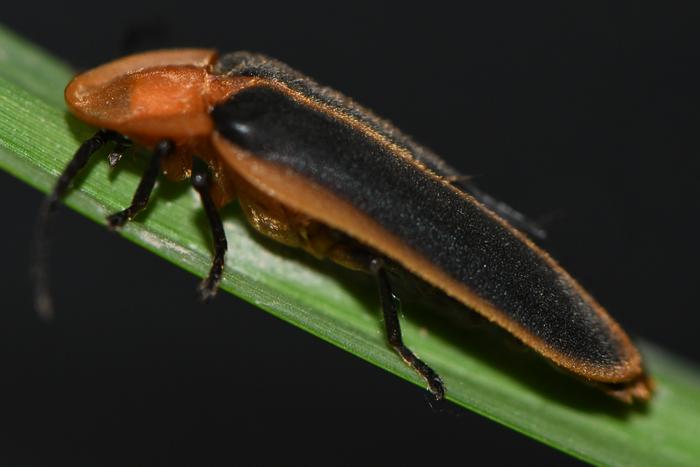
The leading hypothesis for the origin of firefly lights has been overturned by a genomic analysis. It had been posited that the bright lights emitted by many species in the Lampyridae family of beetles—better known as fireflies—first evolved as a warning signal to predators, advertising the toxicity of fireflies, and were then repurposed as a mating signal. This explanation would account for why eggs, larvae, and pupae also glow. Ying Zhen and colleagues put the conventional wisdom to the test by compiling a family tree of fireflies and tracing the evolution of the chemical compounds that makes fireflies toxic: lucibufagins. The team collected fresh samples for 16 species of Lampyridae from diverse locations across China, along with two related species, which they analyzed along with preexisting collections and genetic data. In total, the authors compiled genomic level data from 41 species. For each species, the authors also looked for lucibufagins using liquid chromatography-mass spectrometry. The team were able to show that the lucibufagins are only found in one subfamily of fireflies, whereas bioluminescence is found widely across the entire family, strongly suggesting that the toxin evolved after the development of bioluminescence. So why did fireflies first begin to shine? The substrate of firefly bioluminescence, luciferin, has previously been shown to have antioxidant properties. Ying Zhen and colleagues found that firefly ancestors evolved and diversified during a historical period when atmospheric oxygen levels continued to rise from a historical low after the Toarcian Oceanic Anoxic Event. The authors also note that glowing millipedes are thought to initially evolved bioluminescence to cope with oxidative stress in hot, dry environments and suggest that perhaps the fireflies followed a similar path.

Credit: Chengqi Zhu
The leading hypothesis for the origin of firefly lights has been overturned by a genomic analysis. It had been posited that the bright lights emitted by many species in the Lampyridae family of beetles—better known as fireflies—first evolved as a warning signal to predators, advertising the toxicity of fireflies, and were then repurposed as a mating signal. This explanation would account for why eggs, larvae, and pupae also glow. Ying Zhen and colleagues put the conventional wisdom to the test by compiling a family tree of fireflies and tracing the evolution of the chemical compounds that makes fireflies toxic: lucibufagins. The team collected fresh samples for 16 species of Lampyridae from diverse locations across China, along with two related species, which they analyzed along with preexisting collections and genetic data. In total, the authors compiled genomic level data from 41 species. For each species, the authors also looked for lucibufagins using liquid chromatography-mass spectrometry. The team were able to show that the lucibufagins are only found in one subfamily of fireflies, whereas bioluminescence is found widely across the entire family, strongly suggesting that the toxin evolved after the development of bioluminescence. So why did fireflies first begin to shine? The substrate of firefly bioluminescence, luciferin, has previously been shown to have antioxidant properties. Ying Zhen and colleagues found that firefly ancestors evolved and diversified during a historical period when atmospheric oxygen levels continued to rise from a historical low after the Toarcian Oceanic Anoxic Event. The authors also note that glowing millipedes are thought to initially evolved bioluminescence to cope with oxidative stress in hot, dry environments and suggest that perhaps the fireflies followed a similar path.
Journal
PNAS Nexus
Article Title
Firefly toxin lucibufagins evolved after the origin of bioluminescence
Article Publication Date
25-Jun-2024
Cite Scienmag News
Gavin Prescott. (June 25, 2024). The evolution of firefly lights. Scienmag. https://scienmag.com/the-evolution-of-firefly-lights/
Gavin Prescott. "The evolution of firefly lights." Scienmag, 25 June 2024, https://scienmag.com/the-evolution-of-firefly-lights/. Accessed 4 September 2026.
Gavin Prescott. "The evolution of firefly lights." Scienmag. June 25, 2024. https://scienmag.com/the-evolution-of-firefly-lights/

