


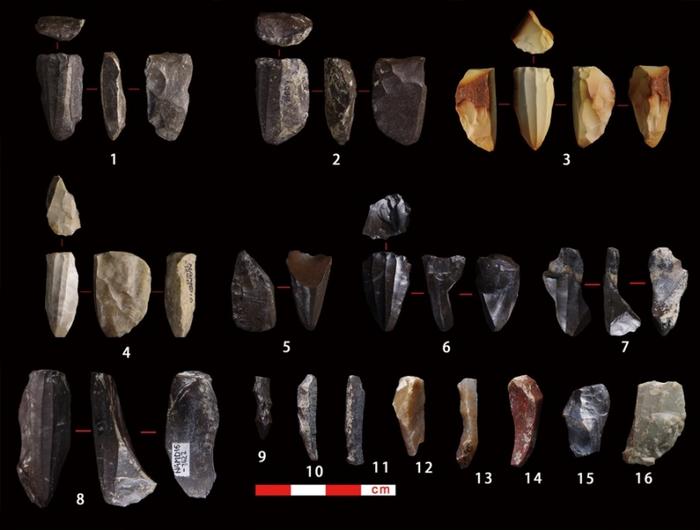
A research team led by Prof. Zhang Xiaoling from the Institute of Vertebrate Paleontology and Paleoanthropology (IVPP), Chinese Academy of Sciences, published a paper entitled “The Earliest Evidence for a Microblade Adaptation in the Remote, High Altitude Regions of the Tibetan Plateau” in Science China Earth Sciences recently. The earliest microblade technology site in the hinterland of the Tibetan Plateau so far was reported. ND3 is located on the shores of Silin Lake, at an altitude of around 4,600 meters. The site features typical microblade technology, with over 1,100 lithic artifacts unearthed. Detailed Optical Stimulated Luminescence (OSL) and Radiocarbon (14C) dating studies, combined with an analysis of the stratigraphy correlation and site formation process, have determined that the site is approximately 11,000-10,000 years ago.

Credit: Picture creditd by Jin Yingshuai.
A research team led by Prof. Zhang Xiaoling from the Institute of Vertebrate Paleontology and Paleoanthropology (IVPP), Chinese Academy of Sciences, published a paper entitled “The Earliest Evidence for a Microblade Adaptation in the Remote, High Altitude Regions of the Tibetan Plateau” in Science China Earth Sciences recently. The earliest microblade technology site in the hinterland of the Tibetan Plateau so far was reported. ND3 is located on the shores of Silin Lake, at an altitude of around 4,600 meters. The site features typical microblade technology, with over 1,100 lithic artifacts unearthed. Detailed Optical Stimulated Luminescence (OSL) and Radiocarbon (14C) dating studies, combined with an analysis of the stratigraphy correlation and site formation process, have determined that the site is approximately 11,000-10,000 years ago.
At ND3 site, microblades were the primary target product, with fewer flake tools such as side scrapers and end scrapers. The lithic artifacts excavated from ND3 contain the entire production process of microblades. The most common raw materials are flint and agate agglomerates found on riverbanks; and flaky blanks were chosen to produce microblades. Through detailed lithic technology analysis, the authors confirmed the use of typical wedge-shaped core and semi-conical core technologies for microblade production at the site, reconstructing the knapping sequences of these technologies.
The authors of the article concluded, through technology comparisons, that the ND3 technology is consistent with that of southern North China, indicating a strong link between the microblade technologies of the two regions. By integrating the lithic analysis with the chronology of microblade products across the plateau, the authors identified a clear route of microblade technology entering the plateau from the northeastern part of the Tibetan Plateau. Microblade technology spread from southern North China to the northeastern edge of the plateau, such as Qinghai Lake Basin, the Kunlun Mountains, and the Qingnan Plateau around 15,000 years ago. By 11,000 to 10,000 years ago, this technology had reached the interior of the plateau.
Microblade technology spread into the hinterland of the plateau during the Holocene, a period characterized by a favorable climate. The flat terrain of the northern Tibetan Plateau facilitated a rapid diffusion of this technology. By the Middle Holocene, microblade technology spread southward and eastward, primarily distributing within the river valleys of southern and eastern Tibet. Despite the emergence of agriculture, microblade technology continued to be an important role for agricultural populations.
The authors suggest that microblade technology continued to exist until about 2000-3000 years ago. Molecular biology research indicates that the large-scale adoption of microblade technology coincided with significant population influxes into the plateau during the early Holocene. Populations bearing microblade technology did not disappear or get replaced after migrating to the plateau; instead, they continued to evolve, potentially forming a significant part of the ancestry of modern Tibetans.
This study was supported by the National Key Research and Development Project of China, the Second Tibetan Plateau Scientific Expedition and Research, the National Natural Science Foundation of China, and the National Social Science Foundation of China.
See the article:
Jin Y, Zhang X, Wang S, Ge J, He W, Da W, Tan Y, Yang Z, Morgan C, Gao X. 2024. The earliest evidence for a microblade adaptation in the remote, high altitude regions of the Tibetan Plateau. Science China Earth Sciences, 67(5): 1561–1573,
Journal
Science China Earth Sciences
Cite Scienmag News
Gavin Prescott. (June 12, 2024). The earliest evidence for a microblade adaptation in the remote, high altitude regions of the Tibetan plateau. Scienmag. https://scienmag.com/the-earliest-evidence-for-a-microblade-adaptation-in-the-remote-high-altitude-regions-of-the-tibetan-plateau/
Gavin Prescott. "The earliest evidence for a microblade adaptation in the remote, high altitude regions of the Tibetan plateau." Scienmag, 12 June 2024, https://scienmag.com/the-earliest-evidence-for-a-microblade-adaptation-in-the-remote-high-altitude-regions-of-the-tibetan-plateau/. Accessed 5 September 2026.
Gavin Prescott. "The earliest evidence for a microblade adaptation in the remote, high altitude regions of the Tibetan plateau." Scienmag. June 12, 2024. https://scienmag.com/the-earliest-evidence-for-a-microblade-adaptation-in-the-remote-high-altitude-regions-of-the-tibetan-plateau/

