


August 16, 2024

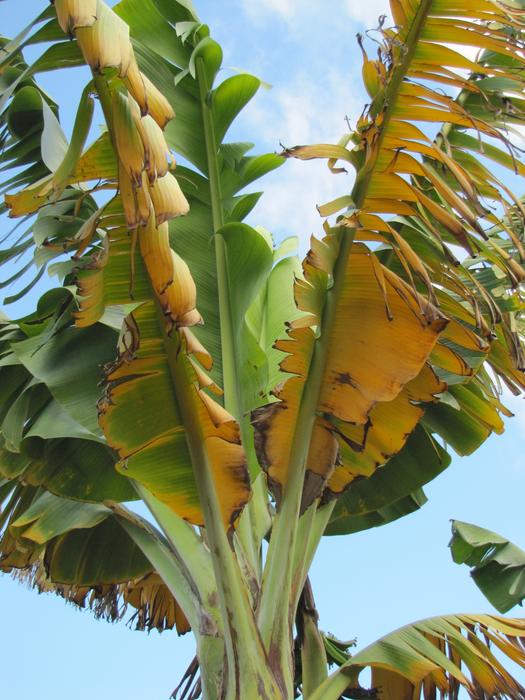
Credit: A. Viljoen
August 16, 2024
The Banana Apocalypse is Near, but UMass Amherst Biologists Might Have Found a Key to Their Survival
Discovery of molecular mechanisms used by the banana-destroying microbe brings hope to the breakfast table
AMHERST, Mass. – The bananas in your supermarket and that you eat for breakfast are facing functional extinction due to the disease Fusarium wilt of banana (FWB) caused by a fungal pathogen called Fusarium oxysporum f.sp. cubense (Foc) tropical race 4 (TR4). However, thanks to recent research from an international team of scientists led by the University of Massachusetts Amherst, we now know that Foc TR4 did not evolve from the strain that wiped out commercial banana crops in the 1950s and that the virulence of this new strain seems to be caused by some accessory genes that are associated the production of nitric oxide. The research, published in Nature Microbiology, opens the door to treatments and strategies that can slow, if not control, the as-of-yet unchecked spread of Foc TR4.
“The kind of banana we eat today is not the same as the one your grandparents ate. Those old ones, the Gros Michel bananas, are functionally extinct, victims of the first Fusarium outbreak in the 1950s.” says Li-Jun Ma, professor of biochemistry and molecular biology at UMass Amherst and the paper’s senior author.
Today, the most popular type of commercially available banana is the Cavendish variety, which was bread as a disease-resistant response to the Gros Michel extinction. For about 40 years, the Cavendish banana thrived across the globe in the vast monocultured plantations that supply the majority of the world’s commercial banana crop.
But by the 1990s, the good times for the Cavendish banana had begun to come to a close. “There was another outbreak of banana wilt,” says lead author Yong Zhang, who completed his doctorate in UMass Amherst’s Organismic and Evolutionary Biology program under Ma’s direction. “It spread like wildfire from South-East Asia to Africa and Central America.”
“We have spent the last 10 years studying this new outbreak of banana wilt,” says Ma, who is an expert in Fusarium oxysporum, which is not a single species but a “species complex” with hundreds of different varieties that specialize in affecting different plant hosts. These varieties are determined by the acquisition of strain-specific accessory genes in addition to a shared core genome. “We now know that the Cavendish banana-destroying pathogen TR4 did not evolve from the race that decimated the Gros Michel bananas. TR4’s genome contains some accessory genes that are linked to the production of nitric oxide, which seems to be the key factor in TR4’s virulence.”
To arrive at this conclusion, Yong, Ma and their co-authors from China and South Africa as well as universities in the U.S., sequenced and compared 36 different Foc strains collected from all over the world, including those strains that attack Gros Michel bananas. Then, with the help of UMass Amherst’s Institute for Applied Life Sciences, the team discovered that Foc TR4, responsible for the current outbreak of banana wilt, uses some accessory genes for both production and detoxification of fungal nitric oxide to invade the host.
While the team doesn’t yet know exactly how these activities contribute to disease infestation in Cavendish banana, they were able to determine that the virulence of Foc TR4 was greatly reduced when two genes that control nitric oxide production were eliminated.
“Identifying these accessory genetic sequences opens up many strategic avenues to mitigate, or even control, the spread of Foc TR4,” says Yong.
Even so, Ma is quick to point out that the ultimate problem facing one of our favorite breakfast foods is the practice of monocropping. “When there’s no diversity in a huge commercial crop, it becomes an easy target for pathogens,” she says. “Next time you’re shopping for bananas, try some different varieties that might be available in your local specialty foods store.”
Funding for this study was provided by the U.S. National Science Foundation, the U.S. Department of Agriculture’s National Institute of Food and Agriculture, the U.S. Department of Health & Human Services, the U.S. Department of Energy the National Institutes of Health, the Guangdong Science and Technology Project, CARS and the Laboratory of Lingnan Modern Agriculture Project.
Contacts: Li-Jun Ma, lijun@umass.edu
Daegan Miller, drmiller@umass.edu
Journal
Nature Microbiology
Article Title
Virulence of the banana wilt-causing fungal pathogen Fusarium oxysporum tropical race 4 is mediated by nitric oxide biosynthesis and accessory genes
Article Publication Date
16-Aug-2024
Cite Scienmag News
Drew Townsend. (August 16, 2024). The banana apocalypse is near, but UMass Amherst biologists might have found a key to their survival. Scienmag. https://scienmag.com/the-banana-apocalypse-is-near-but-umass-amherst-biologists-might-have-found-a-key-to-their-survival/
Drew Townsend. "The banana apocalypse is near, but UMass Amherst biologists might have found a key to their survival." Scienmag, 16 August 2024, https://scienmag.com/the-banana-apocalypse-is-near-but-umass-amherst-biologists-might-have-found-a-key-to-their-survival/. Accessed 3 September 2026.
Drew Townsend. "The banana apocalypse is near, but UMass Amherst biologists might have found a key to their survival." Scienmag. August 16, 2024. https://scienmag.com/the-banana-apocalypse-is-near-but-umass-amherst-biologists-might-have-found-a-key-to-their-survival/

