


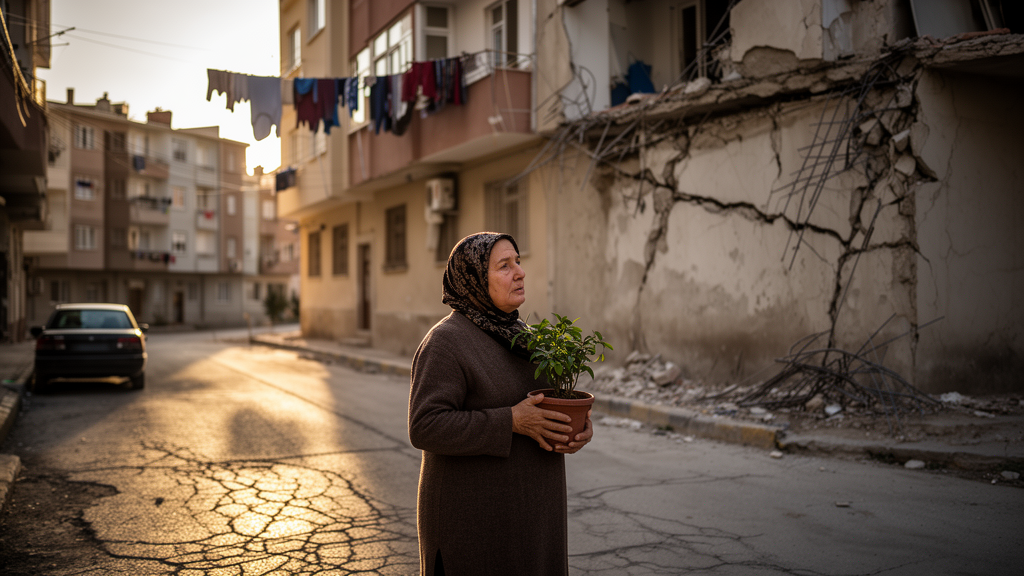
A qualitative grounded-theory study of 16 adults who lived in Hatay both before and after the 6 February 2023 earthquakes found that residents described remaining in the province as being “tethered to a wounded place.” The study’s central finding was that post-earthquake life was bound to Hatay as a damaged home, with residents negotiating continuing harm, exclusion, uncertain reconstruction and a sense of belonging. The authors characterized this experience as combining grief, numbness, anger, shame, fear, attachment and fragile hope rather than a linear process of recovery.
Researchers used a constructivist grounded-theory design to examine how disrupted places, long-standing exclusion and institutional practices shaped everyday life among residents who stayed in Hatay. They conducted face-to-face, in-depth, semi-structured interviews with 16 adults about changes in daily routines, care and relationships, encounters with state institutions and aid, and thoughts about whether to remain or leave. Interviews were audio-recorded, transcribed verbatim and analyzed through initial, focused and theoretical coding. The process included constant comparison, memo-writing, team debriefing and reflexive journaling, alongside field notes kept during the first post-earthquake year.
Four interlinked categories described the process reported in the study’s abstract. The first concerned institutional abandonment, discrimination and contested reconstruction. The second captured what the authors called day-to-day survival in suspended futures. The third addressed the re-weaving of care and relationships within damaged spaces, while the fourth involved creating hope and politicized resistance. Across these categories, residents continued to live with and as Hatay, experiencing the city simultaneously as a source of ongoing harm and as their only imaginable and morally acceptable home. Emotional oscillations connected participants’ responses to the city’s wounded and uncertain condition, linking mental health experiences with the surrounding social and material environment.
The findings are based on a small, locally defined qualitative sample of residents who remained in Hatay, so they are not designed to estimate the prevalence of experiences across the province or Türkiye. The study also focuses on one particular context shaped by borderland politics, sectarianized tensions, perceptions of state neglect, reports of delayed rescue and non-transparent reconstruction. Its grounded-theory framework is intended to explain the reported process of post-earthquake life rather than test an intervention or establish causal effects. The authors concluded that distress in Hatay was closely associated with damaged environments, historically layered trauma, institutional betrayal and disputes over reconstruction and belonging. They further argued that responses in such settings may need to consider place and justice rather than focusing only on individual symptoms, although the supplied abstract does not report testing of any such approach.
Subject of Research: Constructivist grounded theory of post-earthquake life among residents who remained in Hatay after the February 2023 earthquakes
Article Title: Tethered to a wounded place: A constructivist grounded theory of post-earthquake life in Hatay, Türkiye
Article References: Gazey, H., Türkel, N. N., Başaran, A. S., Yelli, I., & Candansayar, S. (2026). Tethered to a wounded place: A constructivist grounded theory of post-earthquake life in Hatay, Türkiye. BMC Psychology. https://doi.org/10.1186/s40359-026-05647-3
Image Credits: AI Generated
DOI: 10.1186/s40359-026-05647-3
Keywords: Hatay, earthquake recovery, grounded theory, qualitative research, place attachment, mental health, reconstruction, institutional exclusion, post-earthquake life, Tethered, wounded, place
Cite Scienmag News
Glenn Wilkins. (October 20, 2026). Tethered to a wounded place: A constructivist grounded theory of post-earthquake life in Hatay, Türkiye. Scienmag. https://scienmag.com/tethered-to-a-wounded-place-a-constructivist-grounded-theory-of-post-earthquake-life-in-hatay-turkiye/
Glenn Wilkins. "Tethered to a wounded place: A constructivist grounded theory of post-earthquake life in Hatay, Türkiye." Scienmag, 20 October 2026, https://scienmag.com/tethered-to-a-wounded-place-a-constructivist-grounded-theory-of-post-earthquake-life-in-hatay-turkiye/. Accessed 20 October 2026.
Glenn Wilkins. "Tethered to a wounded place: A constructivist grounded theory of post-earthquake life in Hatay, Türkiye." Scienmag. October 20, 2026. https://scienmag.com/tethered-to-a-wounded-place-a-constructivist-grounded-theory-of-post-earthquake-life-in-hatay-turkiye/


