


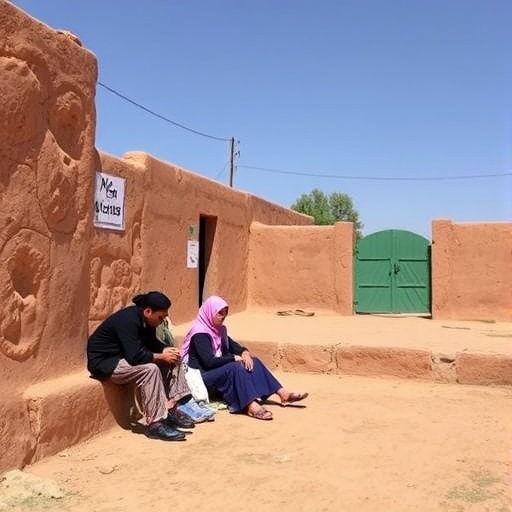
In the arid yet culturally rich landscapes of Southern Morocco, a remarkable initiative is quietly transforming the lives of vulnerable populations by bridging the gap between them and essential government welfare services. Researchers Baghdadi, Soussi, and Hands have spearheaded a pioneering feasibility study that explores the effectiveness of a non-governmental organization (NGO)-led signposting intervention aimed at improving access to social welfare programs. Their findings, published in the International Journal for Equity in Health, reveal promising results that could inform future policy and community engagement strategies not only in Morocco but also across similar socio-economic contexts worldwide.
Access to government welfare programs in many developing regions remains a significant challenge, often hindered by bureaucratic complexity, lack of information, and social exclusion. Southern Morocco, a region characterized by diverse rural communities and limited infrastructure, epitomizes these access barriers. Against this backdrop, the researchers embarked on an innovative pilot project where NGOs took an active role in guiding citizens through the maze of welfare entitlements. By acting as signposts—offering information, personalized guidance, and continuous support—the NGOs sought to dismantle systemic obstacles and empower individuals to claim benefits designed to improve their quality of life.
The intervention was meticulously crafted to respond to the unique socio-economic and cultural context of Southern Morocco. Recognizing the mistrust many citizens harbor towards formal institutions, the project leveraged the existing community ties and credibility of local NGOs. These organizations are often better positioned to engage marginalized groups effectively due to their grassroots presence and participatory approach. Through rigorous training, NGO workers were equipped with comprehensive knowledge of government programs, eligibility criteria, and application procedures, enabling them to provide nuanced assistance tailored to each beneficiary’s circumstances.
Notably, this intervention highlighted the underlying importance of ‘signposting’ as an active and dynamic process rather than a passive dissemination of information. Signposting includes continuous follow-up, feedback loops, and adaptive responses to challenges faced by welfare applicants, such as language barriers, literacy limitations, and fluctuating economic conditions. The study documents that this personalized approach resulted in higher application completion rates and reduced frustrations often associated with navigating welfare systems.
Data collected during the pilot phase illustrate significant improvements in beneficiaries’ access to services ranging from healthcare subsidies to educational grants and income support schemes. This quantitative evidence was complemented by qualitative interviews revealing increased trust in welfare institutions and heightened awareness of rights amongst participants. Such social capital enhancements are crucial for sustainable community development, indicating that interventions extend beyond immediate material benefits to foster broader empowerment.
Intriguingly, the researchers also encountered operational challenges typical for grassroots mobilization in resource-constrained environments. Issues such as limited funding, variations in NGO capacity, and the need for coordination among multiple government agencies emerged as obstacles. However, these hurdles did not detract from the overall success; rather, they underscored areas for refinement and scalability considerations. The study advocates for institutionalizing NGO roles within welfare frameworks to ensure consistency, accountability, and enhanced outreach.
Another key insight from this feasibility study is the transformative potential of digital tools integrated within the signposting process. While rural Morocco presents infrastructural constraints regarding internet access, leveraging mobile technology for real-time updates and application assistance demonstrated potential to streamline interventions. Future iterations of the project are planned to expand digital literacy components, aiming to create hybrid pathways that blend personal interactions with technological facilitation.
The implications of this research extend well beyond Morocco’s borders, offering a replicable model for other nations grappling with similar challenges of welfare accessibility among marginalized populations. The blend of localized knowledge, NGO-driven advocacy, and government program synergy provides a powerful framework for enhancing social equity. Policymakers, development practitioners, and academics are now called upon to consider how such interventions can be adapted, scaled, and integrated within broader social protection architectures.
Critically, this study sheds light on the nuanced role of NGOs not merely as service providers but as intermediaries capable of influencing institutional resilience and responsiveness. Their position at the interface between citizens and formal structures enables them to identify systemic bottlenecks and advocate for reform from an informed perspective. Encouragingly, the research team found that government stakeholders expressed openness to this collaborative model, recognizing its potential to improve welfare delivery efficiency.
Furthermore, the economic analysis embedded in the study confirms that investing in NGO-led signposting offers favorable cost-benefit ratios. By reducing application errors, expediting processing times, and minimizing the need for corrective interventions, the program alleviates administrative burdens and optimizes resource allocation. This economic dimension is vital for ensuring the sustainability of social welfare enhancement initiatives, especially in low-resource settings.
The sociological ramifications are equally profound. Empowering individuals with knowledge about their entitlements fosters a sense of agency and dignity often eroded by poverty and marginalization. It encourages civic engagement and can stimulate grassroots demand for improved governance transparency and accountability. The researchers argue that such empowerment is a foundational pillar for long-term societal development and poverty reduction strategies.
In conclusion, the feasibility study by Baghdadi, Soussi, and Hands represents a significant step forward in conceptualizing and testing innovative pathways toward social equity. Their comprehensive evaluation showcases that NGO-led signposting interventions are both practicable and impactful in enhancing access to government welfare in Southern Morocco. As the world confronts rising inequality and the necessity of inclusive social safety nets, these findings provide timely evidence for stakeholders invested in creating more just and accessible social protection systems.
Ongoing and future research will need to address how these interventions perform at scale, adapt to evolving socio-political landscapes, and integrate with digital governance platforms. Nonetheless, the pilot study’s success invites optimism that thoughtful collaborations between NGOs and governments can break down traditional barriers to welfare access, offering new hope to underserved populations across diverse geographies.
Cite Scienmag News
Courtney Benton. (October 16, 2025). Testing NGO Signposting to Boost Moroccan Welfare Access. Scienmag. https://scienmag.com/testing-ngo-signposting-to-boost-moroccan-welfare-access/
Courtney Benton. "Testing NGO Signposting to Boost Moroccan Welfare Access." Scienmag, 16 October 2025, https://scienmag.com/testing-ngo-signposting-to-boost-moroccan-welfare-access/. Accessed 3 September 2026.
Courtney Benton. "Testing NGO Signposting to Boost Moroccan Welfare Access." Scienmag. October 16, 2025. https://scienmag.com/testing-ngo-signposting-to-boost-moroccan-welfare-access/


