


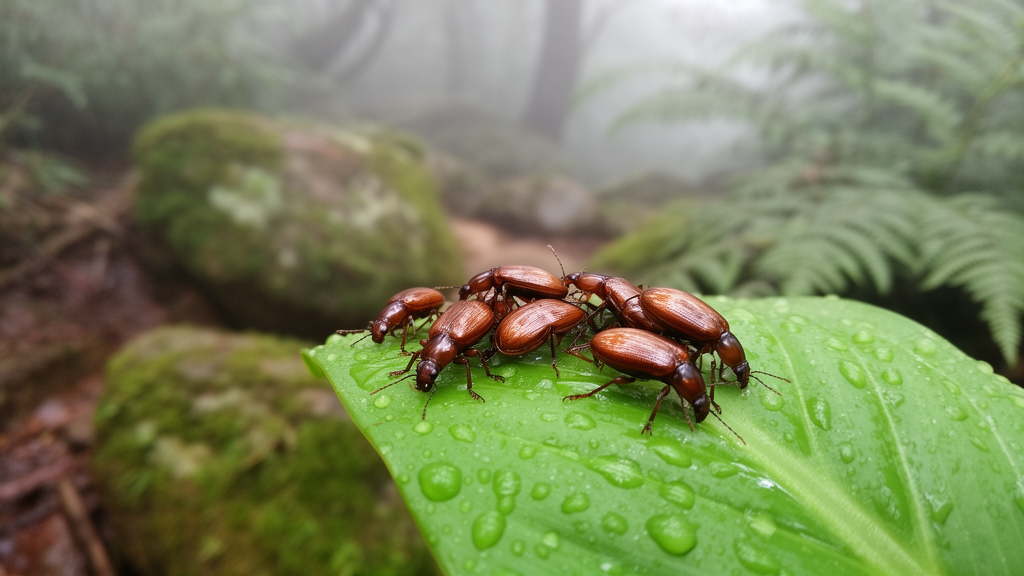
Deep in the mist-shrouded forests of central China, a team of entomologists has uncovered a startling abundance of hidden life. A comprehensive revision of the ground beetle subgenus Morphohaptoderus, published in the Deutsche Entomologische Zeitschrift, recognizes fourteen species in Hubei Province alone, ten of which are entirely new to science. The finding more than doubles the number of these beetles known from the province and pushes the global tally for the subgenus to 44 species, most of them endemic to China.
The newly described beetles belong to the genus Pterostichus, a sprawling group of predatory ground beetles in the family Carabidae. Members of Morphohaptoderus are small to medium-sized insects, ranging from 4.6 to 12.6 millimeters in body length, with short, wide bodies, elliptical and often iridescent wing covers, and dark reddish-brown to black coloration. They scurry through leaf litter and beneath stones in mountain forests, hunting smaller invertebrates under the cover of darkness.
What makes this discovery remarkable is not just the number of species but how many of them coexist in a single mountain range. Eleven of the fourteen Hubei species live in Shennongjia, a UNESCO-listed forestry district famed in Chinese legend as the home of the ‘wild man.’ The remaining three inhabit the Houhe Reserve in Wufeng County. At some mid-elevation sites, such as Jinhouling at 2,500 meters, researchers collected as many as seven species living side by side, a level of sympatry that is extraordinary for ground beetles.
Distinguishing these species demanded painstaking anatomical work. The team, drawing on a decade of fieldwork and 365 examined specimens, relied heavily on the male genitalia, particularly the median lobe of the aedeagus and its apical lamella, a structure that often bears hooks, denticles, or twisted flanges unique to each species. New morphological terms were introduced to describe these features, including the lamellar denticle, lamellar apex, and lamellar base, allowing precise measurement and comparison across species.
External appearance proved deceptively unreliable. Several of the new species, such as Pterostichus quyuani and P. shennongjianus, are so similar in outward form that they have frequently been confused with one another, even occurring in the same pitfall traps. Only stable differences in the male abdomen, genitalia, and the female ovipositor, specifically the shape and setation of the gonocoxite, allowed the researchers to separate them with confidence. In one striking case, the two species can be told apart by the presence or absence of oblique wrinkles on the seventh abdominal segment of males.
The revision also corrected earlier mistakes. Two species previously assigned to Morphohaptoderus, P. megaloderus and P. yulongshanensis, were found to lack the subgenus’s critical diagnostic trait: metacoxae bearing three setae. Together with a slightly pointed right paramere, this indicated they belong instead to the related subgenus Neohaptoderus. Such reassignments echo a long history of confusion surrounding the group, which was first established in 1898 but only defined as a natural unit in 1994.
Geography and altitude shape the diversity of these beetles in striking ways. In the high Hengduan Mountains of Sichuan and Yunnan, Morphohaptoderus species generally occupy cloud forests between 3,000 and 4,000 meters, whereas in Hubei and neighboring Chongqing some species thrive below 1,000 meters. Within Shennongjia itself, the eleven species show clear altitudinal stratification: P. lingjun and P. rongyu are confined to the lowest surveyed site at Guanmenshan around 1,361 meters, while P. toledanoi and the tiny P. chachi inhabit alpine zones near 2,500 to 2,890 meters.
One of the new species stands out as a record-breaker. P. chachi, at just 4.6 to 4.7 millimeters long, is the smallest Pterostichus species ever found in China. It also possesses a unique combination of traits: a missing parascutellar pore, an unusual arrangement of bristles on the third elytral interval, and a setigerous pore on the first elytral interval never before observed in any Chinese Pterostichus. Only females have been discovered so far, a rarity that inspired its melancholy name.
That name carries a literary flourish. All ten new species are named after Qu Yuan, the revered poet and statesman of the fourth-century BC State of Chu, whose heartland lay in present-day Hubei. P. quyuani honors the poet himself; P. lisao commemorates his masterpiece ‘Li Sao’; P. lingjun takes its name from Qu Yuan’s declared literary name in that poem; P. wangshu borrows the moon’s charioteer, fitting for beetles that run in the moonlight; and P. xuanzhang references the delicate black carvings of ‘Huai Sha,’ an apt description of these dark, elegant insects.
The authors caution that the inventory is far from complete. Unidentified female specimens hint at further undescribed species in both Shennongjia and Wufeng, and similar habitats are widely but discontinuously distributed across western Hubei. As the first step in a broader revision of what may be China’s most species-rich Pterostichus subgenus, the study suggests that the mountains of central China still conceal a wealth of small, dark predators, each waiting, like Qu Yuan’s verses, to be brought into the light.
Subject of Research: Taxonomic revision and description of ten new Pterostichus ground beetle species in Hubei, China
Article Title: Revision of the subgenus Morphohaptoderus Tschitschérine, 1898, in Hubei, China, with descriptions of ten new species ( Coleoptera , Carabidae , Pterostichus )
Article References: Wu, Z.-Y., Chen, J.-H., & Shi, H.-L. (2025). Revision of the subgenus Morphohaptoderus Tschitschérine, 1898, in Hubei, China, with descriptions of ten new species (Coleoptera, Carabidae, Pterostichus). Deutsche Entomologische Zeitschrift, 72(2), 465-504. https://doi.org/10.3897/dez.72.159716
Image Credits: AI Generated
Keywords: Pterostichus, Morphohaptoderus, Carabidae, ground beetles, new species, Shennongjia, Hubei, taxonomy, Qu Yuan, entomology, China biodiversity, altitudinal distribution
Cite Scienmag News
Drew Townsend. (October 17, 2026). Ten New Beetle Species Named After Ancient Chinese Poet Qu Yuan Discovered in Hubei. Scienmag. https://scienmag.com/ten-new-beetle-species-named-after-ancient-chinese-poet-qu-yuan-discovered-in-hubei/
Drew Townsend. "Ten New Beetle Species Named After Ancient Chinese Poet Qu Yuan Discovered in Hubei." Scienmag, 17 October 2026, https://scienmag.com/ten-new-beetle-species-named-after-ancient-chinese-poet-qu-yuan-discovered-in-hubei/. Accessed 17 October 2026.
Drew Townsend. "Ten New Beetle Species Named After Ancient Chinese Poet Qu Yuan Discovered in Hubei." Scienmag. October 17, 2026. https://scienmag.com/ten-new-beetle-species-named-after-ancient-chinese-poet-qu-yuan-discovered-in-hubei/


