

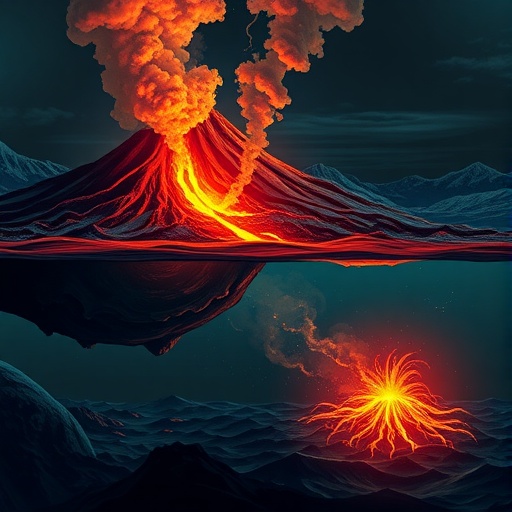
Deep Beneath the Earth’s Surface, Continents Are Slowly Peeling Away, Feeding Unexpected Volcanic Activity in the Oceans
For decades, Earth scientists have been mystified by the presence of continental-like materials erupting in volcanic islands located far from any tectonic plate boundaries in the middle of the oceans. Now, groundbreaking research led by the University of Southampton has unveiled a previously unknown geological phenomenon: continents aren’t just fractured at the surface; their deep roots are gradually being peeled away and swept sideways into the oceanic mantle, where they fuel volcanic activity for millions of years. This discovery fundamentally reshapes our understanding of mantle dynamics and volcanic genesis in oceanic regions.
The Earth’s mantle, a dense, mostly solid layer beneath the crust, is a dynamic environment where slow-moving rock flows and convection patterns drive geological activity. Oceanic mantle, beneath the seafloor, was traditionally thought to be largely distinct from continental material, except where subduction recycles crustal components. However, numerous volcanic islands in the world’s ocean basins exhibit a geochemical fingerprint rich in ‘enriched’ elements—chemical signatures typically associated with continental crust, not oceanic mantle. This paradox has long suggested that continental material somehow infiltrates the oceanic mantle, but the mechanisms remained elusive.
Previous explanations centered on sediment recycling during subduction or on deep mantle plumes bringing enriched materials toward the surface. While these mechanisms do contribute to mantle chemistry, they fail to explain all instances, especially where volcanic regions lack evidence of crustal recycling or mantle plumes. These gaps in understanding pushed researchers to explore the physical properties and tectonic interactions at the boundary between continental and oceanic realms more closely.
The team’s breakthrough came from advanced numerical simulations that examined the behavior of continental lithospheric roots during rifting—the process where continents break apart to form ocean basins. These simulations revealed the presence of a ‘mantle wave’: a slow-moving, wave-like instability propagating along the base of continents, extending to depths of 150-200 kilometers. This mantle wave subtly but relentlessly erodes the deep crystalline roots beneath the continents, stripping fragments away over prolonged geological timescales.
Unlike the rapid fragmentation at the surface, this basal peeling occurs at an extraordinarily slow pace— roughly a millionth the speed of a snail. This imperceptible movement gradually detaches crustal fragments that become entrained in the adjacent oceanic mantle. Remarkably, these peeled-off pieces can be transported laterally for over 1,000 kilometers from their continental origins, migrating into the oceanic mantle, where they persist as geochemical anomalies.
Once integrated into the oceanic mantle, these continental fragments assume an active role in mantle melting processes. Their chemical composition enriches the melt that feeds seamounts and volcanic islands, sustaining volcanic activity for tens of millions of years without relying on the presence of mantle plumes. This provides an elegant and robust solution to the geological puzzle of enriched volcanic island signatures far from plate boundaries.
To strengthen their hypothesis, the researchers focused on the Indian Ocean Seamount Province, a collection of volcanic features formed following the breakup of the supercontinent Gondwana over 100 million years ago. Geochemical analysis of erupted materials from this region revealed an initial surge of enriched magmas shortly after continental fragmentation. This affluent geochemical signature gradually diminished over tens of millions of years, aligning perfectly with the proposed mantle wave-driven peeling process, absent plume activity.
Co-author Professor Sascha Brune emphasized the long-lasting influence of continental breakup on mantle dynamics: “The mantle’s response to continental separation doesn’t cease with the formation of new ocean basins. Instead, the mantle remains active, continuously reorganizing and transferring enriched material far from its continental source.” This enduring influence challenges traditional models that view mantle processes as spatially and temporally discrete events.
This novel understanding expands the classic paradigm of plate tectonics and mantle convection, revealing a subtler and more intricate interplay between continental roots and mantle flow. It implies that the Earth’s upper mantle is more chemically heterogeneous than previously appreciated, with spatially extensive zones influenced directly by former continental lithosphere materials. These findings could also impact how we interpret the chemical evolution of oceanic crust and mantle-derived magmas worldwide.
The insight does not negate the role of mantle plumes entirely but indicates that enriched mantle compositions, typically attributed to plumes rising from the deep mantle, may also originate from shallower tectonic mechanisms like mantle waves. This opens new avenues for reinterpreting mantle tomography and geochemical data from volcanic provinces around the globe and could have implications for volcano hazard assessment and understanding mantle convection’s role in Earth’s evolution.
Beyond oceanic volcanism, the discovery aligns with earlier work by the same research team, which showed that mantle waves can induce significant geodynamic phenomena, including triggering diamond eruptions deep within continental interiors and reshaping broad continental landscapes thousands of kilometers from plate margins. These interconnected processes highlight the mantle’s dynamic influence, far beyond localized plate boundary effects.
Ultimately, this study presents a paradigm shift in geological sciences, revealing that the Earth’s continents are not static entities merely fragmented by surface tectonics but are dynamically interacting with the mantle beneath, with their roots slowly peeled, transported, and recycled in ways previously unimagined. The implications are profound, extending our grasp of mantle convection, continental evolution, and the genesis of volcanism on Earth’s surface.
Published in the prestigious journal Nature Geoscience, this research opens exciting questions about how these mantle waves might manifest in other regions, their influence on mantle geochemistry, and the broader geological processes shaping our planet over the eons.
Subject of Research: Geodynamics and mantle processes related to continental breakup and oceanic volcanism
Article Title: Mantle Wave-Induced Peeling of Continental Roots Fuels Prolonged Oceanic Volcanism
News Publication Date: 11-Nov-2025
Web References: http://dx.doi.org/10.1038/s41561-025-01843-9
Image Credits: Prof Tom Gernon, University of Southampton
Keywords: Geology, Physical geology, Geological events, Marine geology, Earth structure, Volcanology


