


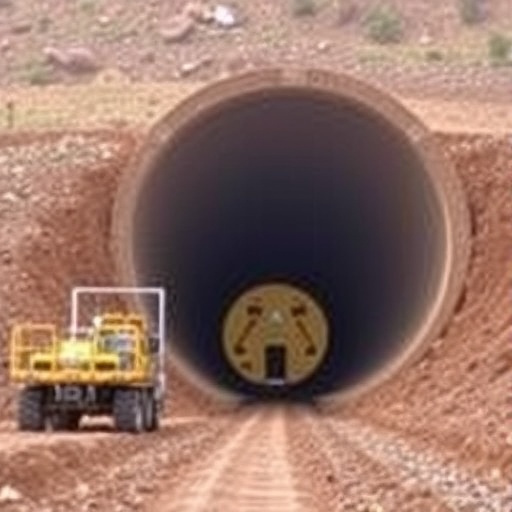
In the ever-evolving field of underground engineering, the unpredictable behavior of water inflow through faults and fractures during deep tunnel excavation poses significant challenges. This elusive phenomenon not only complicates excavation logistics but also raises substantial safety concerns and economic burdens. Recent pioneering research by Sakuma, Ishii, and Murakami offers a transformative approach to this enduring problem, introducing a novel predictive framework to forecast the long-term natural decay of water inflow. Their study leverages the concept of flow dimension—a sophisticated mathematical tool—to provide unprecedented insights into groundwater behavior in fractured geological structures.
Deep underground tunneling has become a cornerstone for developing critical infrastructure, such as subways, highways, and utility conduits, especially in urban environments where surface space is scarce. However, the interaction between geological faults and infiltrating water remains a formidable obstacle. When excavation intersects permeable faults or fractures, unexpected water inflows can flood the worksite, delay progress, and compromise structural integrity. Until now, engineers have relied largely on empirical models or simplified assumptions to estimate inflow rates, which often fall short of capturing the complex, heterogeneous nature of subsurface hydrology.
The groundbreaking methodology proposed by Sakuma and colleagues harnesses the principle of flow dimension, a concept rooted in fractal and dimensional analysis, to quantify the dynamics of water seepage through irregular, anisotropic fault networks. By assigning a flow dimension to the fracture system, the researchers establish a scalable framework capable of characterizing inflow decay rates over extremely long time spans. This approach bridges the gap between microscopic fracture geometry and macroscopic flow behavior, enabling more accurate, quantitative predictions.
Crucial to their study is the recognition that water inflow does not taper off linearly or according to simplistic exponential decay models commonly used in conventional hydrogeology. Instead, the decay follows complex, non-linear trajectories dictated by the fractal structure of the flow pathways. This insight opens new avenues for modeling groundwater-surface interactions in fault zones, revealing how intrinsic geological properties dictate the temporal evolution of flow rates after excavation encounters a fault.
The authors meticulously validated their predictive model using data from multiple deep tunnel construction projects that experienced variable inflow conditions across diverse geological settings. By integrating field observations with numerical simulations, they demonstrated that the flow dimension parameter offers robust predictive power in natural decay trends spanning days, months, and even years. This breakthrough suggests that tunnel engineers can now anticipate long-term inflow dynamics more reliably, informing mitigation strategies well beyond immediate excavation phases.
Moreover, the implications of this research extend far beyond just the domain of underground construction. The analytical framework has the potential to revolutionize groundwater management in fractured rock aquifers, enhance risk assessments for subsurface contamination, and optimize the design of subterranean waste repositories. Understanding the long-term decay behavior could also aid in climate resilience planning, as fluctuating groundwater pressures often influence surface subsidence and fault stability.
This comprehensive insight into fracture flow dynamics is built upon a rigorous theoretical foundation and enriched by advanced computational techniques. The researchers employed fractal geometry principles, probabilistic hydrological modeling, and machine learning algorithms to dissect and predict the multifaceted interactions between water and subterranean rock structures. This multidisciplinary approach bridges engineering, geology, and applied mathematics to tackle one of the most persistent issues in subsurface exploration.
One notable aspect of the study is its practical applicability. The predictive model requires only minimal input data related to the geometric and hydraulic properties of faults, making it feasible to implement alongside existing geological surveys and borehole investigations. Consequently, infrastructure developers and geotechnical engineers can integrate flow dimension analysis into routine planning processes without necessitating extensive additional resources or specialized instrumentation.
Furthermore, the temporal scale of prediction is a critical advancement. Traditional inflow models typically focus on short-term estimations, adequate for immediate construction phases but insufficient for lifecycle management of underground assets. Sakuma et al.’s approach projects inflow decay trajectories over decades, enabling maintenance scheduling, waterproofing system design, and contingency planning that align with the operational life of facilities.
The societal impact of these findings cannot be overstated. As urban populations burgeon and reliance on subterranean infrastructure intensifies, ensuring safe and cost-efficient tunnel construction becomes ever more imperative. Reducing unexpected water ingress not only trims project delays and cost overruns but also enhances worker safety by mitigating flooding hazards inside tunnels. This technology-driven predictive capacity thus promises to shape safer urban landscapes and more resilient infrastructure networks.
Environmental conservation benefits also emerge from the enhanced understanding of subterranean water flows. Predicting long-term inflow patterns aids in preserving natural groundwater regimes and preventing inadvertent ecological disturbances. The research contributes towards sustainable development goals by supporting balanced interaction between human infrastructure and groundwater ecosystems.
In terms of future research, this study sets a strong foundation for exploring the coupling between mechanical stress changes induced by excavation and the resultant fracture permeability variations affecting inflow behavior. Integrating geomechanical simulations with flow dimension metrics could unlock even deeper predictive accuracy, facilitating adaptive tunnel design responsive to evolving subsurface conditions.
Additionally, expanding the model’s versatility to incorporate chemical interactions between groundwater and rock matrices could enhance predictions for inflow quality as well as quantity. This would be crucial in contexts such as radioactive waste disposal or contaminant migration monitoring, where fluid chemistry significantly influences safety and regulatory compliance.
The flow dimension approach also resonates with parallel advances in fracture network characterization achieved through remote sensing, microseismic monitoring, and 3D geological modeling. When combined, these innovations could usher in an era of digital twin technologies for underground construction, providing dynamic, real-time inflow forecasts that inform immediate operational decisions and long-term asset management.
Ultimately, Sakuma, Ishii, and Murakami’s study exemplifies the power of interdisciplinary innovation in solving complex engineering challenges. By bringing together sophisticated mathematics, empirical evidence, and computational prowess, they have crafted a blueprint for a predictive science of subterranean waters that could transform tunneling practices worldwide. As extraction, transportation, and habitation increasingly venture underground, mastering the flow dynamics of fracture networks becomes not just a technical imperative but a societal one.
The research profoundly shifts the paradigm from reactive inflow management to proactive, predictive control, positioning the flow dimension as a key metric in future underground infrastructure development. This leap forward heralds safer tunnels, optimized project timelines, and more sustainable coexistence between human activity and geological processes lurking beneath our feet.
Cite Scienmag News
Violet Maxwell. (November 11, 2025). Forecasting Fault Inflow Decay in Deep Tunnel Excavation. Scienmag. https://scienmag.com/forecasting-fault-inflow-decay-in-deep-tunnel-excavation/
Violet Maxwell. "Forecasting Fault Inflow Decay in Deep Tunnel Excavation." Scienmag, 11 November 2025, https://scienmag.com/forecasting-fault-inflow-decay-in-deep-tunnel-excavation/. Accessed 4 September 2026.
Violet Maxwell. "Forecasting Fault Inflow Decay in Deep Tunnel Excavation." Scienmag. November 11, 2025. https://scienmag.com/forecasting-fault-inflow-decay-in-deep-tunnel-excavation/


