


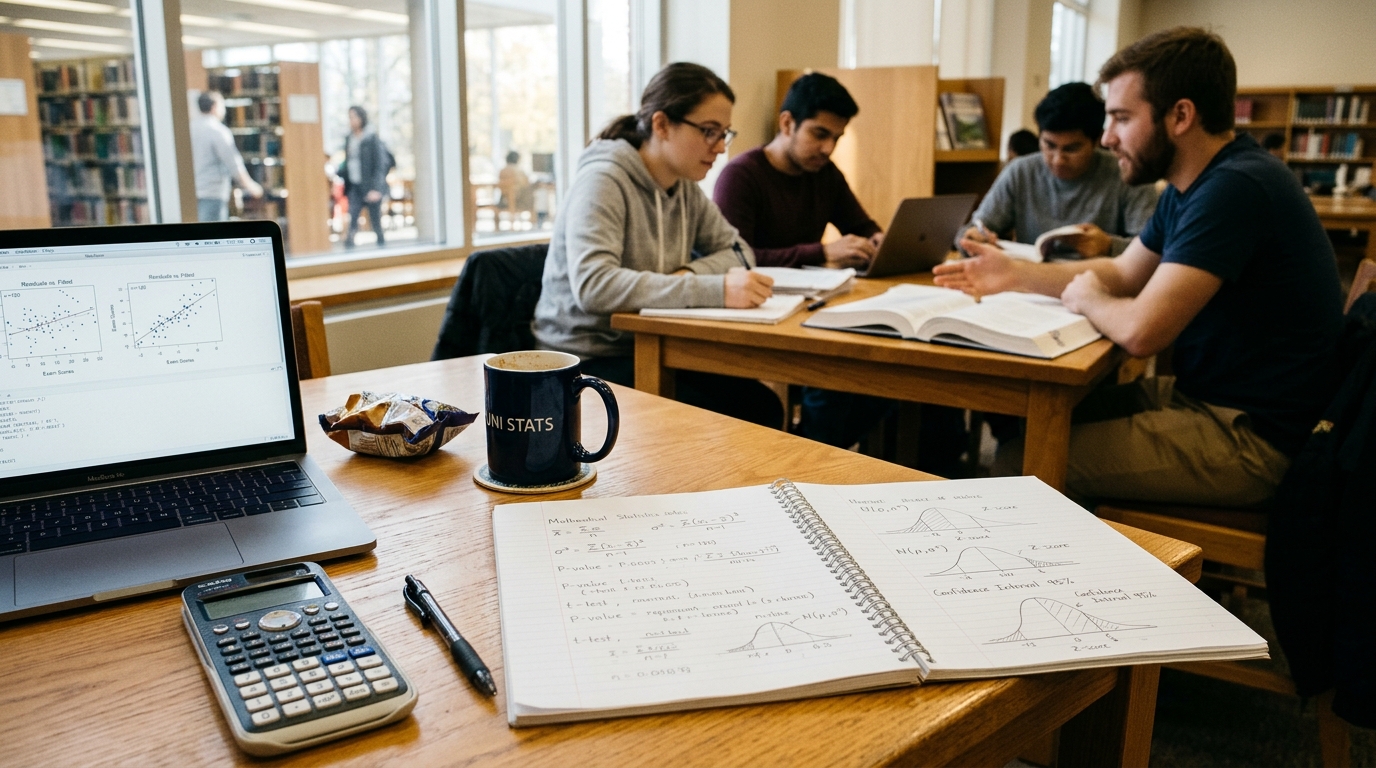
A new experimental study has revealed that altering the order in which instructional materials are presented and changing the type of examples used does not affect students’ statistics understanding or anxiety. Conducted by researchers from the School of Psychology at the University of Nottingham and published in Psychology Teaching Review, the study investigated whether pedagogical adjustments could alleviate common challenges faced by learners, finding that educators have considerable flexibility in deciding how to introduce statistical concepts.
Students across disciplines ranging from psychology and medicine to law are frequently required to learn statistics, though many encounter difficulties understanding statistical concepts and experience anxiety about the subject. While statistics is often introduced through lectures presenting abstract equations before students apply them to example data, the researchers investigated whether placing worked examples first or altering example types could make the material easier to grasp and less anxiety-provoking. In an online experiment focused on standard deviation, defined as a measure of how spread-out numbers are around their average, participants learned the equation for standard deviation and calculated it for a set of numbers using Microsoft Excel.
The experiment evaluated two distinct teaching orders alongside two example types. Under the equation-first condition, participants learned the equation prior to completing the worked example, whereas under the example-first condition, participants worked through the example before encountering the equation. To test example types, the researchers compared a real-world scenario utilizing life expectancy data from the United Nations against a fictional scenario involving the heights of aliens from another planet. The researchers found that neither the presentation order nor the choice between real-world and fictional examples influenced participants’ understanding or their measured anxiety regarding statistics.
Lead author Dr Kieran Lyon explained that the study sought to determine whether adjusting material order and example types would reduce anxiety and improve comprehension, concluding that both orders and example types proved equally effective without negatively impacting student experiences or grades. Co-author Nikki Dean Marshall, an Assistant Professor in the School of Psychology, added that the findings demonstrate there is no single right way to teach statistics, noting that whether instruction begins or ends with equations, or employs real-world or simulated examples, learners perform just as effectively, providing educators the freedom to adapt methods to learner needs.
Subject of Research: Impact of instructional order and example type on statistics learning and anxiety
Article Title: Study suggests there is no ‘right’ way to teach statistics, giving flexibility to educators
Article References: Study suggests there is no ‘right’ way to teach statistics, giving flexibility to educators. Original publication (Bibliographic details unavailable.)
Image Credits: AI Generated
DOI: Not provided
Keywords: statistics education, psychology, teaching methods, statistics anxiety, standard deviation, worked examples, higher education, educational psychology, suggests, there, right, teach
Cite Scienmag News
Glenn Wilkins. (November 6, 2026). Teaching Order And Example Types Do Not Affect Statistics Learning. Scienmag. https://scienmag.com/teaching-order-and-example-types-do-not-affect-statistics-learning/
Glenn Wilkins. "Teaching Order And Example Types Do Not Affect Statistics Learning." Scienmag, 6 November 2026, https://scienmag.com/teaching-order-and-example-types-do-not-affect-statistics-learning/. Accessed 6 November 2026.
Glenn Wilkins. "Teaching Order And Example Types Do Not Affect Statistics Learning." Scienmag. November 6, 2026. https://scienmag.com/teaching-order-and-example-types-do-not-affect-statistics-learning/




