


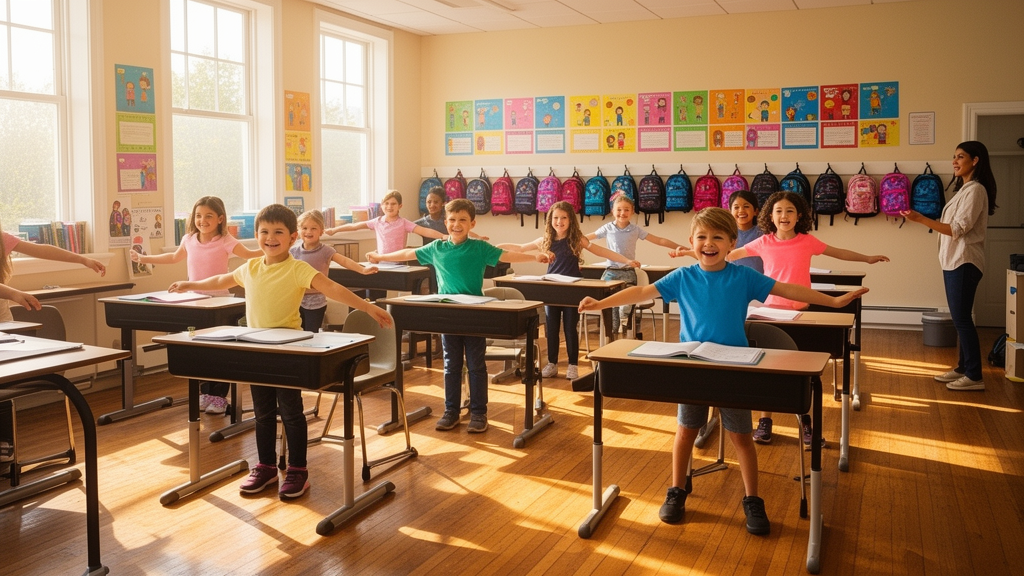
When children learn while moving, something remarkable happens in the classroom. Teachers in Nova Scotia, Canada, report that lessons built around physical activity do far more than burn off excess energy. According to a new qualitative study published in Frontiers in Sports and Active Living, physically active learning appears to touch nearly every dimension of student wellbeing, from sharper focus and stronger friendships to improved mood and a renewed sense of belonging at school.
The research examined the Nova Scotia Active Smarter Kids (NS ASK) Project, a Canadian adaptation of a Norwegian program that integrates bodily movement into curriculum lessons so students can learn while moving. Since 2017, when provincial government departments partnered with the original ASK team, more than 130 Nova Scotia schools have received training, and over 3,000 teachers have been introduced to the approach. Lessons are deliberately simple and non-competitive, often taking place outdoors, and typically involve relay-style tasks, word and number studies, or true/false activities using basic equipment such as numbered bean bags, large dice, hula hoops, and whiteboards.
To understand how teachers perceive the program’s effects, researchers at Dalhousie University conducted semi-structured interviews with ten teachers, five from elementary grades 4 to 5 and five from middle school grades 7 to 8. Interviews lasted an average of 46 minutes and explored how teachers conduct active lessons, what they observe in their students, and what obstacles they face. Data were analyzed using reflexive thematic analysis, a method that treats coding as an interpretive, researcher-driven process rather than a mechanical extraction of themes. The analysis produced seven themes: four describing perceived wellbeing benefits, one describing the pedagogical approaches behind them, and two describing ongoing implementation challenges.
The wellbeing benefits teachers described were strikingly multi-dimensional. Physically, teachers reported that active lessons broke up sedentary time and offered inclusive, low-barrier opportunities for movement, particularly valuable for students who lack access to organized sports due to financial or time constraints. Unlike physical education, which can feel evaluative and skill-based, active lessons allowed students to experience success regardless of prior athletic ability. Over time, teachers noticed improvements in endurance, movement skills, and willingness to engage, suggesting that regular participation builds physical competence and confidence in everyday classroom contexts.
Cognitively, teachers described a reliable boost to engagement and focus, both during and after lessons. Students were more attentive, more eager to attend school, and more ready to learn when they returned to class. One teacher recalled a student saying she loved active lessons because she could move around when feeling fidgety, something never permitted in a traditional classroom. Teachers also described a kind of cognitive refresh, noting that morning lessons woke students up and pepped them up for the day. These observations align with a growing body of international evidence linking physically active lessons to improved executive function, on-task behaviour, and time-on-task, with the Norwegian ASK cluster-randomized controlled trial showing that students in the lowest academic tertile at baseline demonstrated significant improvements in numeracy and executive functions.
Socially, the collaborative, team-based format of active lessons fostered relationships, communication, leadership, and belonging. Students formed new friendships while working together, and students perceived to be on the margins, whether due to learning needs, social differences, or language barriers, became more visible and engaged when lessons were adapted to fit their needs. One middle school teacher described putting lesson questions into a student’s home language so the student felt more involved while classmates rallied around them. Teachers also reported stronger student-teacher relationships, gaining new perspectives on their students through shared participation in movement.
Emotionally, teachers emphasized joy, happiness, and emotional regulation. Students came in happier after outdoor lessons, looked forward to the next one, and asked when they could go back out. One teacher even suggested that the extra exercise could help battle the anxiety and depression running rampant among junior high students. The combination of movement, fresh air, and novelty appears to create optimal conditions for learning, aligning attention, motivation, and emotional states. However, teachers noted that competitive elements sometimes undermined these benefits, creating anxiety or reluctance among students who felt pressured by teammates or upset by losing, reinforcing evidence that low-pressure, non-competitive formats are essential for emotional wellbeing.
Underlying these benefits, teachers identified specific pedagogical approaches as catalysts: integrating movement throughout the day, creating peer learning opportunities, remaining adaptable and flexible in a low-pressure environment, and supporting outdoor, non-competitive lessons. These approaches align closely with Self-Determination Theory, which posits that wellbeing depends on satisfying three basic psychological needs: autonomy, competence, and relatedness. Active lessons appeared to satisfy all three, allowing students choice in how they contributed, success in what they did, and connection with peers. Given the program’s frequent outdoor setting, the researchers also considered nature relatedness, a sense of connection to nature, as a complementary psychological need that may partly explain why students prefer outdoor lessons and experience greater focus and emotional regulation in natural settings.
Yet the study also exposed persistent barriers. Teachers described spatial constraints in small, older schools where classrooms could not accommodate active lessons in bad weather, forcing major disruptions to move desks and chairs. Equipment was in high demand, with shared items like dice and bean bags claimed early in the morning or even the day before. Time for lesson preparation was scarce, particularly when teachers covered for colleagues during planning periods. Weather, inadequate outdoor clothing, and limited accessibility for students with physical disabilities added further complications. One teacher anticipated that anything off the main path where lessons are usually set up would not be accessible to a wheelchair user, highlighting the risk that active learning, if not carefully planned, could inadvertently isolate students with disabilities.
Beyond resources, teachers navigated the status quo of existing school structures and cultures. Some were the only implementers in their schools, facing skepticism from colleagues who viewed outdoor, movement-based lessons as unstructured or non-essential. Curriculum pressures and traditional assessment expectations made it harder to evaluate students academically during active lessons, requiring teachers to rethink what assessment could look like. Despite these challenges, teachers persisted because they saw clear benefits for students. The researchers argue that realizing the full potential of physically active learning requires systemic shifts: better lesson planning resources, administrative support that values and prioritizes movement, investment in flexible and accessible spaces, durable equipment, targeted professional development around inclusive practice, policies that protect time for active lessons, and sustainable funding. If these barriers can be removed, more students across Nova Scotia and beyond may reap the wellbeing benefits of learning while moving.
Subject of Research: Health
Article Title: Teachers' perspectives on physically active learning and student wellbeing in the Nova Scotia Active Smarter Kids Project
Article References: Campbell, J. E., Moore, S. A., Truong, S., Rainham, D. G., & Stone, M. R. (2026). Teachers' perspectives on physically active learning and student wellbeing in the Nova Scotia Active Smarter Kids Project. Frontiers in Sports and Active Living, 8, Article 1914074. https://doi.org/10.3389/fspor.2026.1914074
Image Credits: AI Generated
DOI: 10.3389/fspor.2026.1914074
Keywords: physically active learning, student wellbeing, education, physical activity, schools, Active Smarter Kids, Nova Scotia, teacher perspectives, Teachers', perspectives, physically, active
Cite Scienmag News
Gavin Prescott. (October 17, 2026). Teachers Say Learning While Moving Boosts Student Wellbeing in Nova Scotia Schools. Scienmag. https://scienmag.com/teachers-say-learning-while-moving-boosts-student-wellbeing-in-nova-scotia-schools/
Gavin Prescott. "Teachers Say Learning While Moving Boosts Student Wellbeing in Nova Scotia Schools." Scienmag, 17 October 2026, https://scienmag.com/teachers-say-learning-while-moving-boosts-student-wellbeing-in-nova-scotia-schools/. Accessed 17 October 2026.
Gavin Prescott. "Teachers Say Learning While Moving Boosts Student Wellbeing in Nova Scotia Schools." Scienmag. October 17, 2026. https://scienmag.com/teachers-say-learning-while-moving-boosts-student-wellbeing-in-nova-scotia-schools/


