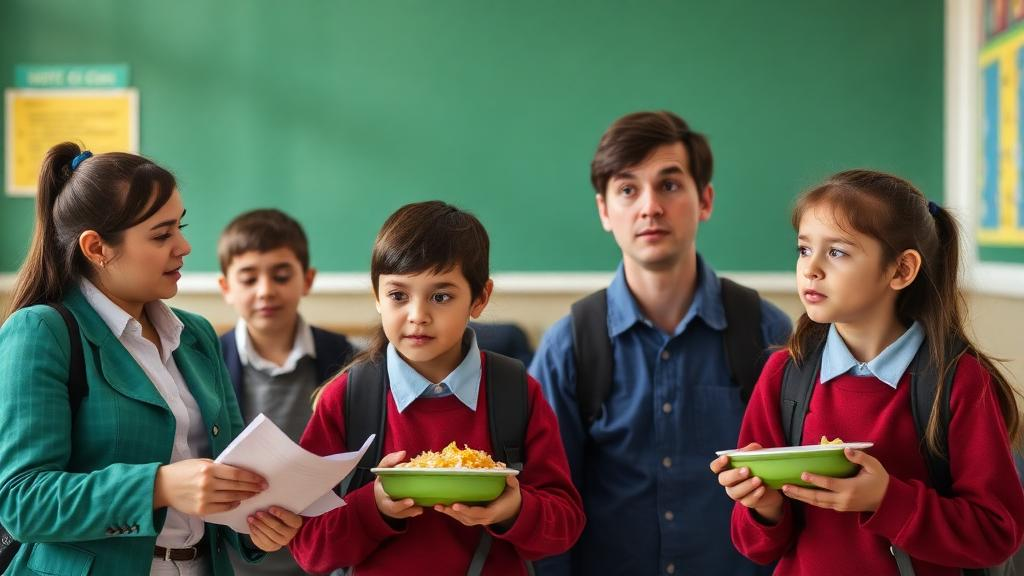
When the federal government allowed its pandemic-era universal free school meals policy to expire, elementary school teachers in one Alaskan district quickly noticed the difference in their classrooms. A new qualitative study published in the Journal of Nutrition Education and Behavior, a peer-reviewed journal published by Elsevier, documents what happened when kindergarten through sixth-grade students in Anchorage lost access to meals that had been provided at no cost to every child, regardless of family income. According to the teachers interviewed, the end of the policy was followed by more students going hungry during the school day, growing anxiety among children about the cost of their meals, and a measurable decline in participation in school meal programs.
The research team, led by Deborah A. Olarte, PhD, RD, Assistant Professor of Nutrition at New York University, conducted online interviews with 25 elementary school teachers drawn from six elementary schools in Anchorage, Alaska. The study used an observational, qualitative design, asking teachers to reflect on two consecutive school years: the 2021–2022 school year, when the federal universal free school meals policy was in effect, and the following school year, after the policy had ended. This before-and-after structure gave researchers a rare window into how a single policy change rippled through classrooms, cafeterias, and family budgets as perceived by the educators who spend every day with young children.
Universal free school meals emerged during the COVID-19 pandemic as a federal waiver system that allowed schools across the United States to serve breakfast and lunch to all students at no charge, removing the income-based applications and eligibility categories that normally determine who pays and who eats for free. When those waivers lapsed, most districts returned to the traditional tiered system, in which families must qualify for free or reduced-price meals based on household income while other students pay full or reduced rates. The Anchorage teachers in this study experienced that transition directly, and their accounts form the core of the new analysis.
During the year of universal free meals, teachers described a classroom environment noticeably freed from food-related worry. They reported that providing free meals to all students reduced concerns about hunger and eased financial stress for families. Because every child received meals on the same terms, the program also carried the potential to reduce the stigma that can attach to means-tested meal programs, a dynamic the researchers highlight in their conclusions. Not every observation was positive: some teachers perceived that food waste increased while meals were universally free, a concern frequently raised in debates over universal meal policies. Yet when asked what benefits emerged after the policy ended, the teachers could not identify any. Instead, the post-expiration period brought a cluster of problems.
After universal free school meals ended, many teachers observed that fewer students participated in school meals, that more students appeared hungry during the school day, and that some children expressed worry about the cost of meals. Several teachers reported going further than observation: they provided food to students themselves when they noticed children without enough to eat. That detail underscores a quiet reality of American classrooms, in which educators often absorb gaps left by policy, spending their own resources to keep students fed and ready to learn. The study suggests that when the federal safety net narrowed, the burden did not disappear; it shifted onto families and, in some cases, onto teachers.
The anxiety teachers witnessed extended beyond hunger itself to the mechanics of paying for food. Children who once ate without a second thought began expressing concern about meal costs, an emotional burden that educators found visible in the classroom. The researchers frame this as evidence that school meal policies influence more than nutrition. As Olarte explained, teachers witness firsthand how hunger affects students’ ability to learn, focus, and participate in the classroom, and their experiences provide valuable insight into how school meal policies can influence not only nutrition but also student well-being and the overall classroom environment.
The study also captured a dimension of school meals that rarely appears in policy debates: the classroom experience of eating together. Teachers described benefits of eating meals in the classroom, including stronger classroom communities, improved student behavior, and more opportunities to build relationships with students. Shared mealtimes, in this account, functioned as social infrastructure, moments when the boundaries between instruction and care blurred productively. At the same time, the teachers were candid about the costs to themselves. Supervising meals created additional clean-up responsibilities and reduced the planning time they needed for instruction, a trade-off that any future policy design would need to weigh.
The researchers conclude that teacher perspectives should be considered when designing future school meal policies. That recommendation carries weight because teachers occupy a unique observational position: they see children for hours each day, across months, in settings where hunger, distraction, and anxiety are difficult to hide. Survey instruments and cafeteria participation statistics can quantify how many meals were served, but they cannot easily capture a child hesitating at a register, worrying about a balance owed, or quietly declining a meal. The qualitative method used here, built on in-depth interviews rather than standardized questionnaires, is designed to surface exactly those lived experiences and to translate them into evidence that policymakers can act upon.
The findings arrive at a moment when the role of school meals in child well-being is under active discussion across the United States. Some states have moved to adopt their own universal free school meal programs after the federal waivers ended, while other districts continue to operate under the traditional income-based eligibility model. The Anchorage study offers a grounded case study of what the rollback looked like from the front of the classroom: increased hunger, increased anxiety about meal costs, and decreased participation in the very programs designed to feed children. The authors suggest that universal free school meals may help improve student well-being, reduce stigma surrounding school meals, and support a more positive learning environment, positioning the policy not merely as a nutrition program but as an educational intervention with consequences visible in attention, behavior, and classroom community.
For the teachers at the center of the study, the contrast between the two school years was stark enough to reshape how they think about food in schools. During universal free meals, they saw fewer hungry children and calmer families; after the policy ended, they saw the reverse, and some began feeding students out of their own supplies. The study, titled When School Meals Are No Longer Free: A Qualitative Exploration of Elementary School Teachers’ Experiences and Perceptions, does not claim to measure outcomes across an entire district or to establish causation with statistical precision. What it does provide is a detailed, systematic record of educator perceptions during a natural policy experiment, gathered from 25 teachers across six schools and published in a journal that reaches the nutrition education professionals who shape school food programs. As states and districts weigh whether to extend or restore universal meal access, the message from these classrooms is that the price of a school lunch is visible not only on a family’s bill but in a child’s ability to focus, participate, and feel secure during the school day.
Subject of Research: Teacher-reported effects of the expiration of the federal universal free school meals policy on elementary students in Anchorage, Alaska
Article Title: Elementary school teachers report increased student hunger and anxiety after universal free school meals ended
Article References: Elementary school teachers report increased student hunger and anxiety after universal free school meals ended. (n.d.). Original publication
Image Credits: AI Generated
DOI: Not provided
Keywords: universal free school meals, school nutrition, child hunger, elementary education, Anchorage Alaska, Journal of Nutrition Education and Behavior, food insecurity, student well-being, classroom behavior, school meal participation, qualitative research, education policy
Cite Scienmag News
Courtney Benton. (October 10, 2026). Teachers Report More Hungry, Anxious Students After Universal Free School Meals Ended. Scienmag. https://scienmag.com/teachers-report-more-hungry-anxious-students-after-universal-free-school-meals-ended/
Courtney Benton. "Teachers Report More Hungry, Anxious Students After Universal Free School Meals Ended." Scienmag, 10 October 2026, https://scienmag.com/teachers-report-more-hungry-anxious-students-after-universal-free-school-meals-ended/. Accessed 10 October 2026.
Courtney Benton. "Teachers Report More Hungry, Anxious Students After Universal Free School Meals Ended." Scienmag. October 10, 2026. https://scienmag.com/teachers-report-more-hungry-anxious-students-after-universal-free-school-meals-ended/