


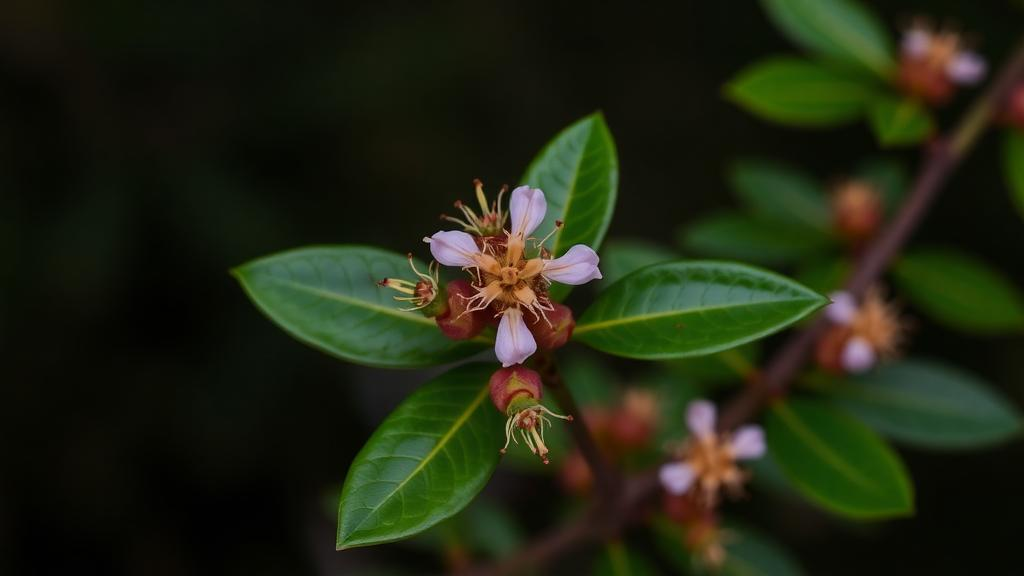
A taxonomic study has identified a new species, Vaccinium fangianum, from Dulongjiang Township in northwestern Yunnan, China. The study was based on living and dried flowering and fruiting material collected in Yunnan during July 2011, April 2022 and March 2023, together with herbarium specimens, specimen photographs and digital records. Comparisons with type collections and additional specimens showed that populations from Dulongjiang differ consistently from the true Vaccinium ardisioides.
The researchers described the new species and determined that the previously published V. rubescens is conspecific with V. ardisioides, resolving a taxonomic confusion involving both names. Vaccinium is a large genus in the heath family, Ericaceae, with approximately 485 species distributed worldwide. China has recorded 105 species, including the recently described V. dehongense and V. longisetosum.
Yunnan Province contains about 50 species and has the greatest recorded diversity of the genus in China. V. fangianum was named in honor of Prof. Rhui-Cheng Fang, who has contributed substantially to knowledge of Vaccinium in China.
Its Chinese name is 瑞征越橘, pronounced ruì zhēng yuè jú. The formal description is based principally on the specimen collected at Maku Village in Gongshan County on 8 March 2023. The new species differs from V. ardisioides in both vegetative and reproductive morphology.
Its leaf blades are ovate-lanceolate to ovate, 6 to 14 centimeters long and 3 to 6 centimeters wide, with length-to-width ratios of 1.8 to 2.6 and the widest point near the base. The leaves of V. ardisioides are elliptic to oblong-lanceolate, 7.5 to 13 centimeters long and 2.5 to 4 centimeters wide, with ratios of 3 to 3.5 and their widest point near the middle. V. fangianum has eight to 12 pairs of lateral veins, compared with 10 to 16 pairs in V. ardisioides.
Floral characters provide further separation between the two species. The calyx limb of V. fangianum is nearly divided to the base, with narrowly triangular lobes about 1.5 millimeters long and no apical gland. In V. ardisioides, the calyx limb is divided by less than half and carries broadly triangular lobes measuring 0.5 to 1 millimeter, each ending in a gland.
The corolla of V. fangianum is yellowish green, tubular and five-angled, 7 to 9 millimeters long, and villous on its internal surface. That of V. ardisioides is white-pinkish or pinkish, sometimes turning purplish red later, and is glabrous internally. The tubular portions of the anthers in V. fangianum are about 1.7 times as long as the pollen-bearing thecae and lack the two short abaxial spurs found in V. ardisioides.
Both plants are evergreen shrubs that grow epiphytically on trees, but they differ in stature and in the structure of their inflorescences and fruits. V. fangianum is 0.5 to 1.2 meters tall, with axillary racemes 5 to 10 centimeters long and usually 24 to 35 flowers, although some inflorescences have only 10. Its greenish clavate pedicels measure 6 to 7.5 millimeters.
V. ardisioides can be 2 meters tall and has racemes 6 to 11 centimeters long, generally bearing 17 to 27 flowers but sometimes only 10. Its pedicels are 7 to 15 millimeters long. The fruit of the new species is ellipsoid, about 3 millimeters in diameter, changing from yellowish green to purplish red and finally white with a purple tinge.
The globose fruit of V. ardisioides measures 4 to 6 millimeters and becomes purple-black at maturity. The original description of V. ardisioides was published in 1882 from two collections made in Myanmar by T. Lobb and C.
Parish. Most flowers on both type specimens remained young and unopened, and only one had a torn corolla that exposed short lobes. This limited material contributed to uncertainty over the description of the corolla.
Chinese specimens from southwest Yunnan had been reported to differ from the protologue in inflorescence length, pedicel length and the degree of corolla division. Examination of the type collections and numerous additional specimens showed that the inflorescences and pedicels of the Chinese material were longer than those preserved on the young type specimens. The flowers of the southwest Yunnan populations consistently had the shallowly lobed corolla attributed by the authors to the true V. ardisioides.
That history also explains the description of V. rubescens in 1999 from southwest Yunnan. The types and paratypes of that name were found to agree with V. ardisioides in key characters, including five to seven pseudo-whorled leaves, subsessile petioles, leathery oblong-lanceolate blades, raised veins, entire margins, many-flowered axillary racemes, purplish-red angular rachises, clavate pedicels and anthers with two short abaxial spurs. On the basis of these agreements, the study treats V. rubescens as a synonym of V. ardisioides.
It also provides a revised account of V. ardisioides because the protologue and the earlier Flora of China treatment contained inaccurate floral descriptions. The new species is currently known only from Dulongjiang Township in Gongshan County, where it grows epiphytically on tree trunks in evergreen broad-leaved and mixed forests at elevations of 1,200 to 1,500 meters. Flowering occurs from March to April, and fruiting from May to July.
Its type locality is close to the China–Myanmar border, and the authors consider it likely that the species may also occur in adjacent northeastern Myanmar, but field investigations have not confirmed that distribution. The species is therefore assessed as Data Deficient under the IUCN Red List categories. Its documented occurrence is restricted, while its actual range and population status remain uncertain.
V. ardisioides has a substantially wider documented distribution. It occurs in southwest Yunnan, eastern Myanmar and northwestern Thailand, usually as an epiphyte in evergreen broad-leaved forests or along riversides at elevations of 1,400 to 2,500 meters. Flowering and fruiting extend from February to June.
More than 20 locations have been recorded, and the study estimates an extent of occurrence of approximately 280,000 square kilometers. Based on specimen records, its relatively broad range and the absence of observed evidence of severe population decline, the authors assess V. ardisioides as Least Concern. The two species therefore have both clearly distinguished diagnostic features and different levels of distributional documentation.
Within the genus, V. fangianum is assigned to V. sect. Epigynium because it is evergreen, has pseudo-verticillate leaves, elongated racemose inflorescences and anthers without dorsal spurs. Most species in that section have serrated leaf margins, whereas V. fangianum and V. ardisioides have entire blades, a combination the authors describe as unique within the section.
The new species is also geographically separated from V. ardisioides: V. fangianum is recorded in northwestern Yunnan, while V. ardisioides occurs in southwestern Yunnan, southeastern Myanmar and western Thailand. The study presents V. fangianum as a distinct taxonomic entity and uses herbarium and field comparisons to establish its diagnostic combination of leaf, calyx, corolla, anther and fruit characters.
Subject of Research: Taxonomic description of Vaccinium fangianum and revision of Vaccinium ardisioides in Yunnan, China
Article Title: Vaccinium fangianum ( Ericaceae ), a new species from Northwest Yunnan, China, with critical notes on V. ardisioides
Article References: Liang, X.-H., Ni, J.-B., & Tong, Y.-H. (2026). Vaccinium fangianum (Ericaceae), a new species from Northwest Yunnan, China, with critical notes on V. ardisioides. PhytoKeys, 275, 61-71. https://doi.org/10.3897/phytokeys.275.197108
Image Credits: AI Generated
DOI: 10.3897/phytokeys.275.197108
Keywords: Vaccinium fangianum, Vaccinium ardisioides, plant taxonomy, species description, Ericaceae, Dulongjiang, northwestern Yunnan, epiphytic shrub, herbarium taxonomy, conservation assessment, Vaccinium, fangianum
Cite Scienmag News
Margaret Porter. (October 20, 2026). Taxonomic study describes Vaccinium fangianum from northwestern Yunnan. Scienmag. https://scienmag.com/taxonomic-study-describes-vaccinium-fangianum-from-northwestern-yunnan/
Margaret Porter. "Taxonomic study describes Vaccinium fangianum from northwestern Yunnan." Scienmag, 20 October 2026, https://scienmag.com/taxonomic-study-describes-vaccinium-fangianum-from-northwestern-yunnan/. Accessed 20 October 2026.
Margaret Porter. "Taxonomic study describes Vaccinium fangianum from northwestern Yunnan." Scienmag. October 20, 2026. https://scienmag.com/taxonomic-study-describes-vaccinium-fangianum-from-northwestern-yunnan/


