

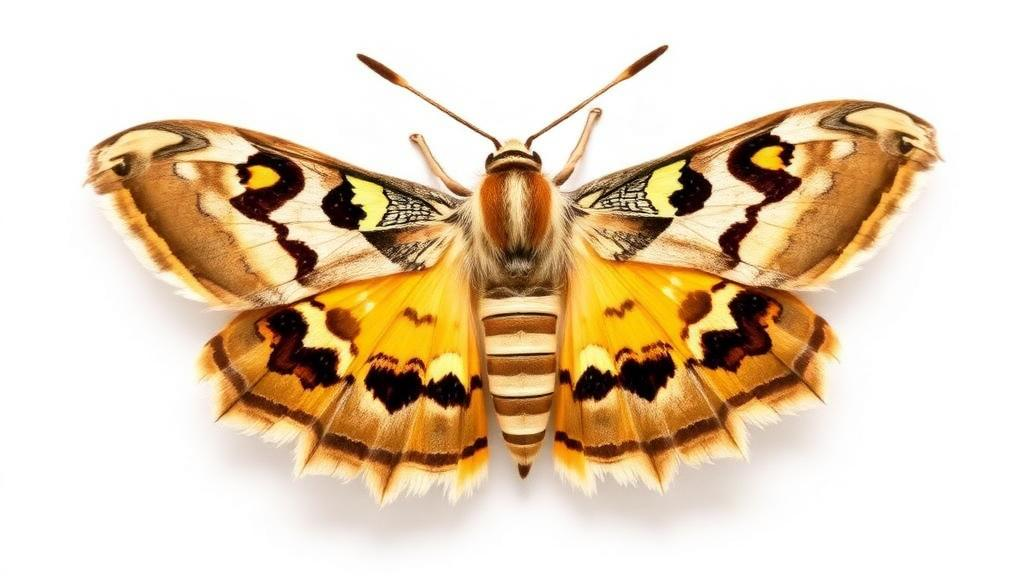
A taxonomic review of the bagworm moth genus Phalacropterix on Corsica concluded that Phalacropterix restonicae, described as a separate species in 2015, is not sufficiently distinct from the widespread Phalacropterix apiformis. The authors combined field records, examination of adult males and larval cases, comparisons of male genital anatomy, and DNA barcoding of mitochondrial DNA. Their conclusion was formalized as Phalacropterix restonicae syn. nov., returning the Corsican specimens to P. apiformis as a single species.
The species now treated as P. apiformis has a western Mediterranean distribution. It occurs on the Italian mainland and on Sardinia, Sicily and Capraia, as well as in Malta, on the French mainland and on Corsica. The genus contains eight species confined to the Palaearctic region. Most occur in the Mediterranean area or have restricted ranges in southern and southeastern Europe, through Anatolia and into the Middle East, although P. graslinella is more widely distributed across temperate Europe and extends to Siberia.
Evidence that P. apiformis occurs on Corsica predates the description of P. restonicae. Historical records cited in the study place the moth around Ajaccio, Corte, Monte Renoso, Monte Incudine and Bonifacio. Kollmorgen reported in 1899 that it was very common from the coast up to 1,800 metres. The later description of P. restonicae was based on eight specimens collected in 2014 around the Gorges de la Restonica near Corte, an area that had long been investigated by lepidopterists. The new study therefore reassessed a population already known to inhabit the island rather than documenting a newly detected presence.
The authors compiled localities from their own sampling, collection and taxonomic records, and earlier literature. Fieldwork by Michael Weidlich in 1999 lasted one week, while Wilfried R. Arnscheid searched for psychid moths during ten days on the island in 2010. Larval cases attributed to P. apiformis were collected, and several caterpillars were reared to adults. The resulting records extend along much of the coast and inland into mountainous areas, including the Asco and Restonica gorges, the Solenzara region, the vicinity of Corte and sites around Ajaccio. The mapped localities included coastal sites at 5 to 50 metres, low inland sites at 150 to 330 metres, and records at higher elevations, including 950, 1,400 and 1,800 metres.
The biological observations clarify the species’ vertical range and seasonal pattern on Corsica. P. apiformis was recorded from sea level to about 1,800 metres, although the authors considered records attributed to some higher sites, including Col de Vergio, Monte Renoso and Monte Incudine, imprecise. Its caterpillars are polyphagous on different herbs and grasses. When pupating, they begin spinning in exposed positions on rocks and also in cracks and clefts between boulders. The main flight period is at the beginning of May, although an adult emerged on 24 April 1999 under laboratory conditions. The collection material included specimens found as cases, larvae, pupae and reared adults from Corsican localities.
The central morphological comparison addressed the characters previously used to distinguish P. restonicae from P. apiformis. With a larger series of specimens than the original description, the authors could not confirm a significant difference in wingspan. Male wingspans of P. apiformis measured 15–18 millimetres and fell within the normal variation of the population. Because wingspan depends substantially on how a specimen is spread, forewing length was treated as a more informative measurement, but it also showed no statistically significant difference between the taxa. Abdominal colour in both forms ranged from medium brown-yellowish to completely black, and forewing venation was variable and often asymmetric. In the Corsican population, the median veins M2 and M3 could arise from one point, remain shortly stalked or be completely divided.
Differences in the male genitalia were also judged insufficient to support separation. In P. apiformis, the authors described a slightly medially indented tegumen with a small downward-pointing process, short stout valvae, an elongate sacculus with short apical spines, a short semicircular anellus, an almost triangular vinculum and a broad, caudally spatulate saccus. The genitalia of specimens identified as P. restonicae appeared somewhat more compact in overall view, and the authors noted differences in the distal anellus and tegumen. They also observed that valval length varied in both taxa, sometimes reaching the distal end of the tegumen or protruding slightly beyond it. However, the authors said it was unclear whether the remaining genital distinctions were statistically significant. Their broader assessment was that P. restonicae was not morphologically significantly different from P. apiformis.
The molecular analysis reached the same taxonomic conclusion. The researchers examined a 658-base-pair fragment from the 5′ terminus of the mitochondrial cytochrome c oxidase I gene, or COI, following established extraction, amplification and sequencing protocols. Six publicly accessible Phalacropterix samples had been placed in two Barcode of Life Data System barcode identification numbers, one for P. apiformis and one for P. restonicae. Maximum intraspecific pairwise divergence among these samples was 1.3 percent, which the authors considered too small to establish a distinct species in the absence of other evidence. By comparison, the widely dispersed populations of P. graslinella showed only about 1 percent intraspecific divergence, while divergence between the P. apiformis–P. restonicae group and P. graslinella was approximately 11 percent.
A neighbour-joining tree of the COI barcodes did not separate the Corsican specimens assigned to P. restonicae from populations of P. apiformis. Genetic distances between the two nominal taxa ranged from 0.3 to 1.1 percent in the sampled material. The authors interpreted the overlap as evidence that the Corsican population had not diverged sufficiently from P. apiformis to represent a separate species. Together, the morphology and DNA barcodes did not support full speciation on Corsica. The proposed treatment is therefore a taxonomic synonymy rather than a claim that the island lacks potentially distinctive or localized forms.
The study emphasizes that the establishment of diagnostic morphology and speciation are not always directly correlated, particularly in allopatric settings. The authors note that island faunas can develop local forms and that the degree of divergence may be related to the time a population has been isolated. For P. apiformis, however, the available morphological and genetic variation did not meet the authors’ criteria for recognizing a distinct Corsican species. The result reduces the number of recognized Phalacropterix species associated with Corsica and places the island population within the western Mediterranean range of P. apiformis. The study’s taxonomic scope is limited to the material and evidence examined, including six publicly accessible DNA samples and the available Corsican specimens and records; it does not establish that the island’s other psychid species are similarly variable or that named species elsewhere in the genus are invalid.
Subject of Research: Taxonomic status, morphology, distribution and mitochondrial DNA barcoding of Phalacropterix moths on Corsica
Article Title: Faunistic and taxonomic notes on Phalacropterix apiformis (Rossi, 1790) and P. restonicae (Fiumi & Govi, 2015) from Corsica, France ( Lepidoptera , Psychidae , Oiketicinae )
Article References: Weidlich, M., & Arnscheid, W. R. (2021). Faunistic and taxonomic notes on Phalacropterix apiformis (Rossi, 1790) and P. restonicae (Fiumi & Govi, 2015) from Corsica, France (Lepidoptera, Psychidae, Oiketicinae). Nota Lepidopterologica, 44, 57-67. https://doi.org/10.3897/nl.44.58027
Image Credits: AI Generated
DOI: 10.3897/nl.44.58027
Keywords: Phalacropterix apiformis, Phalacropterix restonicae, Corsica, taxonomic synonymy, DNA barcoding, mitochondrial COI, male genitalia, Lepidoptera, Psychidae, Mediterranean moths, Faunistic, taxonomic
Cite Scienmag News
Scienmag. (October 20, 2026). Corsican moth species synonymized after morphology and DNA review. https://scienmag.com/corsican-moth-species-synonymized-after-morphology-and-dna-review/
Scienmag. "Corsican moth species synonymized after morphology and DNA review." Scienmag, 20 October 2026, https://scienmag.com/corsican-moth-species-synonymized-after-morphology-and-dna-review/. Accessed 20 October 2026.
Scienmag. "Corsican moth species synonymized after morphology and DNA review." Scienmag. October 20, 2026. https://scienmag.com/corsican-moth-species-synonymized-after-morphology-and-dna-review/


