


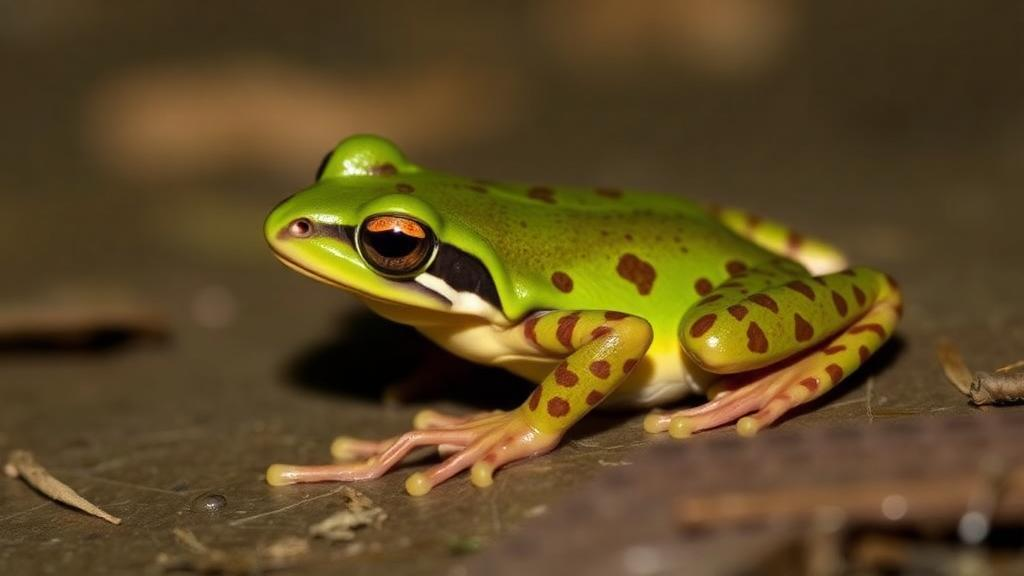
Micryletta hekouensis, a small paddy frog previously known only from two specimens collected in southern China, has been confirmed in northern Vietnam. A reassessment of museum material combines measurements, coloration and habitat observations with mitochondrial DNA analysis to identify 12 Vietnamese frogs as the same species. The specimens came from Cuc Phuong National Park in Ninh Binh Province and Cat Ba National Park in Hai Phong Province, extending the confirmed distribution roughly 335 airline kilometers southeast to the type locality near Hekou in Yunnan, China.
The frog was originally described from an adult male holotype and a female paratype from Nanxi Village, Nanxi Town, Hekou County, collected at an elevation of 350 meters above sea level. The holotype, KIZ 20210510, was collected on 15 May 2021; the source does not give that collection date for the paratype. The Chinese type specimens measured 20.5 and 20.8 millimeters in snout-vent length, but the Vietnamese series reveals that adults can be substantially larger: males measured 20.0–24.1 millimeters and females 25.4–29.5 millimeters. The authors propose that the female paratype was subadult when described and that the species is medium-sized within the Micryletta genus, rather than uniformly small.
The identification rests partly on an analysis of the mitochondrial 16S ribosomal RNA gene. Maximum-likelihood and Bayesian analyses recovered the Vietnamese samples in the same lineage as the holotype and paratype of M. hekouensis. Six newly analyzed sequences differed from the Chinese type-series sequences by an uncorrected genetic distance of 0.7 percent. The reconstructed tree placed M. hekouensis within a monophyletic complex containing M. steinegeri, M. menglienica and M. immaculata. Maximum-likelihood support was estimated with 1,000 ultrafast bootstrap replicates, while Bayesian posterior probabilities were calculated from two simultaneous runs of four Markov chains, each run for 5 million generations.
Morphological examination independently supported the molecular result. The Vietnamese frogs have a relatively slender body, a small triangular head, small slightly projecting eyes and a rounded snout that projects beyond the lower jaw. Their fingers and toes are unwebbed, the outer metatarsal tubercle is absent, and the tibiotarsal articulation of an adpressed hind limb reaches the level of the eye. Distinctive features include a white upper-lip stripe extending from below the eye toward the forelimb, a dark chin in adult males, irregular white marbling on the chest and lateral belly, and dorsal coloration ranging from purplish brown to bluish gray or dark brown. The dorsal surface bears small tubercles, while the ventral surface of the body and limbs is smooth.
Variation created an important qualification to the original description. The Chinese type series was reported to possess a small, rounded and distinct tympanum, whereas the tympanum was concealed in the Vietnamese specimens. Other proportional differences, including the ratio of tibia length to snout-vent length in females, could reflect genuine intraspecific variation, differences in preservation, reproductive condition or observer effects. The authors acknowledge that mitochondrial markers alone have limitations for delimiting amphibian species, but the close genetic match, corresponding external morphology and similar coloration collectively support the assignment of the Vietnamese animals to M. hekouensis. The comparison also documented a wider range of female body size than was apparent from the original two-specimen description.
Observations from the two Vietnamese parks add limited natural-history information to a species for which biological data had previously been scarce. In Cuc Phuong National Park, the frogs were seen from 16:00 to 20:00 beneath dead leaves on the ground. In Cat Ba National Park, they were observed during the same hours between small pieces of limestone rock. Gravid females were recorded at Cuc Phuong in June. The species shared its habitat with several other microhylid frogs, including Micryletta nigromaculata, and all three confirmed localities—the two Vietnamese parks and the Chinese type locality—are associated with limestone karst environments. The study had not previously reported the frog’s advertisement call, tadpole morphology or diet, leaving major aspects of its biology unresolved.
Those records suggest that M. hekouensis may occupy additional limestone massifs in northern Vietnam, but the paper distinguishes anticipated range from confirmed occurrence. The authors identify Quang Ninh, Lang Son and Bac Giang in northeastern Vietnam, together with Hoa Binh, Ha Nam and Thanh Hoa in northwestern Vietnam, as areas requiring survey rather than as established parts of the species’ range. The Vietnamese records expand the calculated extent of occurrence to 23,374 square kilometers. This estimate is based on the available records from 12 examined Vietnamese specimens and the Chinese type series, while the actual distribution, abundance and population trends remain unknown.
The Vietnamese record also changes the country’s known Micryletta diversity. Four nominal species were previously recognized in Vietnam, but confirmation of M. hekouensis raises that number to five. Two of the five, M. melanops and M. nigromaculata, are endemic to Vietnam. Conversely, the study supports removing M. steinegeri from the Vietnamese fauna because the northern Vietnamese populations previously identified as that species are now referred to M. hekouensis. The authors also call for re-examination of Micryletta populations formerly assigned to M. inornata across Laos, Cambodia, Thailand and Vietnam. In the molecular analysis, some specimens reported as M. inornata clustered with M. immaculata, while others grouped with M. menglienica, indicating that the distributions of those species may be wider than currently recorded.
Based on the restricted and fragmented records, the authors recommend listing M. hekouensis as Near Threatened under the International Union for Conservation of Nature’s Red List categories. They note that limestone karst in Vietnam and elsewhere in Southeast Asia continues to face severe pressure from deforestation and destruction for cement manufacturing. The size of the frog’s actual population and its sensitivity to habitat loss have not been quantified, so the conservation proposal is based on limited distributional information rather than a measured population trend. Additional fieldwork across northern Vietnam and southern Yunnan is needed to determine where the species persists, clarify its biology and assess its conservation status, with calls, tadpole morphology and diet still unknown.
Subject of Research: Taxonomic reassessment and range extension of the Hekou Paddy Frog, Micryletta hekouensis, in northern Vietnam
Article Title: Range extension and expanded description of Micryletta hekouensis Liu, Hou, Mo & Rao, 2021 ( Amphibia , Anura , Microhylidae ), with comments on Micryletta of Northern Vietnam
Article References: Nguyen, T. V., Liu, S., Tran, V. T., Tran, T. G., Trofimets, A. V., Dau, V. Q., & Poyarkov, N. A. (2024). Range extension and expanded description of Micryletta hekouensis Liu, Hou, Mo & Rao, 2021 (Amphibia, Anura, Microhylidae), with comments on Micryletta of Northern Vietnam. Herpetozoa, 37, 111-121. https://doi.org/10.3897/herpetozoa.37.e120524
Image Credits: AI Generated
DOI: 10.3897/herpetozoa.37.e120524
Keywords: Micryletta hekouensis, Hekou Paddy Frog, Vietnam, amphibian taxonomy, range extension, mitochondrial DNA, karst habitat, conservation assessment, microhylid frogs, Range, extension, expanded
Cite Scienmag News
Drew Townsend. (October 20, 2026). Hekou Paddy Frog Confirmed in Vietnam, Expanding Its Known Range. Scienmag. https://scienmag.com/hekou-paddy-frog-confirmed-in-vietnam-expanding-its-known-range/
Drew Townsend. "Hekou Paddy Frog Confirmed in Vietnam, Expanding Its Known Range." Scienmag, 20 October 2026, https://scienmag.com/hekou-paddy-frog-confirmed-in-vietnam-expanding-its-known-range/. Accessed 20 October 2026.
Drew Townsend. "Hekou Paddy Frog Confirmed in Vietnam, Expanding Its Known Range." Scienmag. October 20, 2026. https://scienmag.com/hekou-paddy-frog-confirmed-in-vietnam-expanding-its-known-range/


