


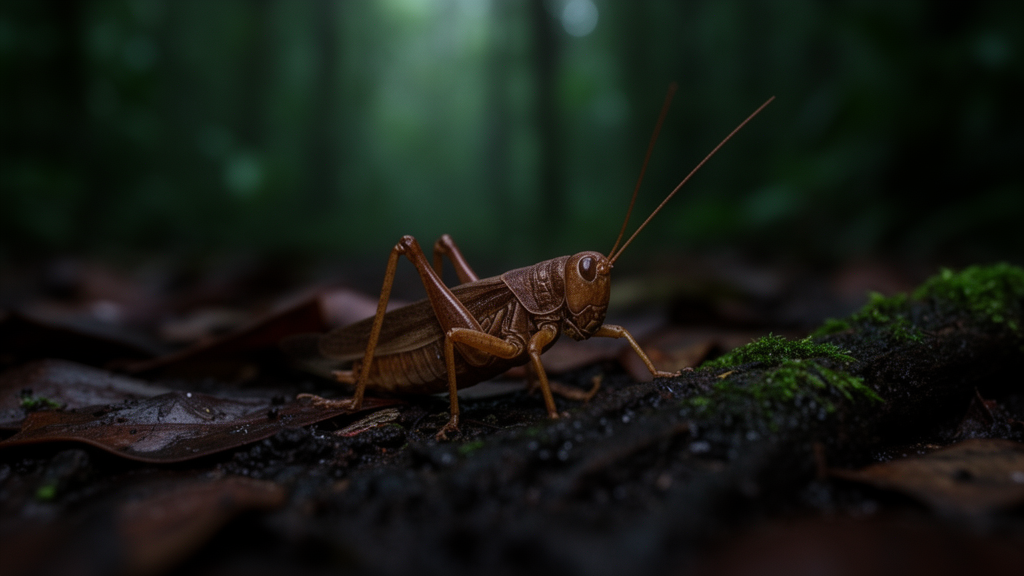
A taxonomic study of South American crickets describes three new species in the genus Apterotrypa: A. assymmetrica, A. hepatica and A. endolongata. The descriptions represent the first Brazilian records of the genus and double its known species diversity from three to six.
The study is based on preserved museum specimens collected in Ceará, Bahia and Santa Catarina. Researchers examined external morphology, including the head, pronotum, metanotum, legs, abdominal terminal structures and ovipositor, as well as the male phallic complex and female copulatory papilla. The study is a taxonomic investigation rather than a behavioral or ecological analysis, and no observations of the crickets’ ecology, courtship, mating or communication were reported.
Apterotrypa belongs to the family Oecanthidae and the tribe Neometrypini, a South American group generally characterized by the absence of tympanal organs and stridulatory apparatus. Members of Apterotrypa are also entirely wingless, and the posterior margin of the pronotum covers the metanotum. These unusual traits prompted an emended diagnosis of the genus, including details of its male and female genitalia.
A. assymmetrica was established from Pacoti, Ceará, with male and female paratypes. A. hepatica was described from Itamaraju, Bahia, based on material collected in Parque Nacional e Histórico do Monte Pascoal. A. endolongata was described from Corupá, Santa Catarina, from specimens collected at RPPN Emílio Batistella. The holotypes are to be deposited at the Museu Nacional, Universidade Federal do Rio de Janeiro, and paratypes at the Museu de Zoologia da Universidade de São Paulo.
Male genitalia were cleared in an aqueous 10% potassium hydroxide solution before examination with stereomicroscopes. Images were produced with stereomicroscopes and cameras, and images taken at different focal planes were stacked to document the structures. The authors compared the new species with the original descriptions and illustrations of A. noeli, A. mitarakensis and A. guyanensis.
Although the new species share the absence of wings, tympana and stridulatory apparatus, as well as broadly similar body form and leg spination, they can be distinguished through features of the supra-anal and subgenital plates and, especially, genital anatomy. The authors’ identification key uses the presence or absence of ocelli, body coloration, metanotal markings, the form of the male genitalia and features of the copulatory papilla. A. mitarakensis is the only known species with ocelli.
Each new species has a name referring to a diagnostic anatomical feature. A. assymmetrica was named for the conspicuous asymmetry of the male ectophallic fold in dorsal and ventral views. A. hepatica was named because a lateral view of the male genitalia resembles an illustration of a human liver. A. endolongata refers to its elongated endophallic sclerite. Other distinctions include the number and arrangement of metanotal spots or lines, genital asymmetry, the proportions of the membranous and sclerotized portions of the pseudepiphallic lateral lobes, and the shape of the copulatory papilla.
The study reports metanotal structures in all three new species, including structures in males and comparable projections in females of A. assymmetrica and A. endolongata. Similar structures in some Eidmanacris crickets have documented glandular and reproductive functions, but the authors did not establish the anatomy or function of the structures in Apterotrypa. They hypothesize that the male structures may have a similar reproductive function and state that further studies are needed to determine their glandular nature and role. The female projections may be vestigial, but that interpretation remains unconfirmed.
The authors also note that the earlier species were described from pinned, dried specimens, which may have obscured metanotal structures concealed beneath the pronotum. It therefore remains unresolved whether A. noeli, A. mitarakensis and A. guyanensis possess comparable structures, limiting confidence in treating the feature as diagnostic across the entire genus. Beyond taxonomy, the study provides a distribution map and an updated identification key for all six recognized species. The genus is recorded from Bolivia, French Guiana and Brazil, and the authors state that more species may remain to be discovered.
The authors attribute the difficulty of finding Apterotrypa partly to its lack of acoustic communication, its occurrence in bushes and trees, and the resemblance of these small, wingless adults to cricket nymphs. However, no behavioral observations establish how the crickets communicate, mate or interact. Whether vibrational communication substitutes for the absent acoustic mechanisms remains a hypothesis rather than a demonstrated finding.
Subject of Research: Taxonomic description of three new Apterotrypa cricket species from Brazil
Article Title: Discovering the diversity of the genus Apterotrypa Gorochov ( Orthoptera , Oecanthidae , Neometrypini )
Article References: Tonon de Almeida, V., Nihei, S. S., Souza-Dias, P. G. B., & Denadai de Campos, L. (2026). Discovering the diversity of the genus Apterotrypa Gorochov (Orthoptera, Oecanthidae, Neometrypini). Journal of Orthoptera Research, 35(1), 87-102. https://doi.org/10.3897/jor.35.158842
Image Credits: AI Generated
Keywords: Apterotrypa, Orthoptera, Oecanthidae, Neometrypini, taxonomy, wingless crickets, Brazil, species description, insect morphology, Discovering, diversity, genus
Cite Scienmag News
Gavin Prescott. (October 20, 2026). Taxonomic study describes three new wingless cricket species from Brazil. Scienmag. https://scienmag.com/taxonomic-study-describes-three-new-wingless-cricket-species-from-brazil/
Gavin Prescott. "Taxonomic study describes three new wingless cricket species from Brazil." Scienmag, 20 October 2026, https://scienmag.com/taxonomic-study-describes-three-new-wingless-cricket-species-from-brazil/. Accessed 20 October 2026.
Gavin Prescott. "Taxonomic study describes three new wingless cricket species from Brazil." Scienmag. October 20, 2026. https://scienmag.com/taxonomic-study-describes-three-new-wingless-cricket-species-from-brazil/


