


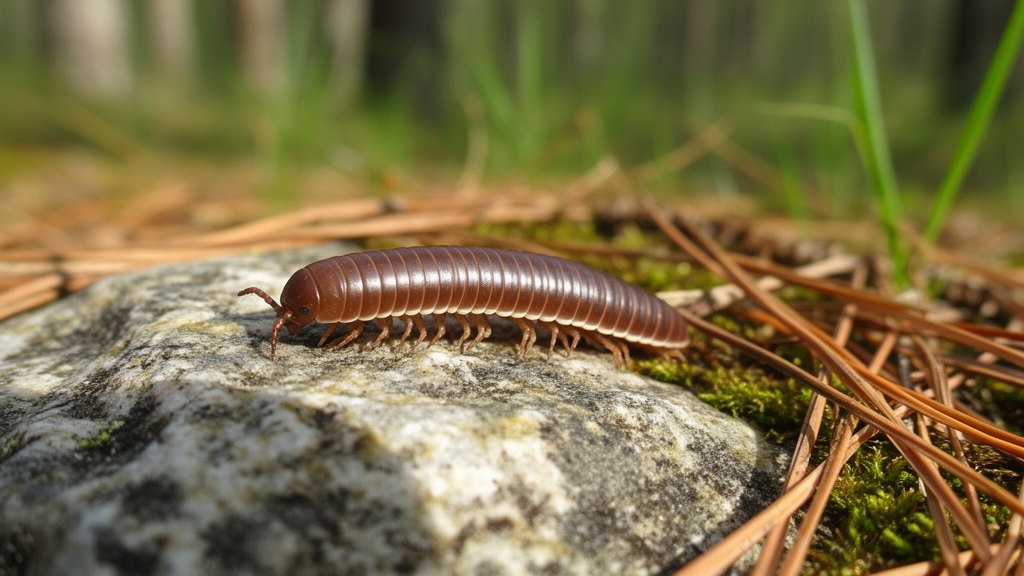
A descriptive taxonomic and morphological study of millipedes collected in 2024 from the Altai Mountains of Kazakhstan established the new monospecific genus Triramidesmus and described its sole species, Triramidesmus kazakhstanus . The genus is characterized by three-branched male gonopod telopodites and by an unusual, nearly complete reduction of the second leg pair in adult females. The specimens were collected near Verkhnie Tainty Village in the Kalba Mountain Range of East Kazakhstan Region, where the species was found in leaf litter and upper soil at an elevation of 1,120 metres.
The description was based on one male holotype and 49 paratypes collected by Yu.V. Dyachkov. The paratypes comprised 40 adult males, two adult females, three subadult males and four subadult females; the holotype brings the total number of adult males in the type series to 41.
The holotype and most paratypes are housed in the Zoological Museum of Lomonosov Moscow State University in Moscow, while duplicate paratypes are deposited at Altai State University in Barnaul. The specimens were preserved in 75% alcohol. Researchers examined the material using digital stereomicroscopy, light microscopy and scanning electron microscopy.
They photographed the external anatomy, including the head, antennae, body rings, legs and female genital structures, and prepared genital images with a scanning electron microscope. Digital image stacking and figure plates were used during image processing, while an online photo-measuring tool was used for approximate measurements. A distribution map was composed in QGIS.
The study was taxonomic and morphological rather than an experiment on mating behavior, development or reproductive function. Adults of both sexes had 20 body rings, comprising the collum, 17 podous rings, one apodous ring and the telson. Their midbody prozona and metazone widths were 0.75 and 1.1 millimetres, respectively.
Preserved animals were pinkish beige with lighter legs. Other documented features included incised paraterga, minute dorsal knobs and tubercles bearing setae, a normal pore formula and four elongated spinnerets at the tip of the epiproct. Placement in the family Polydesmidae required particular consideration.
Some features of the male gonopods initially suggested an affinity with the trichopolydesmid genus Hingstonia , whose species have two- to four-branched telopodites and short, simple, spiniform solenomeres. Triramidesmus kazakhstanus , however, has a distinct accessory seminal chamber at the base of and partly within its solenomere. The study authors treated this feature, which they described as typical only of Polydesmidae in the material assessed, as decisive for the family assignment.
The new taxon resembles Schizoturanius tabescens , a species reported from southwestern Siberia with outlying records along the Yenisei River valley and isolated reports from the Tyumen and Irkutsk oblasts. Both taxa have a small body and incised paraterga, but their male genital structures differ: T. kazakhstanus has a tripartite acropodite and a short seminal groove, whereas S. tabescens has a bipartite acropodite and a long seminal groove. The genus name Triramidesmus refers to the three-branched gonopod telopodites and combines that feature with the suffix “-desmus,” which is commonly used for genera in Polydesmida.
The most unusual observation concerned the second legs of adult females. They were represented only by small telopodite remnants on flattened, subquadrangular coxae that cover the vulvar aperture. Both known adult females showed this condition, supporting the authors’ interpretation that it is a normal species characteristic rather than an individual abnormality.
Subadult females at stadium VII retained normal second walking legs, indicating that the reduction occurs during the final molt from subadult stadium VII to adult stadium VIII. Because the adult females had functional vulvae, the authors suggested that males might close the aperture with the flattened coxae. The authors proposed that the reduced second legs may facilitate copulation, drawing a comparison with three species of Tasmaniosoma in which females reportedly lose their second legs and the removal sites can heal.
They also suggested that the condition could be relevant to sexual competition. These interpretations remain functional hypotheses: the study did not directly observe mating, experimentally test whether the reduced legs facilitate reproduction, or establish the genetic or developmental mechanism responsible for the reduction. Interpretation was also limited by the type series, which contained 41 adult males but only two adult females, an imbalance the authors described as strange and interesting.
They said additional research was needed rather than drawing a firm conclusion from the small number of adult females.
Subject of Research: Taxonomic and morphological description of a new millipede genus from Kazakhstan’s Altai Mountains
Article Title: Losing legs to facilitate sex: Triramidesmus gen. nov., a new remarkable monospecific genus of the millipede family Polydesmidae ( Diplopoda , Polydesmida ) from the Altai Mountains of northeastern Kazakhstan
Article References: Nefediev, P. S., Golovatch, S. I., & Nefedieva, J. S. (2026). Losing legs to facilitate sex: Triramidesmus gen. nov., a new remarkable monospecific genus of the millipede family Polydesmidae (Diplopoda, Polydesmida) from the Altai Mountains of northeastern Kazakhstan. ZooKeys, 1291, 155-169. https://doi.org/10.3897/zookeys.1291.210036
Image Credits: AI Generated
DOI: 10.3897/zookeys.1291.210036
Keywords: Triramidesmus kazakhstanus, new millipede genus, Polydesmidae, Diplopoda, Altai Mountains, Kazakhstan, taxonomy, morphology, reduced legs, animal anatomy, Losing, legs
Cite Scienmag News
Drew Townsend. (October 20, 2026). Taxonomic study describes Kazakh millipede with reduced second legs in adult females. Scienmag. https://scienmag.com/taxonomic-study-describes-kazakh-millipede-with-reduced-second-legs-in-adult-females/
Drew Townsend. "Taxonomic study describes Kazakh millipede with reduced second legs in adult females." Scienmag, 20 October 2026, https://scienmag.com/taxonomic-study-describes-kazakh-millipede-with-reduced-second-legs-in-adult-females/. Accessed 20 October 2026.
Drew Townsend. "Taxonomic study describes Kazakh millipede with reduced second legs in adult females." Scienmag. October 20, 2026. https://scienmag.com/taxonomic-study-describes-kazakh-millipede-with-reduced-second-legs-in-adult-females/


