


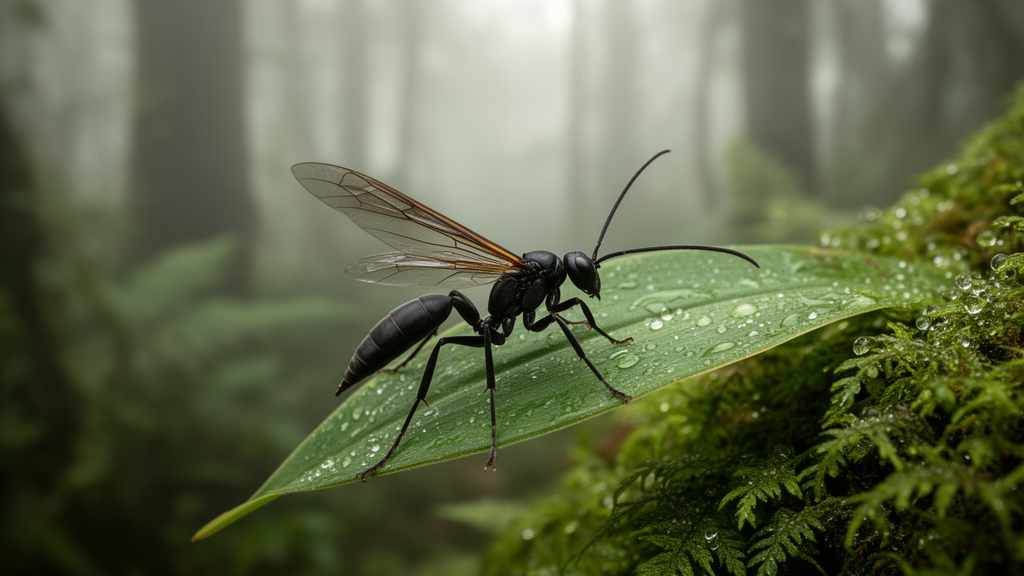
A taxonomic review and DNA-barcode analysis documented five species of the parasitoid wasp subgenus Netelia (Paropheltes) in Taiwan for the first time, including a newly described species, Netelia (Paropheltes) dalupalringi Chen, Konishi & Shiao. The study also found that Paropheltes did not form a monophyletic group in a COI-based phylogeny of Netelia.
Researchers examined Taiwanese and comparative museum specimens using external morphology, including male genitalia, and analyzed mitochondrial cytochrome c oxidase I (COI) sequences. The analysis included COI sequences from 10 Taiwanese specimens representing three Paropheltes species, together with 428 sequences from 190 Barcode Index Number clusters retrieved from the Barcode of Life Data Systems. Maximum-likelihood phylogenies and two molecular species-delimitation methods were then used to test species limits and the classification of the subgenus.
The four species previously described and newly recorded from Taiwan were N. (Paro.) fulginosa Konishi, 1996, N. (Paro.) guptai Kaur & Jonathan, 1979, N. (Paro.) savchenkoi Tolkanitz, 1981, and N. (Paro.) yui Konishi, 2000. Their identifications were based on combinations of body structure, wing venation, coloration and male genitalia, with comparisons to original descriptions, type specimens and other documented material. N. yui did not have molecular data in the study, but the authors recognized it as a separate species on the basis of its morphology.
The new species, N. (Paro.) dalupalringi, was described from material collected in Kaohsiung, Nantou and Hualien. Its male genitalia have a parallel-sided gonostyle with a rounded, blunt apex, a semi-circular pad projecting dorso-basally, a brace that is parallel-sided basally and narrower apically, and a dorsal submarginal spine. It resembles N. (Paro.) caucasica in the general form of the gonostyle and pad but differs in gonostyle shape, the presence of the spine and its paler mesosoma. The name derives from Lake Dalupalringi, the holotype locality in Kaohsiung City.
Both molecular species-delimitation approaches, Assemble Species by Automatic Partitioning and Bayesian Poisson Tree Processes, were consistent with the morphological treatment of the taxa for which molecular data were available. In the COI tree of Paropheltes, each operational taxonomic unit formed a distinct lineage with strong nodal support. The automatic partitioning analysis selected a threshold K2P distance of 0.13731 for the all-included dataset and 0.26493 for the Paropheltes dataset; all mean pairwise K2P distances among the sampled Paropheltes operational taxonomic units in the latter dataset exceeded 0.05, and most exceeded 0.15.
The broader phylogeny did not recover Paropheltes as a monophyletic group. N. guptai, N. millieratae, N. inedita, N. caucasica and one BOLD cluster each formed strongly supported independent lineages, while other sampled Paropheltes occurred in separate clusters. This result agrees with an earlier morphology-based analysis that also recovered the subgenus as polyphyletic. The authors noted that its boundary remains ambiguous with the subgenera Longiterebates and Prosthodocis and that some diagnostic characters, including the occipital carina and the position of forewing vein 1cu-a relative to M&RS, vary within Paropheltes. COI alone may have limited resolution at deeper nodes because of genetic saturation and other potential biases, so the result provides further evidence for reclassification rather than a proposed revision.
Alongside the taxonomy, the study proposed two methods for improving the observation of male genitalia. The first places black paper or flannel behind the specimen or adjusts the transmitted light source to make membranous structures, including the pad, easier to see. The second stains one side of the gonostyle for a few seconds with undiluted ink from a black rollerball pen or another dye such as chlorazol black E, followed by washing in water. The staining method is particularly useful when over-maceration in potassium hydroxide has made the pad too translucent for a dark background to reveal its outline clearly.
The authors recommended line drawings to complement photographs and recommended consistent conventions for displaying the structures, including stippling for membranous areas, dashed lines for concealed structures and bold lines for the pad outline. They also proposed this approach for representing the diversity of genital morphology in Netelia. The review documented 19 males and six females, including the holotype, for the new species and supplied diagnostic keys for the Taiwanese Paropheltes species, with the male key emphasizing genital characters and the female key using body structure and coloration.
The Taiwanese records show that Paropheltes occurs in mountainous habitats, including sites from about 1,300 to 2,800 meters elevation. The authors associated this pattern with the concentration of the subgenus’s described species in the Palearctic and Nearctic regions, where 36 of 48 species, or 75%, occur, and with previously described Oriental species found mainly at high elevations in India and the Tibetan Plateau. These distributional observations suggest that the Taiwanese fauna has been incompletely sampled, but the study did not quantify the island’s full Netelia diversity.
Subject of Research: Taxonomic and molecular review of the parasitoid wasp subgenus Netelia (Paropheltes) in Taiwan
Article Title: Review of the subgenus Paropheltes Cameron of genus Netelia Gray ( Hymenoptera , Ichneumonidae , Tryphoninae ) from Taiwan, with a proposal for improving male genitalia observations
Article References: Chen, H.-P., Konishi, K., & Shiao, S.-F. (2026). Review of the subgenus Paropheltes Cameron of genus Netelia Gray (Hymenoptera, Ichneumonidae, Tryphoninae) from Taiwan, with a proposal for improving male genitalia observations. Journal of Hymenoptera Research, 99, 1-46. https://doi.org/10.3897/jhr.99.167713
Image Credits: AI Generated
Keywords: Netelia, Paropheltes, Taiwan, taxonomy, new species, Ichneumonidae, COI barcoding, phylogeny, male genitalia, parasitoid wasps, Review, subgenus
Cite Scienmag News
Margaret Porter. (October 20, 2026). Taxonomic review records five Netelia (Paropheltes) species in Taiwan and finds the subgenus polyphyletic. Scienmag. https://scienmag.com/taxonomic-review-records-five-netelia-paropheltes-species-in-taiwan-and-finds-the-subgenus-polyphyletic/
Margaret Porter. "Taxonomic review records five Netelia (Paropheltes) species in Taiwan and finds the subgenus polyphyletic." Scienmag, 20 October 2026, https://scienmag.com/taxonomic-review-records-five-netelia-paropheltes-species-in-taiwan-and-finds-the-subgenus-polyphyletic/. Accessed 20 October 2026.
Margaret Porter. "Taxonomic review records five Netelia (Paropheltes) species in Taiwan and finds the subgenus polyphyletic." Scienmag. October 20, 2026. https://scienmag.com/taxonomic-review-records-five-netelia-paropheltes-species-in-taiwan-and-finds-the-subgenus-polyphyletic/


