


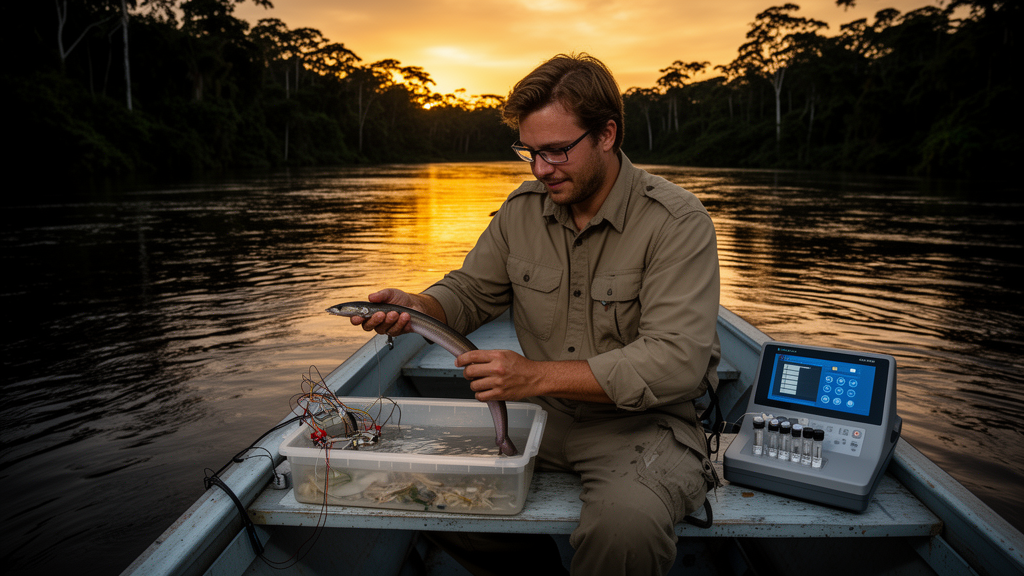
A reference library of nearly full-length mitochondrial 12S ribosomal RNA gene sequences covers 152 species of Neotropical electric fishes in the order Gymnotiformes, spanning all five families and 30 of 35 genera. The study reports that the marker distinguished the great majority of species, while analysis of two shorter 12S regions commonly used in environmental DNA metabarcoding left five species pairs indistinguishable even when both regions were considered together.
Gymnotiformes comprise more than 250 species distributed across Central and South America, with peak diversity in the Amazon and Orinoco river basins. Many inhabit deep channels or hard-to-sample substrates and are active at night, which complicates conventional field surveys. These characteristics make genetic reference data particularly useful for identifying gymnotiform sequences obtained from environmental samples, although the new study assessed barcode performance and did not conduct an environmental DNA field survey.
Before this work, 38 gymnotiform species had verified 12S sequences in GenBank, and 25 of those species were represented only by shorter fragments of the gene. More than half of the available records belonged to the genus Electrophorus. The new library added 122 species, increasing the number of gymnotiform species with 12S sequence data fourfold. Its broader coverage is also relevant because many older barcodes predate major taxonomic revisions, while nearly 100 gymnotiform species have been described during the past 15 years.
To assemble the library, the researchers obtained 13 specimens from their species’ type localities, along with 18 paratypes and one holotype. For the remaining 120 specimens, they prioritized material located close to the respective type localities. Almost all tissues came from museum voucher specimens. Each specimen was examined and identified morphologically using the original species descriptions as diagnostic references, and the new sequences were deposited in GenBank.
DNA was extracted from preserved tissues, and the investigators used multiple primer sets to amplify a fragment spanning nearly the full 12S gene across the major gymnotiform lineages. The main primer pair produced an approximately 1,130-base-pair amplicon that extended into the adjacent tRNA-Val and 16S rRNA genes. Taxon-specific primers were used where this pair did not amplify the sample. Following polymerase chain reaction and Sanger sequencing, assembly and trimming produced an average sequence length of 985 base pairs.
The researchers aligned the new sequences and reconstructed a maximum-likelihood tree, which broadly agreed with established hypotheses of gymnotiform systematics. Most genera were monophyletic, and four of the five families were recovered as monophyletic. Sternopygidae appeared polyphyletic in the analysis, although the study notes the limited ability of a single mitochondrial marker to resolve deeper phylogenetic relationships.
Across the full reference barcodes, the mean minimum pairwise sequence divergence between species was 2.91%. Two species pairs had complete sequence identity: Sternarchella duccis with Sternarchella orthos and Gymnotus varzea with Gymnotus chaviro. Fourteen additional pairs, as well as a cluster of five Sternarchella species, had divergence below 1%. By comparison, the cited COI dataset for 167 gymnotiform species or sequences had an average minimum divergence of 6.36%. Because the study did not quantify intraspecific diversity, it could not determine whether a 12S barcoding gap exists for the order.
The investigators also evaluated two shorter 12S regions used in metabarcoding. The roughly 170-base-pair MiFish-U region distinguished most library species but had identical sequences for 15 species pairs. The approximately 65-base-pair teleo region separated 10 of those 15 pairs. Combining the two regions left five pairs indistinguishable: Gymnotus arapaima with G. ucamara, G. varzea with G. chaviro, Hypopygus nijsseni with H. isbruckeri, Sternarchella orthos with S. duccis and Sternarchella rex with S. calhamazon.
Four of the five unresolved pairs have partial or no overlap in their known distributions, so locality information may help distinguish them; the distributions of S. rex and S. calhamazon overlap. The authors recommend using both 12S metabarcoding regions together to reduce ambiguity and describe the remaining pairs as a practical limit of the currently examined loci. The near-full-length reference sequences may also support the design of additional primers. Broader sampling across each species’ geographic range is still needed to assess intraspecific variation, represent genetically divergent lineages and establish a species-level barcoding gap.
Subject of Research: Taxonomic resolution and environmental DNA barcode coverage for Neotropical gymnotiform fishes
Article Title: A 12S rDNA barcode reference library for Neotropical electric fishes ( Teleostei , Gymnotiformes )
Article References: Juby, N. D., Crampton, W. G. R., & Lovejoy, N. R. (2026). A 12S rDNA barcode reference library for Neotropical electric fishes (Teleostei, Gymnotiformes). Metabarcoding and Metagenomics, 10, Article e181378. https://doi.org/10.3897/mbmg.10.181378
Image Credits: AI Generated
Keywords: Gymnotiformes, 12S rDNA barcoding, environmental DNA, metabarcoding, Neotropical electric fishes, genetic reference library, MiFish-U, teleo barcode, species identification, rDNA, barcode, reference
Cite Scienmag News
Juliet Wilcox. (October 20, 2026). 12S rDNA reference library resolves most Neotropical electric fish species. Scienmag. https://scienmag.com/12s-rdna-reference-library-resolves-most-neotropical-electric-fish-species/
Juliet Wilcox. "12S rDNA reference library resolves most Neotropical electric fish species." Scienmag, 20 October 2026, https://scienmag.com/12s-rdna-reference-library-resolves-most-neotropical-electric-fish-species/. Accessed 20 October 2026.
Juliet Wilcox. "12S rDNA reference library resolves most Neotropical electric fish species." Scienmag. October 20, 2026. https://scienmag.com/12s-rdna-reference-library-resolves-most-neotropical-electric-fish-species/


