

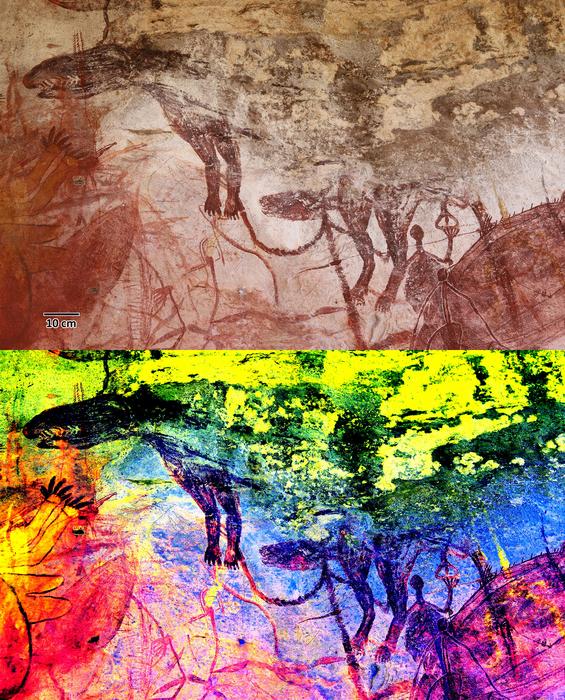
The enigmatic striped marsupial commonly known as the Tasmanian tiger, or thylacine, has fascinated both scientists and the public for decades. Once believed to have vanished from mainland Australia millennia ago, recent discoveries have begun to challenge established timelines regarding the species’ presence and cultural significance. A groundbreaking research project, spearheaded by Professor Paul Taçon, Chair in Rock Art Research at Griffith University, has unveiled newly documented rock art in northern Australia’s Arnhem Land, depicting thylacines and Tasmanian devils. These findings offer unprecedented insight into the historical biogeography of these species and their enduring influence on Indigenous cultures.
The study focused on two significant sites, Awunbarna and Injalak Hill, located in the northwest Arnhem Land region of the Northern Territory. Here, a total of fourteen new thylacine images and two depicting Tasmanian devils were meticulously cataloged in various traditional Aboriginal art styles. The artworks, crafted predominantly with red ochre—sometimes yellow—and white pipe clay pigments, present a complex chronology. Radiometric and stylistic analysis suggests some paintings may be as old as 15,000 years, whereas others, particularly those featuring white pigments which degrade relatively rapidly, are likely under a millennium in age. This temporal range raises compelling questions about when these animals last inhabited the Australian mainland.
Previously, the prevailing scientific consensus held that thylacines and Tasmanian devils disappeared from mainland Australia roughly 3,000 years ago. However, the presence of rock art estimated to be younger than 1,000 years opens the possibility that these species persisted much longer in more remote northern regions than archaeological and paleontological records alone have indicated. Such a hypothesis is transformative, especially given the paucity of direct physical evidence supporting extended survival on the mainland during this period.
Professor Taçon emphasized that while thylacine imagery vastly outnumbers that of the Tasmanian devil—with over 160 depictions documented compared to just 25 for devils—both animals held significant cultural value. The disparity in artistic representation hints at a broader geographic distribution and perhaps deeper symbolic importance of the thylacine among Aboriginal groups. This assertion is supported by ethnographic records and oral histories, which depict the thylacine, locally named Djankerrk, as a creature not only familiar to Indigenous peoples but also integral to cosmological narratives.
Importantly, the possibility that some artworks represent direct observation of living thylacines, rather than purely mythological or symbolic images, challenges assumptions about the species’ extinction timeline. If Aboriginal artists painted from firsthand encounters, the implication is that thylacines survived in Arnhem Land well past their accepted extinction on the mainland. Conversely, the artworks might also represent cultural memory or artistic homage inspired by earlier renditions. Such nuances highlight the complexity of interpreting rock art as both historical record and living tradition.
The use of red ochre, a durable and long-lasting pigment, alongside white pipe clay, which fades more readily, complicates chronological assessments but allows researchers to differentiate artworks’ relative ages. The retouching of some paintings over generations, as documented by Dr. Andrea Jalandoni, co-author and Griffith Centre for Social and Cultural Research researcher, underscores a dynamic relationship between people and these iconic animals. This act of renewing images maintains the animals’ presence within cultural consciousness despite their physical disappearance, illustrating rock art’s role as a living repository of knowledge.
Oral histories deepen the understanding of the thylacine’s cultural and spiritual resonance. In Arnhem Land traditions, thylacines were often described as companions or pets of the Rainbow Serpent—an essential figure in many Aboriginal cosmologies—and were associated with aquatic environments and swimming behaviors. These narratives connect the animals to specific environmental contexts, offering potential ecological insights alongside spiritual significance.
Joey Nganjmirra, a Djalama man from Western Arnhem Land and co-author of the study, shared that stories passed down from his ancestors recounted hunting alongside thylacines. Such accounts provide an invaluable perspective, grounding scientific inquiry in lived Indigenous experiences and emphasizing the importance of collaborative research frameworks that respect and incorporate traditional knowledge systems.
The interdisciplinary approach of this project—combining archaeological observation, ethnographic context, and Indigenous storytelling—exemplifies how scientific understanding can be enriched through cultural collaboration. It reframes the thylacine not as a relic of the past but as a creature of ongoing significance whose image and presence persist vividly in Aboriginal art and collective memory.
Moreover, this research compels a reevaluation of extinction chronologies and biogeographical distributions in Australia’s pre-colonial period. If thylacines and Tasmanian devils survived longer than previously acknowledged, it suggests that environmental or anthropogenic pressures may have varied regionally, affecting species’ survival in nuanced ways. This new evidence contributes to broader debates in paleoecology and conservation biology regarding species resilience, habitat connectivity, and human-wildlife interactions over millennia.
The findings, published in the journal Archaeology in Oceania under the title “The Devil Is in the Detail: Tasmanian Devil and Tasmanian Tiger Paintings From Awunbarna and Injalak Hill, Northern Territory, Australia,” offer a seminal contribution to the field of rock art research and Australian natural history. The study exemplifies the power of integrating artistic heritage with scientific methodologies to uncover hidden chapters of ecological and cultural histories.
In conclusion, the rediscovery of detailed thylacine and Tasmanian devil imagery in Arnhem Land reasserts the profound link between Indigenous Australians and their natural environment. These rock paintings do not merely commemorate extinct species; they act as vibrant, living narratives that affirm the complex interplay between humans and marsupials in Australia’s deep past. As the thylacine lives on as Djankerrk in contemporary artworks and stories, this research embodies a meaningful reconciliation of science and tradition, illuminating a more nuanced understanding of extinction, survival, and cultural memory.
Subject of Research: People
Article Title: The Devil Is in the Detail: Tasmanian Devil and Tasmanian Tiger Paintings From Awunbarna and Injalak Hill, Northern Territory, Australia
News Publication Date: 31-Mar-2026
Web References: http://dx.doi.org/10.1002/arco.70024
References: Taçon, P. S. C., Jalandoni, A., Nganjmirra, J. (2026). The Devil Is in the Detail: Tasmanian Devil and Tasmanian Tiger Paintings From Awunbarna and Injalak Hill, Northern Territory, Australia. Archaeology in Oceania.
Image Credits: photo: Craig Banggar
Keywords: Archaeology, Aboriginal rock art, Thylacine, Tasmanian tiger, Tasmanian devil, Arnhem Land, Indigenous culture, extinction timelines, paleoecology, marsupials


