

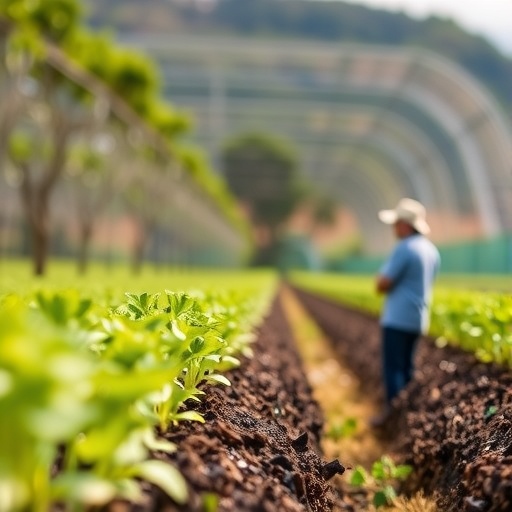
In the battle against climate change, carbon farming has emerged as a promising approach to mitigate carbon emissions while simultaneously supporting ecological and community resilience. Recently, a landmark study led by Bhattarai, Christie-Whitehead, Drake, and their colleagues has highlighted the immense untapped potential of tailoring carbon farming practices specifically to the Australian landscape. Published in Nature Communications in 2026, this work emphasizes that customized carbon farming strategies not only improve carbon sequestration but also unlock a wider array of environmental, economic, and social co-benefits.
Carbon farming, broadly defined, involves land management practices aimed at increasing the amount of carbon stored in soil and vegetation. Techniques such as reforestation, agroforestry, biochar application, and improved grazing management promote the uptake of atmospheric CO2, converting it into organic matter stable within terrestrial ecosystems. While carbon farming has gained traction globally, the authors argue that a one-size-fits-all approach dramatically limits its potential impact, especially given the diversity of Australian biomes ranging from arid deserts to temperate forests.
The researchers conducted extensive analyses across different Australian regions, integrating soil carbon data, vegetation dynamics, climate models, and socio-economic factors. Their findings underscore the necessity of region-specific tailoring, showing that what works to maximize carbon stock in one ecosystem may be counterproductive or less efficient in another. For example, deploying reforestation in arid zones without considering water availability might strain local resources, while agroforestry in temperate areas can simultaneously boost biodiversity and agricultural yield, creating a win-win scenario.
Beyond carbon capture, the study reveals a spectrum of co-benefits that arise when carbon farming is contextually optimized. Enhanced soil health leads to better water retention and nutrient cycling, directly benefiting crop productivity and reducing the need for chemical inputs. These improvements help farmers become more resilient to climate extremes such as drought and flooding. Furthermore, increased vegetation cover supports native wildlife habitats, fostering biodiversity that sustains ecosystem functions like pollination and pest control.
Economic implications are equally significant. The researchers highlight that appropriately tailored carbon farming practices can diversify income streams for rural communities through carbon credits, sustainable timber harvesting, or ecotourism development. This diversification helps buffer farmers against market shocks and fluctuating commodity prices. Moreover, indigenous communities often possess invaluable traditional ecological knowledge that can guide the design of interventions, promoting social inclusion and cultural heritage preservation alongside environmental goals.
The paper also addresses policy frameworks critical to scaling carbon farming successfully. The authors advocate for adaptive governance models that encourage participatory approaches, aligning incentives with local stakeholder needs. They argue that rigid, top-down regulations frequently hamper innovation and overlook site-specific challenges. Flexible policies enabling experimental pilot projects, coupled with robust monitoring and verification mechanisms, can accelerate the refinement and uptake of tailored carbon farming strategies.
Technological advancements further bolster this vision. Precision agriculture tools such as remote sensing, drone surveys, and AI-driven soil analysis allow for detailed mapping of carbon stocks and identification of optimal intervention zones. This data-driven approach minimizes guesswork and improves resource allocation efficiency. Additionally, advances in biochar technology and soil microbiome engineering offer promising avenues to enhance carbon stabilization in soils more effectively.
Importantly, the study contends that broader environmental challenges such as biodiversity loss, land degradation, and water scarcity are intricately linked with carbon dynamics. Integrated management practices that address these multiple pressures simultaneously can break the cycle of degradation. By improving ecosystem services holistically, tailored carbon farming contributes to regenerating landscapes that underpin agricultural productivity and community wellbeing over the long term.
However, realizing this potential requires overcoming several obstacles. The authors note that land tenure uncertainty, lack of awareness, and upfront costs remain significant barriers for many Australian landholders. Capacity-building initiatives, extension services, and accessible financing mechanisms are necessary to empower farmers and indigenous custodians. Furthermore, establishing clear metrics for co-benefits beyond carbon sequestration would help attract investment from stakeholders interested in social and ecological outcomes.
The study also calls for international collaboration, recognizing that carbon farming tailored to Australian conditions can serve as a model for other countries with diverse ecosystems. Sharing knowledge and technology globally amplifies collective climate action and biodiversity conservation efforts. At the same time, it underscores the ethical imperative to respect indigenous sovereignty and local values in co-developing carbon farming frameworks.
This research arrives at a critical juncture, as Australia and the world race to meet ambitious climate targets under the Paris Agreement. The authors argue that carbon farming, when carefully designed and implemented, can become a cornerstone of national mitigation strategies. It offers a proactive solution combining science, traditional knowledge, and community engagement to address environmental degradation while fostering economic resilience.
Furthermore, the long-term monitoring data presented highlight the dynamic nature of carbon pools and ecosystem responses to management changes. This understanding challenges static assumptions and encourages adaptive learning, ensuring that carbon farming practices remain effective under shifting climatic and social contexts. By embedding flexibility into both practice and policy, tailored carbon farming embraces complexity and promotes sustainability.
In conclusion, Bhattarai and colleagues offer a compelling vision for the future of carbon farming in Australia—a future where interventions are informed by ecological nuances and social realities. By moving away from generic prescriptions to nuanced, place-based solutions, carbon farming can deliver multiple dividends, from climate mitigation to rural development and biodiversity revival. This holistic approach exemplifies the multi-dimensional strategies needed to tackle interconnected global challenges.
As the global community seeks scalable and equitable climate solutions, the insights from this study resonate beyond Australia’s borders. Tailored carbon farming represents a paradigm shift towards regenerative agriculture that honors ecosystem variability and empowers local stakeholders. This transformative potential places carbon farming at the forefront of sustainable land management innovations, promising a more resilient and carbon-neutral future for generations to come.
The implications of this research are profound. Customized carbon farming not only elevates carbon sequestration efficacy but also nurtures ecosystems and communities, creating a legacy of stewardship in a rapidly changing world. Embracing this complexity will be key to unlocking the full promise of nature-based climate solutions, positioning Australia as a leader in the sustainable land use revolution.
Subject of Research: Tailored carbon farming practices in Australia and their multi-dimensional co-benefits for climate mitigation, biodiversity, and rural livelihoods.
Article Title: Tailoring Australian carbon farming can realise greater co-benefits.
Article References:
Bhattarai, G., Christie-Whitehead, K.M., Drake, A. et al. Tailoring Australian carbon farming can realise greater co-benefits.
Nat Commun (2026). https://doi.org/10.1038/s41467-026-68628-5
Image Credits: AI Generated


