

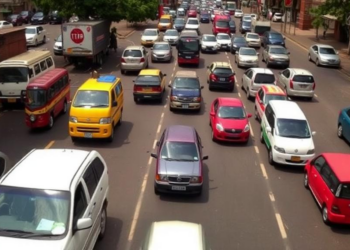
Harare’s Gridlock Is an Economic Squeeze, and a Planning Matrix May Untangle It
A new study applies a log-frame evaluation to Harare's congestion, arguing that the city's gridlock stems from an extreme concentration ...
A new study applies a log-frame evaluation to Harare's congestion, arguing that the city's gridlock stems from an extreme concentration ...

A Finnish study of 673 preschool-aged children finds that frequent parent-child visits to yards and nature are linked to less ...
A satellite analysis of 456 green patches in Lucknow, India, shows that urban cooling rises with patch size up to ...
A new synthesis in Current Psychology unifies environmental psychology, public health and urban studies into a framework showing that the ...
A machine learning study of 25 lakes in Da Nang, Vietnam, quantifies urban lake cooling with SHAP interpretability, finding the ...
A decade of satellite imagery and surveys shows Greater Kumasi lost nearly a third of its natural areas while most ...
A systematic review of 139 studies reclassifies urban green infrastructure into ten functional types, offering high-density cities a mechanism-based playbook ...
A systematic review of 58 studies finds that environmental noise—dominated by transportation sources—is tied to economic losses, psychological distress, sleep ...
Researchers in Japan used a Weibull survival model and four-dimensional GIS data to forecast building-level demolition probabilities and construction material ...
Microsimulation of Brazil's HIDS-UNICAMP innovation district shows through traffic, not the district itself, could overwhelm its planned roads, and that ...

Embark on a thrilling journey of discovery with Scienmag.com—your ultimate source for cutting-edge breakthroughs. Immerse yourself in a world where curiosity knows no limits and tomorrow’s possibilities become today’s reality!