


Scanning Tunnelling Luminescence Maps Exciton Emission from Single Defects in MoS2
Scanning tunnelling luminescence resolves exciton emission from single atomic defects in monolayer MoS2, identifying carbon–hydrogen complexes as the source of ...
Scanning tunnelling luminescence resolves exciton emission from single atomic defects in monolayer MoS2, identifying carbon–hydrogen complexes as the source of ...

WS2 waveguide microcavities generate spin-polarized exciton–polariton currents that travel over 90 micrometers at room temperature through a non-resonantly pumped optical ...
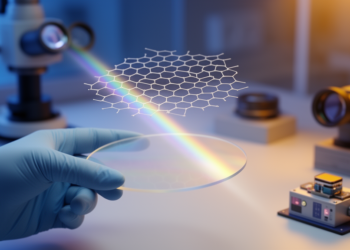
A Journal of Materials Science review surveys graphene, TMDs and black phosphorus for optoelectronics, covering synthesis, tunable optical properties and ...
First-principles calculations predict that monolayer FeCoCl2, FeCoBr2, FeVSe2, and FeVTe2 are stable half-metals with magnetic ordering temperatures up to 550 ...

A new review highlights how graphene, MXene, and TMD-based flexible sensors are enabling real-time wearable detection of volatile organic compounds ...
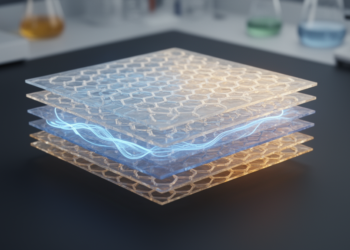
A comprehensive review details how defect engineering, phase control, and multicomponent design turn transition metal dichalcogenides into broadband electromagnetic wave ...

A new review in Opto-Electronic Manufacturing details how laser-induced phase transitions can precisely reprogram two-dimensional materials for next-generation electronic and ...
Researchers have shown that nonlinear circular dichroism in second-harmonic generation is directly proportional to the local Berry curvature, enabling an ...

Researchers have shown that solution-processed niobium carbide MXene electrodes deliver cleaner, lower-resistance contacts than platinum or gold for p-type 2D ...

Researchers have synthesized quaternary (RuMoVNb)Se2 alloy nanosheets that achieve near-platinum hydrogen evolution performance across the full pH range by combining ...


Embark on a thrilling journey of discovery with Scienmag.com—your ultimate source for cutting-edge breakthroughs. Immerse yourself in a world where curiosity knows no limits and tomorrow’s possibilities become today’s reality!