Hydrogen has long been heralded as the clean fuel of the future, yet the obstacle standing between promise and practice has always been the catalyst. Splitting water into hydrogen and oxygen at industrial scale demands electrodes that can shuttle electrons with almost frictionless efficiency, and for decades the only materials that could deliver that performance were those built around platinum. Now a team of researchers in South Korea, working with collaborators in Italy, has unveiled a four-metal alloy nanosheet that pushes performance startlingly close to platinum benchmarks while relying on far cheaper and more abundant ingredients. The work, published in Advanced Science, describes quaternary alloys of ruthenium, molybdenum, vanadium, and niobium selenide, written chemically as (RuMoVNb)Se2, and demonstrates hydrogen evolution activity across the entire pH range from strong acid to strong base.
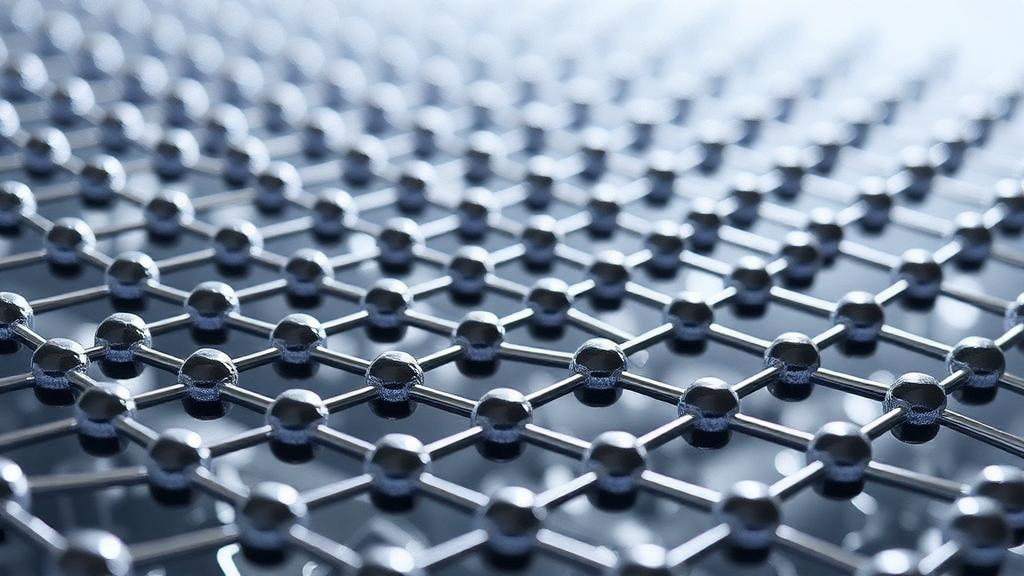
The starting point for the study was a class of materials known as two-dimensional transition metal dichalcogenides, or TMDs. In these compounds, a sheet of transition metal atoms is sandwiched between two sheets of chalcogen atoms, in this case selenium, forming layers just a few atoms thick. Molybdenum diselenide and its relatives can crystallize in two main arrangements: the hexagonal 2H phase, which is semiconducting, and the octahedrally coordinated 1T phase, which tends to be metallic and therefore far better at moving charge during electrocatalysis. Pristine TMDs suffer from low conductivity and weak hydrogen adsorption, and researchers have spent years trying to fix these flaws through vacancy creation, doping, intercalation, and alloying. The new study combines several of these tricks at once, and the result is a material whose catalytic behavior exceeds the sum of its parts.
Synthesis was carried out by colloidal chemistry, a technique more familiar from the production of quantum dots than from industrial electrocatalysts. The researchers dissolved ruthenium chloride, molybdenum chloride, niobium chloride, and vanadium chloride together with dibenzyl diselenide in oleylamine, then injected the mixture into a hot flask held at 260 degrees Celsius. By systematically varying the fraction of the ruthenium precursor from zero all the way to one, while keeping the other three metals in equal proportion, they produced a family of nine samples spanning the full compositional range. The products were then annealed at either 400 or 600 degrees Celsius under argon flow. Crucially, energy-dispersive X-ray spectroscopy confirmed that the composition of each product faithfully mirrored the recipe of precursors fed into the reaction, giving the team precise control over the final alloy.
What happened next is where the story becomes genuinely surprising. At zero ruthenium content, the material formed flower-like aggregates of layered nanosheets with the expected 2H structure. As ruthenium was added, the nanosheets shrank in lateral size but kept their layered form, and a new crystal phase began to emerge. X-ray diffraction revealed that starting at a ruthenium fraction of 0.25, the cubic pyrite phase characteristic of ruthenium diselenide appeared alongside the layered phases, and a previously unassigned diffraction peak turned out to belong to the 1T phase. In other words, adding ruthenium did not merely dilute the original alloy; it triggered a structural transformation from the semiconducting 2H arrangement toward the metallic 1T arrangement, while the nanosheet morphology survived across nearly the whole composition range.
Atomic-resolution scanning transmission electron microscopy provided the definitive proof that the four metals were genuinely mixed at the atomic scale rather than segregated into separate domains. Ruthenium, molybdenum, and niobium, whose atomic numbers are too similar to distinguish in these images, appeared uniformly distributed, and vanadium showed no tendency to cluster. Fast Fourier transform analysis of the images confirmed the coexistence of 2H and 1T regions in the mid-composition samples and the dominance of the cubic phase in pure ruthenium diselenide. X-ray photoelectron spectroscopy and X-ray absorption fine structure measurements then traced the electronic consequences: ruthenium incorporation lowered the oxidation states of vanadium and niobium, enhanced the metallic character of the material, and confirmed that every ruthenium atom was coordinated to selenium rather than to other ruthenium atoms.
To understand why the 1T phase becomes favorable, the team turned to density functional theory, constructing supercells of 150 atoms in which the four metals were randomly distributed. The calculations showed that in the pristine, vacancy-free models the 2H phase remained more stable, but by margins that shrank rapidly as ruthenium content increased. The decisive ingredient turned out to be selenium vacancies. The annealed alloy samples carried an average of about 8 percent selenium vacancies, and when the theorists built these vacancies into their models, the energy gap between the 1T and 2H phases narrowed dramatically. The vacancies preferentially formed near vanadium sites, which explains why vacancy concentrations dropped at the highest ruthenium loadings. In effect, the defects and the alloying worked together to tip the thermodynamic balance toward the catalytically superior metallic phase.
The electrochemical measurements are where the practical payoff becomes vivid. In 1 molar potassium hydroxide, the original ternary alloy without ruthenium required an overpotential of 265 millivolts to drive a current density of 10 milliamperes per square centimeter. The quaternary alloys with ruthenium fractions between 0.16 and 0.4 slashed that figure to between 36 and 40 millivolts, with the best sample, at a ruthenium fraction of 0.4, delivering 36 millivolts and a Tafel slope of 61 millivolts per decade. For context, commercial platinum-on-carbon needed 21 millivolts under the same conditions. In 0.5 molar sulfuric acid the quaternary alloys cut the overpotential from 137 to as low as 82 millivolts, and in neutral phosphate buffer the improvement was even more dramatic, falling from 503 to 139 millivolts, essentially matching the 145 millivolts of the platinum reference. Chronoamperometry showed negligible current decay over five days of continuous operation, and post-test analysis confirmed the catalyst’s structure and composition were intact.
The theoretical descriptor that ties these results together is the Gibbs free energy of hydrogen adsorption, often abbreviated as delta G of H-star. An ideal catalyst binds hydrogen neither too weakly nor too strongly, giving a value near zero. On the basal selenium atoms of the pristine 2H phase, the calculated values ranged from 0.74 to 1.55 electron volts, far too positive for efficient catalysis. But at selenium vacancy sites, where hydrogen could bind directly to exposed metal atoms, the values collapsed toward zero: minus 0.13 electron volts at a ruthenium-vanadium-niobium site, minus 0.087 electron volts at a pair of ruthenium atoms, and a remarkable 0.0055 electron volts at a ruthenium-vanadium pair in the 1T phase. Every near-optimal site involved at least one ruthenium atom, identifying ruthenium as the key catalytic species while the surrounding metals tuned the electronic environment.
Perhaps the most technically ambitious part of the study was the use of operando X-ray absorption spectroscopy, which allowed the researchers to watch the catalyst’s electronic structure change in real time as voltage was applied in alkaline electrolyte. As the overpotential increased, the white-line intensity of the ruthenium, molybdenum, and niobium absorption edges decreased, signaling that all three metals became more metallic under working conditions. Fitting of the extended absorption data revealed that in the quaternary alloy, ruthenium atoms formed bonds with oxygen species from adsorbed water or hydroxide, with a ruthenium-oxygen distance of 1.94 angstroms, while the ruthenium-selenium bonds contracted slightly. In the pure cubic ruthenium diselenide, only the bond contraction appeared. This suggests the quaternary alloy is better at adsorbing the electrolyte, a critical step in alkaline hydrogen evolution where water molecules must first be split before hydrogen can be released.
Taken together, the results sketch a coherent design principle for next-generation hydrogen catalysts. Ruthenium incorporation drives a phase transition toward the metallic 1T structure, selenium vacancies expose highly active metal sites where hydrogen binds with near-thermoneutral energy, the multi-metal composition enhances metallicity across the entire electronic structure, and the nanosheet geometry maximizes the surface area available for reaction. The optimum sits at a ruthenium fraction of 0.4, beyond which performance plateaus and then declines as vacancies become scarcer. Because ruthenium is dramatically cheaper than platinum and the alloy uses only modest amounts of it, the approach offers a credible route toward electrodes that approach platinum-class performance without platinum-class cost. If the colloidal synthesis can be scaled from millimole batches to industrial production, four-metal nanosheets like these could become a cornerstone of the green hydrogen economy that climate targets increasingly demand.
Subject of Research: Two-dimensional quaternary transition metal dichalcogenide alloy nanosheets for electrocatalytic hydrogen evolution
Article Title: Two‐Dimensional Quaternary Alloys of (RuMoVNb)Se2 for Superior Hydrogen Evolution Reaction Catalysis
Article References: Ihsan, J., Kim, J. Y., Mishal, I., Choi, J. H., Eun An, J., Choi, Y. J., Kim, D., Kwak, I. H., Vilé, G., Kwon, I. S., Kang, H. S., & Park, J. (2026). Two‐Dimensional Quaternary Alloys of (RuMoVNb)Se 2 for Superior Hydrogen Evolution Reaction Catalysis. Advanced Science, 13(56), Article e76600. https://doi.org/10.1002/advs.76600
Image Credits: AI Generated
DOI: 10.1002/advs.76600
Keywords: hydrogen evolution reaction, transition metal dichalcogenides, quaternary alloy, ruthenium diselenide, electrocatalysis, green hydrogen, 1T phase, selenium vacancies, colloidal synthesis, DFT calculations, X-ray absorption spectroscopy, nanosheets
Cite Scienmag News
Denise Maddox. (October 11, 2026). Four-Metal Nanosheets Bring Cheap Hydrogen Fuel Closer to Platinum Performance. Scienmag. https://scienmag.com/four-metal-nanosheets-bring-cheap-hydrogen-fuel-closer-to-platinum-performance/
Denise Maddox. "Four-Metal Nanosheets Bring Cheap Hydrogen Fuel Closer to Platinum Performance." Scienmag, 11 October 2026, https://scienmag.com/four-metal-nanosheets-bring-cheap-hydrogen-fuel-closer-to-platinum-performance/. Accessed 11 October 2026.
Denise Maddox. "Four-Metal Nanosheets Bring Cheap Hydrogen Fuel Closer to Platinum Performance." Scienmag. October 11, 2026. https://scienmag.com/four-metal-nanosheets-bring-cheap-hydrogen-fuel-closer-to-platinum-performance/