


Biomedical engineering’s next test: proving value where patients actually live
A new journal section challenges biomedical engineers to prove their devices deliver real clinical outcomes for patients, from intensive care ...
A new journal section challenges biomedical engineers to prove their devices deliver real clinical outcomes for patients, from intensive care ...

A new research collection highlights robotic systems for spine and femur surgery that pair technical innovation with unmet clinical needs, ...
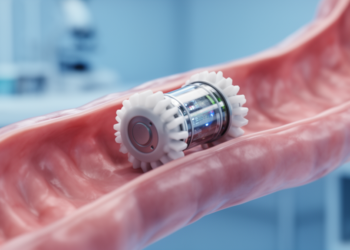
Researchers built a self-propelled colonoscopy robot with soft 3D-printed gears that reached 9.6 mm/s and 1.5 N of propulsive force ...

A laboratory study of bovine cortical bone shows that impact forces at a saw blade's turning point introduce microcracks that ...

A new review of thirty studies finds artificial intelligence showing strong potential across minimally invasive vascular surgery, from risk prediction ...

A new test-time adaptation framework shows that online model updates can rescue surgical instrument segmentation from severe low light and ...

Researchers at Nagoya University tested a surgical robot that asks for human help only when its own uncertainty is high, ...

Researchers at RWTH Aachen University have demonstrated an automated workflow that configures Time-Sensitive Networking for ISO IEEE 11073 SDC-based medical ...

Researchers at the University of Leeds have developed PICO, a single-stage AI system that estimates the full 3D position and ...
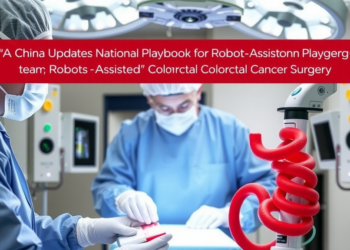
China's leading colorectal cancer surgical experts have issued a comprehensive 2025 national consensus codifying how robotic surgery for colorectal cancer ...


Embark on a thrilling journey of discovery with Scienmag.com—your ultimate source for cutting-edge breakthroughs. Immerse yourself in a world where curiosity knows no limits and tomorrow’s possibilities become today’s reality!