


Iterative Framework Resolves Nonlinear Wave Dynamics in Memory-Dependent Oscillator Networks
A new homotopy recursive iterative framework accurately models wave propagation and pattern formation in memory-dependent fractional oscillator networks.
A new homotopy recursive iterative framework accurately models wave propagation and pattern formation in memory-dependent fractional oscillator networks.

Researchers have mathematically derived and numerically confirmed how species inertial delay and fitness taxis synergistically govern Turing and wave instabilities ...

Researchers have developed a normalized time-fractional chemotaxis framework demonstrating that stronger memory effects accelerate finite-time cellular blow-up across multiple spatial ...

Researchers derived new exact stochastic solutions for the Nagumo neural model to analyze noise-induced phenomena in excitable media.
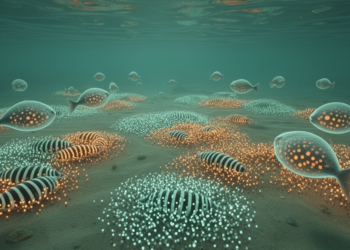
A new mathematical analysis shows that reversing the orientation of predator-taxis is the only route to stationary spatial instability in ...

A new collective variable framework reduces the Kuramoto–Sivashinsky equation to six tractable evolution equations for amplitude, temporal position, width, chirp, ...
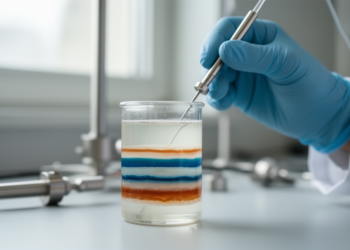
Researchers in Tokyo have reproduced agate and onyx banding in the laboratory by cyclically switching voltages across metal electrodes embedded ...
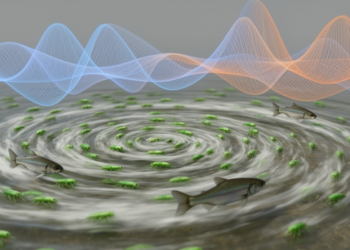
When Alan Turing published his 1952 work on morphogenesis, he revealed something startling: identical cells, governed by identical rules, can ...

Physicists have engineered mechatronic metamaterials in which non-reciprocal wave coarsening drives spontaneous synchronization into a classical time crystal, with frictional ...

Researchers show that Myxococcus xanthus switches between swarming and rippling through just two mechanisms—local cellular alignment and congestion-triggered reversals.


Embark on a thrilling journey of discovery with Scienmag.com—your ultimate source for cutting-edge breakthroughs. Immerse yourself in a world where curiosity knows no limits and tomorrow’s possibilities become today’s reality!