
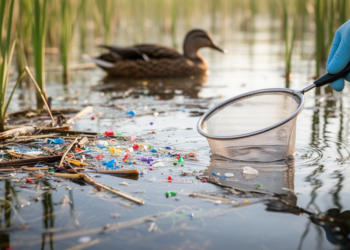
Sunlight-Aged Microplastics Turn More Toxic to Water Fleas, Study Finds
Brazilian researchers show that sunlight-weathered polyethylene microplastics become more damaging to the reproduction of Daphnia similis, while the insecticide imidacloprid ...
New research shows hydrothermal carbonization transforms rather than eliminates PET and polystyrene microplastics in sewage sludge, transferring substantial organic load ...
Researchers have combined near-infrared hyperspectral imaging with a self-organizing map neural network to identify and semi-quantitatively map microplastic contamination on ...
A new review reveals how ultraviolet-driven photooxidation chemically weakens plastics and drives their fragmentation into micro- and nanoplastics across urban, ...
A new Science study estimates that rivers delivered about 263,000 tons of microplastics to the ocean in 2022, with extreme ...
A 28-day mouse study finds sex-specific gut and immune responses to polystyrene nano- and microplastics despite minimal systemic toxicity.
Leading researchers argue that a stabilized definition of the Anthropocene epoch, beginning in 1952, is essential for rigorous science and ...
Researchers at the University of Bayreuth found that polystyrene microplastic particles and the additive Irgafos 168 reduce immune cell viability ...
A new study shows that the additives blended into polypropylene dramatically alter how sunlight and mechanical stress break the plastic ...
A new study of eleven Ugandan composting sites found microplastics in every compost sample, averaging 2,100 particles per kilogram, with ...
© 2025 Scienmag - Science Magazine
