


Weak Stellar Winds in Metal-Poor Stars May Explain Weird Early Galaxies
A Hubble survey of 29 massive stars in extremely metal-poor dwarf galaxies reveals unexpectedly weak stellar winds that could explain ...
A Hubble survey of 29 massive stars in extremely metal-poor dwarf galaxies reveals unexpectedly weak stellar winds that could explain ...

A new Nature Astronomy review synthesizes JWST's discovery of an unexpectedly abundant population of massive, actively growing black holes in ...
A new Nature Astronomy Perspective argues that JWST's mysterious little red dots are million-solar-mass black holes enshrouded in dense gas, ...
A major 2026 online workshop gathered 230 astronomers to debate the physical nature of the compact red objects that JWST ...
When the James Webb Space Telescope turned its mirrors toward a faint, icy body drifting in the outer Solar System ...
A groundbreaking study emerging from joint efforts by the Center for Astrobiology (CAB), CSIC-INTA, and the University of Oxford has ...

Researchers utilizing the James Webb Space Telescope (JWST) have made significant strides in understanding the origins of rocky planets, like ...

The cosmos has always held profound mysteries about the nature of existence, particularly in the formation of planetary systems. One ...
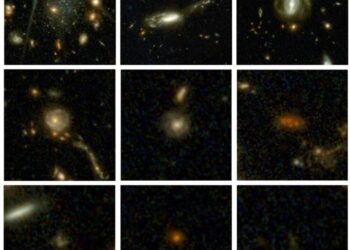
In a groundbreaking move for the field of astrophysics, the multinational research team known as COSMOS has recently unveiled data ...
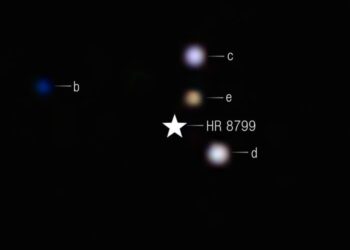
The James Webb Space Telescope has made an unprecedented breakthrough in exoplanet research by directly imaging carbon dioxide in the ...


Embark on a thrilling journey of discovery with Scienmag.com—your ultimate source for cutting-edge breakthroughs. Immerse yourself in a world where curiosity knows no limits and tomorrow’s possibilities become today’s reality!