

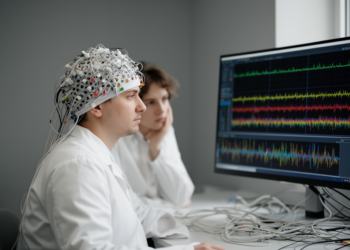
How a Hidden Flaw in EEG Machine Learning Inflates Accuracy by 35 Percentage Points
A new study shows that randomly splitting EEG windows between training and test sets inflates diagnostic accuracy by roughly 35 ...
A new study shows that randomly splitting EEG windows between training and test sets inflates diagnostic accuracy by roughly 35 ...

A systematic review maps how deep learning architectures are transforming EEG analysis for neurological disease diagnosis, while warning that data ...
Every minute of a newborn's life, two of the body's most vital systems—the brain and the heart—are engaged in a ...
A new c-MVEP paradigm modulates stimuli with pseudo-random zooming motion instead of flicker, reaching 85.67% accuracy in an online BCI ...
A new perspective in Frontiers in Neurorobotics proposes that humanoid robots could unlock embodiment-dependent neural signals, such as touch and ...
Event-related potentials, or ERPs, are among the most powerful tools in human neuroscience. Recorded through electrodes on the scalp, these ...
A phase II randomised, double-blind, placebo-controlled trial in Cyprus will test whether six intravenous ketamine infusions can reduce depressive symptoms, ...
The first synchronized multimodal wearable dataset collected during real general-aviation flight shows heart rate and eye movements genuinely track pilot ...
A hybrid EEG–EMG decoder using a BiLSTM network triggered lower-limb exoskeleton assistance faster and more accurately than either signal alone ...
Researchers in India have built a lightweight brain-computer interface framework that combines sliding-window segmentation, Fourier decomposition, and a compact neural ...

Embark on a thrilling journey of discovery with Scienmag.com—your ultimate source for cutting-edge breakthroughs. Immerse yourself in a world where curiosity knows no limits and tomorrow’s possibilities become today’s reality!