

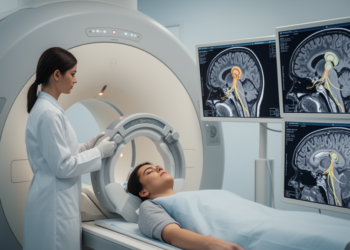
MRI links trigeminal neuralgia to cerebellar thickness and postoperative changes
A cross-sectional MRI study found thicker cerebellar Lobules IV and VI in patients with trigeminal neuralgia, while exploratory paired scans ...
A cross-sectional MRI study found thicker cerebellar Lobules IV and VI in patients with trigeminal neuralgia, while exploratory paired scans ...

An exploratory analysis of 743 healthy adults found no robust prefrontal-specific MRI marker of cognition, with all reported structure–behavior associations ...
A neuroimaging study of 58 drug-free people with generalized anxiety disorder found differences in cortical volume-based networks that were associated ...
Researchers used 7-Tesla MRI and a deep learning model to predict Trail-Making Test performance with 0.795 accuracy across psychiatric patients ...
A large MRI study of 1,761 schizophrenia patients shows that disrupted brain asymmetry is real but subtle, and varies with ...
A multimodal neuroimaging study in China links etomidate use disorder to amplified cue-driven brain responses, impaired prefrontal inhibition of the ...
A new meta-analysis links obsessive-compulsive disorder to thinning in cingulate and frontal cortical regions and ties those structural changes to ...
A large structural MRI study finds that data-driven symptom phenotypes spanning depression and bipolar disorder map onto distinct, modality-specific patterns ...
Stanford researchers found that two cerebellar folds, Crus I and Crus II, are thinner in autistic children and that their ...
A study of nearly 300 patients under 65 shows that the cortical thinning signature of early-onset Alzheimer's disease becomes detectable ...

Embark on a thrilling journey of discovery with Scienmag.com—your ultimate source for cutting-edge breakthroughs. Immerse yourself in a world where curiosity knows no limits and tomorrow’s possibilities become today’s reality!