


Atomic condensate simulates relativistic quantum fields
Researchers used a two-dimensional atomic Bose–Einstein condensate to simulate massive relativistic quantum fields, observing relativistic dispersion and topological domain walls.
Researchers used a two-dimensional atomic Bose–Einstein condensate to simulate massive relativistic quantum fields, observing relativistic dispersion and topological domain walls.

Researchers have demonstrated a room-temperature supersolid state combining superfluid flow and crystalline spatial order in an exciton-polariton Bose-Einstein condensate.

A new quantum algorithm estimates similarity using hybrid discrete-continuous encoding and is applied to simulated atomtronics data for potential magnetic ...

A theoretical study shows that the self-binding threshold of dipolar quantum droplets inside a hollow cylinder shifts measurably in response ...

A numerical Bose–Einstein condensate study finds that analogue horizons enhance quantum depletion and that the long-term depletion rate rises with ...
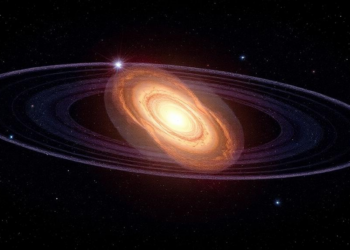
A new theoretical study maps the equilibrium solutions of self-gravitating Bose–Einstein condensates, showing how particle number, boson mass, and self-interaction ...


Embark on a thrilling journey of discovery with Scienmag.com—your ultimate source for cutting-edge breakthroughs. Immerse yourself in a world where curiosity knows no limits and tomorrow’s possibilities become today’s reality!