

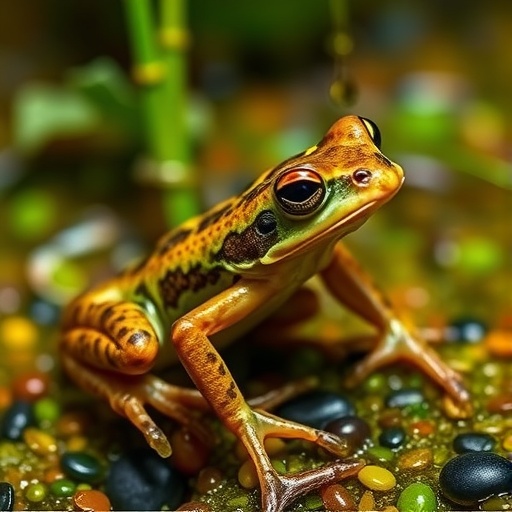
In a groundbreaking study that dives deep into the peculiar dietary habits of tadpoles, researchers from Brazil have brought to light the fascinating phenomenon of geophagy, specifically in the species Thoropa miliaris. This behavior, which involves the ingestion of soil, has been observed in various animal species, but its manifestation in amphibians has rarely been scrutinized with the attention it deserves. The study, titled “Another one bites the dirt: a closer look into geophagy in tadpoles of Thoropa miliaris,” aims to explore the motivations and implications of such an unusual feeding strategy within this species.
The importance of understanding geophagy lies not only in the ecological insights it provides but also in the evolutionary adaptations it hints at. For Thoropa miliaris, a species endemic to the humid forests of Brazil, the act of soil consumption might serve multiple functions. The study delves into the nutritional benefits of soil ingestion, suggesting that it might play a pivotal role in supplementing their diet, especially in nutrient-poor habitats. This research opens a new frontier in amphibian dietary studies, potentially reshaping our understanding of their ecological roles.
One of the critical aspects tackled in the study is the type of soil preferred by the tadpoles. The researchers found that specific soil compositions, enriched with organic matter and minerals, were consumed more frequently. This preference indicates that the tadpoles are not just randomly ingesting dirt but are selecting soils based on their nutritional profiles. Such behavior underscores a level of sophistication in the species’ feeding strategies, one that raises questions about the cognitive abilities of amphibians in foraging scenarios.
The methodology employed in the study highlights an innovative combination of field observations and laboratory experiments. By closely monitoring the tadpoles in their natural habitat and replicating those conditions in controlled settings, the researchers have been able to draw robust conclusions about the dietary habits of these amphibians. The dual approach provided a comprehensive view of how environmental conditions influence the feeding behavior of Thoropa miliaris, a crucial aspect that could have implications for conservation efforts in their native ecosystems.
Geophagy may also offer significant health benefits to the tadpoles. The ingestion of soil has been linked to detoxification processes in various species, and the researchers speculate whether the same holds true for Thoropa miliaris. By consuming certain soils, these tadpoles might be better able to eliminate toxins accumulated from their aquatic environments, allowing them to thrive in challenging conditions. This detoxification hypothesis warrants further investigation, which could unveil critical survival strategies for amphibians in increasingly polluted ecosystems.
Moreover, the study discusses the potential microbial interactions within the ingested soil. It is well-established that soil is a habitat rich in microorganisms, some of which are beneficial. The authors propose that by consuming soil, tadpoles may also be inadvertently introducing beneficial microbes into their systems that could aid in digestion or enhance their immune responses. This interaction raises exciting possibilities regarding the co-evolution of amphibians and their microbial environments, an area that has yet to be thoroughly explored.
As the researchers continue to dissect the implications of their findings, they also highlight the broader significance of studying geophagy in amphibians. The phenomenon is not just a quirky behavior but may reflect how animals adapt to their environments in the face of climate change and habitat alteration. As amphibians are often regarded as bioindicators of ecosystem health, understanding their dietary habits could provide valuable insights into the stability of their habitats, signaling shifts that could impact broader ecological dynamics.
In terms of conservation, the findings from this study stress the need to protect the natural habitats where Thoropa miliaris lives. The specific soil types that these tadpoles prefer might be vulnerable to erosion or degradation due to human activities. Preserving these environments is essential not just for the survival of the species but for maintaining the intricate ecological balances that enable diverse life forms to coexist.
Interestingly, the team also discusses potential applications of their research beyond basic biology. Understanding the dietary preferences of amphibians could lead to innovative strategies in captive breeding programs, where diet plays a crucial role in the health and longevity of captive populations. By mimicking natural feeding behaviors, conservationists could enhance reproduction and survival rates, contributing significantly to the preservation of endangered species.
As the team prepares to publish their findings, they acknowledge that this work is just the beginning. There remains a vast unexplored territory concerning the geophagy of amphibians and its ecological implications at large. The study of Thoropa miliaris is positioned as a crucial stepping stone that could inspire future research into similar behaviors across other amphibian species and even extend to reptiles and mammals.
With the increasing impact of environmental changes, such research is vital to inform conservation efforts and educate the public about the intricate relationships between species and their habitats. The captivating findings surrounding geophagy in Thoropa miliaris invite us to reconsider our perceptions of these remarkable creatures and the complex ecosystems they inhabit. Ultimately, as efforts to conserve biodiversity continue, the revelation of unique behaviors like geophagy could play a crucial role in ensuring a future where diverse amphibian populations can thrive.
The future of amphibian research is undoubtedly exciting, with new technologies and interdisciplinary approaches paving the way for groundbreaking discoveries. As researchers delve deeper into the ecological roles of species like Thoropa miliaris, the insights gleaned from their study will likely resonate across the fields of ecology, evolutionary biology, and conservation. The tale of the humble tadpole, and its dirt-eating habits, thus stands as a testament to nature’s resilience and complexity, inviting further exploration into the lives of these often-overlooked creatures.
As we celebrate the contributions of this research to science and conservation, we are reminded of the importance of curiosity and inquiry in understanding our natural world. Every discovery offers a new chapter in the ongoing narrative of life on Earth, illuminating pathways to safeguard our planet’s precious biodiversity for generations to come.
Subject of Research: Geophagy in tadpoles of Thoropa miliaris
Article Title: Another one bites the dirt: a closer look into geophagy in tadpoles of Thoropa miliaris (Spix, 1824).
Article References:
Colaço, G., Lopes, J., Fidalgo, G. et al. Another one bites the dirt: a closer look into geophagy in tadpoles of Thoropa miliaris (Spix, 1824).
Sci Nat 113, 9 (2026). https://doi.org/10.1007/s00114-025-02061-4
Image Credits: AI Generated
DOI:
Keywords: Geophagy, Thoropa miliaris, amphibians, ecology, conservation, diet, soil consumption, environmental adaptation.


