


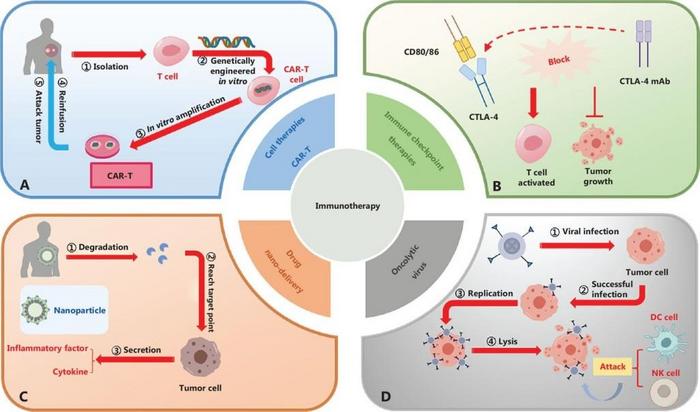
In the past two decades, immune checkpoint inhibitors (ICIs) have revolutionized cancer treatment, showing promising results against various solid tumors. This study reviews recent developments in ICIs, focusing on new targets like T cell immunoreceptor with Ig and ITIM domains (TIGIT), T cell immunoglobulin and mucin domain-containing protein 3 (TIM-3), and lymphocyte activation gene-3 (LAG-3). These targets aim to overcome resistance mechanisms limiting the effectiveness of current therapies, such as anti-PD-1 and anti-CTLA-4. By identifying and developing these new ICIs, researchers hope to improve treatment outcomes and provide new therapeutic options for cancer patients.

Credit: Cancer Biology & Medicine
In the past two decades, immune checkpoint inhibitors (ICIs) have revolutionized cancer treatment, showing promising results against various solid tumors. This study reviews recent developments in ICIs, focusing on new targets like T cell immunoreceptor with Ig and ITIM domains (TIGIT), T cell immunoglobulin and mucin domain-containing protein 3 (TIM-3), and lymphocyte activation gene-3 (LAG-3). These targets aim to overcome resistance mechanisms limiting the effectiveness of current therapies, such as anti-PD-1 and anti-CTLA-4. By identifying and developing these new ICIs, researchers hope to improve treatment outcomes and provide new therapeutic options for cancer patients.
Immunotherapy, especially immune checkpoint blockade (ICB), has transformed cancer treatment. However, many patients develop resistance to current treatments like anti-PD-1 and anti-CTLA-4. This resistance underscores the need for ongoing research to discover new immune checkpoint targets and enhance treatment efficacy. Based on these challenges, it is crucial to conduct in-depth studies to identify additional immune checkpoint inhibitors (ICIs) and develop combination therapies that can provide more effective cancer treatments.
Researchers from Guangdong Pharmaceutical University published a comprehensive review (DOI:10.20892/j.issn.2095-3941.2024.0055) in Cancer Biology & Medicine on May 24, 2024, highlighting recent progress in ICIs. The study, led by Xueqing Kong and colleagues, discusses novel immune checkpoint molecules and their clinical applications, aiming to improve cancer treatment outcomes.
The study explores the mechanisms behind resistance to current ICIs like anti-PD-1 and anti-CTLA-4 therapies. Researchers have identified new immune checkpoints, including T cell immunoreceptor with Ig and ITIM domains (TIGIT), T cell immunoglobulin and mucin domain-containing protein 3 (TIM-3), and lymphocyte activation gene-3 (LAG-3), which help tumors evade the immune system. Monoclonal antibodies targeting these molecules are in development and show promise for enhancing existing treatments. The review also highlights the benefits of combination therapies, such as pairing PD-1 inhibitors with anti-angiogenic agents, radiotherapy, or chemotherapy. These combined approaches have demonstrated improved outcomes in clinical trials. By integrating these new targets and strategies, the study aims to overcome the limitations of current ICIs, offering renewed hope and more effective options for cancer patients.
Dr. Rongxin Zhang, a leading immunologist at Guangdong Pharmaceutical University, commented, “The identification of new immune checkpoint targets marks a significant advancement in cancer immunotherapy. By understanding and targeting these novel molecules, we can develop more effective treatment strategies and overcome resistance mechanisms, ultimately improving patient outcomes.”
The advancements in ICIs not only enhance current cancer treatment protocols but also pave the way for personalized medicine. By combining ICIs with other therapeutic modalities, researchers aim to create tailored treatment plans that address individual patient needs. These developments hold promise for reducing cancer recurrence rates and improving the overall survival of cancer patients.
###
References
10.20892/j.issn.2095-3941.2024.0055
Original Source URL
Funding information
This study was supported by the National Natural Science Foundation of China (Grant Nos. 82173087 and 82203533).
About Cancer Biology & Medicine
Cancer Biology & Medicine (CBM) is a peer-reviewed open-access journal sponsored by China Anti-cancer Association (CACA) and Tianjin Medical University Cancer Institute & Hospital. The journal monthly provides innovative and significant information on biological basis of cancer, cancer microenvironment, translational cancer research, and all aspects of clinical cancer research. The journal also publishes significant perspectives on indigenous cancer types in China. The journal is indexed in SCOPUS, MEDLINE and SCI (IF 5.6, 5 year IF 5.9), with all full texts freely visible to clinicians and researchers all over the world.
Journal
Cancer Biology & Medicine
Subject of Research
Not applicable
Article Title
Immune checkpoint inhibitors: breakthroughs in cancer treatment
Article Publication Date
24-May-2024
COI Statement
The authors declare that they have no competing interests.
Cite Scienmag News
Nathaniel Bowman. (August 13, 2024). Tackling cancer from the inside out: A deep dive into immune checkpoint inhibitors. Scienmag. https://scienmag.com/tackling-cancer-from-the-inside-out-a-deep-dive-into-immune-checkpoint-inhibitors/
Nathaniel Bowman. "Tackling cancer from the inside out: A deep dive into immune checkpoint inhibitors." Scienmag, 13 August 2024, https://scienmag.com/tackling-cancer-from-the-inside-out-a-deep-dive-into-immune-checkpoint-inhibitors/. Accessed 4 September 2026.
Nathaniel Bowman. "Tackling cancer from the inside out: A deep dive into immune checkpoint inhibitors." Scienmag. August 13, 2024. https://scienmag.com/tackling-cancer-from-the-inside-out-a-deep-dive-into-immune-checkpoint-inhibitors/

