


SAN ANTONIO — July 17, 2024 — Geoscientists from Southwest Research Institute (SwRI) and The University of Texas at Dallas (UTD) are collaborating to discover new domestic sources for lithium.
A joint project entitled “Toward domestic lithium independence: Tectonic controls on critical emerging lithium deposits” was selected for funding under the Seed Projects for Research, INnovation, and Technology (SPRINT) Program sponsored by SwRI and UTD. The grant is for $125,000 with a $50,000 cap on UT Dallas costs and $75,000 cap on SwRI costs.
Dr. Adam Cawood, a senior research scientist in SwRI’s Earth Science Section, and Dr. Kristina Butler and Dr. Zach Sickmann, assistant professors in UTD’s Department of Sustainable Earth Systems Sciences, are the co-leads on the project. Cawood said the SPRINT grant should help to kickstart bigger ideas and attract external funding to expand beyond the scope of this 15-month project.
The United States faces a pressing need to reduce its reliance on imported lithium from large producers in Asia and South America.
“Global demand for lithium is expected to increase 46% by 2030, according to the U.S. Geological Survey,” Cawood said. “Right now, the U.S. only produces about 1-2% of the world’s lithium.”
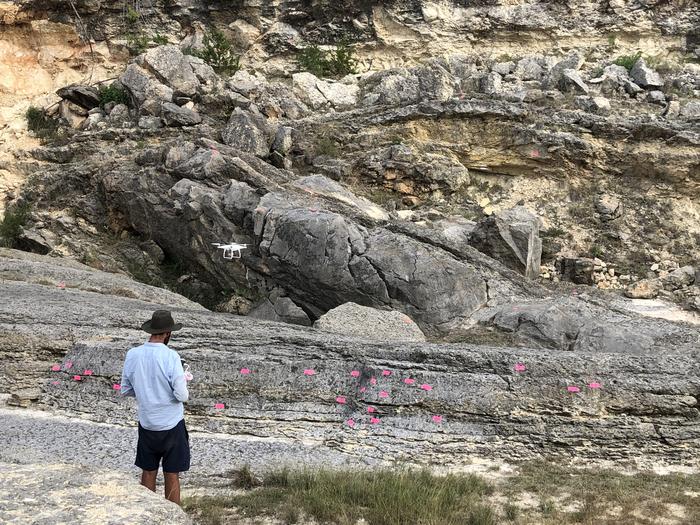
To address that need, this project will study lithium deposit formation through fieldwork, geological mapping, and subsurface interpretation in support of conceptual model development. The researchers plan to leverage their efforts to write grants seeking funding from the National Science Foundation and the U.S. Department of Energy.
“Lithium is critical to U.S. national security because we need it for battery technologies as we continue to turn towards vehicle electrification,” said Butler, who specializes in studying lithium. “The U.S. has few traditional deposits where we know we can find lithium. One of those is in the Clayton Valley in Nevada, one of our field research sites. We need the skills of the SwRI team for quantitative structural geology and robust field mapping to help track the best locations for conventional and unconventional domestic lithium resources.”
Lithium exploration in the U.S. is still in its early stages, Cawood said. “We will consider established techniques from other industries and apply them to this kind of search,” he said. “As structural geologists, we look at faults and fractures in the subsurface where lithium-enriched fluids could flow, leading to lithium transport and accumulation below ground. Meeting domestic lithium demand is the ultimate goal.”
SwRI’s Executive Office and UTD’s Office of Research and Innovation developed SPRINT to enhance greater scientific and engineering collaboration between the two institutions. This program provides opportunities for researchers to work together, addressing issues of mutual interest and need while bringing together the capabilities, facilities and expertise from both organizations.
For more information, visit https://www.swri.org/industries/earth-science.

Credit: Southwest Research Institute
SAN ANTONIO — July 17, 2024 — Geoscientists from Southwest Research Institute (SwRI) and The University of Texas at Dallas (UTD) are collaborating to discover new domestic sources for lithium.
A joint project entitled “Toward domestic lithium independence: Tectonic controls on critical emerging lithium deposits” was selected for funding under the Seed Projects for Research, INnovation, and Technology (SPRINT) Program sponsored by SwRI and UTD. The grant is for $125,000 with a $50,000 cap on UT Dallas costs and $75,000 cap on SwRI costs.
Dr. Adam Cawood, a senior research scientist in SwRI’s Earth Science Section, and Dr. Kristina Butler and Dr. Zach Sickmann, assistant professors in UTD’s Department of Sustainable Earth Systems Sciences, are the co-leads on the project. Cawood said the SPRINT grant should help to kickstart bigger ideas and attract external funding to expand beyond the scope of this 15-month project.
The United States faces a pressing need to reduce its reliance on imported lithium from large producers in Asia and South America.
“Global demand for lithium is expected to increase 46% by 2030, according to the U.S. Geological Survey,” Cawood said. “Right now, the U.S. only produces about 1-2% of the world’s lithium.”
To address that need, this project will study lithium deposit formation through fieldwork, geological mapping, and subsurface interpretation in support of conceptual model development. The researchers plan to leverage their efforts to write grants seeking funding from the National Science Foundation and the U.S. Department of Energy.
“Lithium is critical to U.S. national security because we need it for battery technologies as we continue to turn towards vehicle electrification,” said Butler, who specializes in studying lithium. “The U.S. has few traditional deposits where we know we can find lithium. One of those is in the Clayton Valley in Nevada, one of our field research sites. We need the skills of the SwRI team for quantitative structural geology and robust field mapping to help track the best locations for conventional and unconventional domestic lithium resources.”
Lithium exploration in the U.S. is still in its early stages, Cawood said. “We will consider established techniques from other industries and apply them to this kind of search,” he said. “As structural geologists, we look at faults and fractures in the subsurface where lithium-enriched fluids could flow, leading to lithium transport and accumulation below ground. Meeting domestic lithium demand is the ultimate goal.”
SwRI’s Executive Office and UTD’s Office of Research and Innovation developed SPRINT to enhance greater scientific and engineering collaboration between the two institutions. This program provides opportunities for researchers to work together, addressing issues of mutual interest and need while bringing together the capabilities, facilities and expertise from both organizations.
For more information, visit https://www.swri.org/industries/earth-science.
Cite Scienmag News
Denise Maddox. (July 17, 2024). SwRI-UTD collaborate on geoscience research to find domestic lithium resources. Scienmag. https://scienmag.com/swri-utd-collaborate-on-geoscience-research-to-find-domestic-lithium-resources/
Denise Maddox. "SwRI-UTD collaborate on geoscience research to find domestic lithium resources." Scienmag, 17 July 2024, https://scienmag.com/swri-utd-collaborate-on-geoscience-research-to-find-domestic-lithium-resources/. Accessed 5 September 2026.
Denise Maddox. "SwRI-UTD collaborate on geoscience research to find domestic lithium resources." Scienmag. July 17, 2024. https://scienmag.com/swri-utd-collaborate-on-geoscience-research-to-find-domestic-lithium-resources/

