


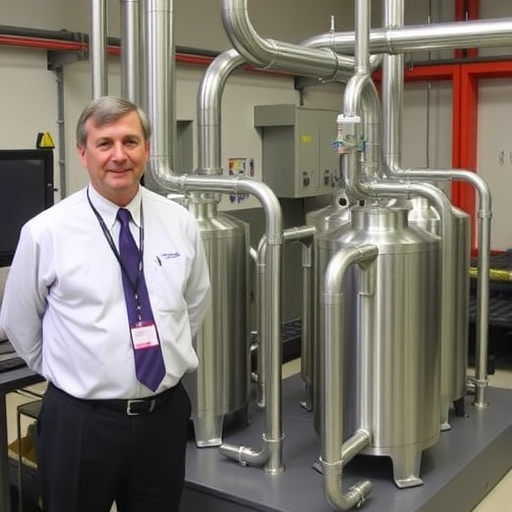
Southwest Research Institute (SwRI) and St. Mary’s University have embarked on a groundbreaking collaboration aimed at revolutionizing the future of hydrogen storage technology. This joint venture seeks to develop a comprehensive, physics-based forecasting tool capable of predicting the degradation and long-term durability of titanium-iron (TiFe)-based metal hydride vessels. Leveraging a chemical and thermo-mechanical modeling framework, the project represents a significant leap forward in tackling one of the most persistent challenges in hydrogen storage materials science. This initiative is made possible through a $125,839 grant from the St. Mary’s-SwRI Technology and Applied Research (S²TAR) Program, designed to foster impactful research collaborations.
Metal hydrides are pivotal materials in the hydrogen energy landscape, serving as one of the few safe and compact solid-state options for hydrogen storage. These materials function by chemically binding hydrogen to metal lattices through chemisorption, effectively locking hydrogen atoms within the structure. Unlike high-pressure gaseous tanks or cryogenic liquid hydrogen storage, metal hydrides offer improved safety profiles and reduce energy-intensive requirements. However, despite these advantages, their widespread application is hindered by their limited durability and performance degradation resulting from repeated hydrogen absorption and desorption cycles.
At the heart of this ambitious research endeavor is the intricate problem of metal hydride vessel degradation. Over numerous charge and discharge cycles, physical changes ensue within the alloy powders comprising the metal hydride bed. These changes include fracturing of particles, densification of the powder bed, and mechanical stresses that collectively impair hydrogen storage capacity and vessel performance. Traditional evaluation methods rely heavily on prolonged, costly experimental testing to assess long-term vessel integrity—a bottleneck that impedes innovation and commercialization.
The project team, headed by Dr. Richard S. Fu of SwRI and Dr. Mohamed Shaat of St. Mary’s University, seeks to transcend these limitations by integrating advanced physics-based simulations with targeted experimental validation. This dual approach aims to create a robust modeling framework capable of forecasting the lifecycle and operational durability of TiFe metal hydride vessels. The predictive tool will account for the coupled chemical, thermal, and mechanical phenomena driving hydrogen cycling performance over hundreds or even thousands of cycles.
Dr. Shaat is spearheading the development of an intricate, multiphysics computational framework at St. Mary’s University. This model is designed to encapsulate the complex interplay between hydrogen diffusion, chemisorption reactions, phase transformations within the metal hydride, heat generation and transfer, and the evolution of mechanical stress within the vessel. By accurately simulating these interconnected processes, the framework seeks to facilitate precise performance predictions, while also identifying design parameters and operational regimes that optimize both efficiency and vessel longevity.
Central to the team’s vision is the translation of fundamental physical and chemical principles of hydrogen interaction into computationally efficient predictive models. Dr. Shaat emphasizes the importance of capturing the coupling mechanisms—particularly how hydrogen transport influences thermal and mechanical responses and vice versa—in order to provide reliable simulations that replace and reduce the dependence on lengthy physical testing. This innovative approach promises to significantly reduce costs, accelerate development cycles, and improve hydrogen storage system designs.
On the experimental front, SwRI’s team, under Dr. Fu’s guidance, is undertaking controlled, long-term cycling experiments to collect essential validation data. By subjecting metal hydride vessels to realistic charge-discharge scenarios, they aim to quantitatively monitor performance degradation mechanisms as they unfold. These experiments will provide the empirical backbone necessary to calibrate and refine the modeling framework, ensuring that simulation outputs faithfully represent real-world behavior under operational conditions.
The synergy between modeling efforts and experiments forms the cornerstone of the project’s iterative design loop. As Dr. Fu explains, modeling insights will direct the focus of experimental tests to critical phenomena, while the resulting data will feedback to correct and enhance the models. This dynamic interplay is expected to unravel previously obscure degradation mechanisms by illuminating the coupled chemical, thermal, and mechanical interactions at work within the metal hydride vessels. Ultimately, this feedback-driven methodology will yield a predictive tool capable of guiding material improvements and engineering decisions.
Hydrogen’s emergence as a clean, versatile energy carrier is a key cornerstone of global efforts to decarbonize energy and transportation sectors. However, to fulfill its potential, advances in storage technology are imperative. Unlike batteries or fossil fuels, hydrogen storage demands novel materials and engineering solutions due to its unique physical and chemical characteristics. By focusing on metal hydride vessels, this project addresses a promising yet underdeveloped storage pathway that could unlock safer, more efficient hydrogen deployment across diverse applications.
The S²TAR funding mechanism plays an instrumental role in enabling this interdisciplinary collaboration by providing seed resources that draw on the expertise strengths of both SwRI and St. Mary’s University. This partnership is not only poised to produce high-impact scientific outcomes but also lays the foundation for sustained cooperation. Through this collaboration, the team is well-positioned to attract larger external funding sources from federal agencies and industry players focused on advancing hydrogen infrastructure and clean energy technology.
As work progresses, the team anticipates that their predictive modeling tool will be an invaluable resource for the hydrogen storage community. It will offer designers and researchers an evidence-based platform to evaluate new materials, optimize vessel designs, and predict operational lifetimes with higher confidence. By systematically addressing the core durability challenges of metal hydride storage, this project represents a wide-reaching advancement that could significantly accelerate solid-state hydrogen storage adoption worldwide.
In conclusion, this joint initiative by Southwest Research Institute and St. Mary’s University epitomizes the cutting edge of hydrogen storage research. Through combining rigor in experimental validation and sophistication in physics-based modeling, the project champions a future where hydrogen is stored more safely and efficiently. The knowledge generated here promises to not only rewrite the fundamentals of storage vessel degradation understanding but also to catalyze practical applications in the global hydrogen economy.
News Publication Date: June 24, 2026
Keywords
Hydrogen storage, metal hydrides, TiFe alloys, chemisorption, physics-based modeling, thermo-mechanical framework, hydrogen diffusion, phase transformation, performance degradation, solid-state hydrogen storage, experimental validation, multiphysics simulations
Cite Scienmag News
Bethany Barker. (June 24, 2026). SwRI and St. Mary’s University Partner to Forecast Durability of Metal Hydride Hydrogen Storage. Scienmag. https://scienmag.com/swri-and-st-marys-university-partner-to-forecast-durability-of-metal-hydride-hydrogen-storage/
Bethany Barker. "SwRI and St. Mary’s University Partner to Forecast Durability of Metal Hydride Hydrogen Storage." Scienmag, 24 June 2026, https://scienmag.com/swri-and-st-marys-university-partner-to-forecast-durability-of-metal-hydride-hydrogen-storage/. Accessed 3 September 2026.
Bethany Barker. "SwRI and St. Mary’s University Partner to Forecast Durability of Metal Hydride Hydrogen Storage." Scienmag. June 24, 2026. https://scienmag.com/swri-and-st-marys-university-partner-to-forecast-durability-of-metal-hydride-hydrogen-storage/


