


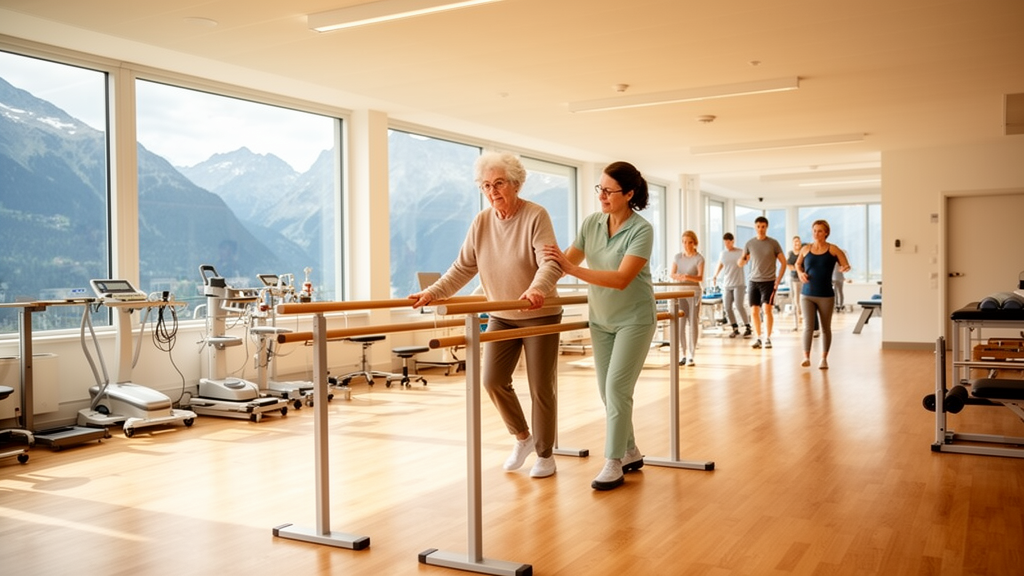
Rehabilitation has long been the quiet workhorse of modern medicine, the set of interventions that helps people regain independence after injury, illness or disability. Yet in Switzerland, one of the world’s wealthiest health systems, it remains strikingly underrepresented in national health strategy. A new policy brief published in Public Health Reviews argues that this neglect is no longer tenable. Drawing on the 2023 World Health Assembly resolution on strengthening rehabilitation in health systems, researchers from the University of Lucerne and partner institutions have distilled 22 evidence-informed policy considerations that could transform rehabilitation from a fragmented afterthought into a core pillar of Swiss health policy.
The urgency is demographic and epidemiological. Switzerland’s population is ageing rapidly, and chronic non-communicable diseases are now the leading cause of premature death, linked to roughly one-third of national health costs. In 2022, more than one-third of the Swiss population was living with a chronic health condition. Recent estimates based on Global Burden of Disease data suggest that four out of nine people in Switzerland could benefit from rehabilitation at some point, and that Years Lived with Disability rose by 38.2 percent between 1990 and 2021. Despite this surging need, rehabilitation is conspicuously absent from both the federal Health2030 strategy and the Swiss NCD strategy, leaving its potential largely unexploited.
The World Health Organization defines rehabilitation as a set of interventions designed to optimize functioning in individuals with health conditions, in interaction with their environment. Functioning, in this technical sense, refers to a person’s capacity and actual performance in daily life, spanning body functions, activities and participation. Rehabilitation is associated with faster hospital discharges, lower care dependency and reduced healthcare costs, and it is even anchored in the Swiss Federal Constitution, whose Article 112b obliges the Confederation and Cantons to promote rehabilitation for people eligible for invalidity benefits. In 2023, all World Health Assembly member states, Switzerland included, unanimously passed the resolution urging action across nine key areas, from national commitment and financing to workforce, data systems, emergency preparedness and assistive technology.
To understand why Switzerland has struggled to act, the researchers first mapped the evidence. Earlier studies of healthcare professionals revealed a reimbursement system misaligned with growing case complexity, a lack of community rehabilitation services and poor integration of rehabilitation into primary care. A subsequent representative national stakeholder survey, covering clinicians, patients, insurers and educational institutions, confirmed that all nine resolution action areas were highly relevant for Switzerland, with particular emphasis on multidisciplinary skills, coordinated interventions and stronger financing mechanisms. Synthesizing these findings, the team identified three persistent challenges: low political recognition, system fragmentation across cantons and insurance schemes, and capacity limitations in workforce, community services and information systems.
The 22 policy considerations were then co-designed with experts. Preliminary recommendations derived from the stakeholder survey were discussed, amended and prioritized in two half-day workshops involving 31 members and advisory board members of the Center for Rehabilitation in Global Health Systems and 14 advisory board members of the LIFE Forum Rehabilitation. Revised considerations were circulated through an online consultation survey, with feedback analyzed thematically using inductive coding. Where perspectives diverged, revisions were pursued only when consensus could be reached. The study received ethical approval from the University of Lucerne. The authors stress that the considerations are evidence-informed recommendations from stakeholder perspectives and expert consensus, not empirical findings, and are strategic directions rather than a detailed implementation roadmap.
The first thematic area targets governance and national commitment. The experts call for a National Swiss Rehabilitation Alliance uniting policymakers, professional associations, insurers, healthcare users, advocacy groups and academics around a shared goal: embedding rehabilitation as a core health service in national priorities. The Alliance would promote a common understanding of rehabilitation’s role in recovery, participation, functioning and healthy ageing, and launch an inclusive, multilingual national campaign. A second consideration proposes a Coordination Unit for Rehabilitation within the Federal Office of Public Health or the Swiss Conference of Cantonal Ministers of Public Health, serving as a central information hub, coordinating strategy development and acting as the national contact point to the WHO.
Financing reform forms the second pillar. Current tariff systems and insurance policies inadequately support complex rehabilitation needs, and out-of-pocket costs such as deductibles and co-payments create barriers. The considerations urge a review of tariffs to ensure fair, accessible and sustainable services, comprehensive inpatient coverage extended to outpatient settings, and stronger connections between health and social service financing. Rehabilitation should be promoted as a high-value, cost-effective investment, supported by innovative models such as tele-rehabilitation, home-based rehabilitation and coordinated case management, with further return-on-investment studies capturing both clinical and societal outcomes like return to work. Investments should align with cantonal demographic projections, and services must expand across all care levels, from primary care and community teams to the social service system, with particular attention to vulnerable groups including older adults, people with disabilities, caregivers, rural residents and people with a migration background.
Workforce and data form the third and fourth pillars. The experts recommend embedding rehabilitation into the core curriculum of all healthcare professions, strengthening case management and interprofessional collaboration, and addressing shortages through national workforce monitoring, forecasting tools and incentive programmes such as scholarships and job placements, alongside accreditation pathways for foreign-trained providers. Retention and working conditions, including flexible models and return-to-practice options, are equally central. On data, the considerations call for health information systems that systematically capture functioning information as defined by the International Classification of Functioning, Disability and Health, and for recognizing functioning as a third core health indicator alongside morbidity and mortality. Artificial intelligence could support data collection and decision-making, provided its use remains ethically grounded with strong data protection. Digital infrastructure gaps should be closed through the national electronic health record reporting a core set of rehabilitation indicators, with affordable open-source solutions for small providers. Research capacity should expand through designated full professorships in rehabilitation science, national research networks and structured knowledge translation strategies.
The final pillar addresses equity, preparedness and assistive technology. Rehabilitation must be fully integrated into emergency response plans and disaster committees, with professionals included in training, simulations and long-term coping processes after public health emergencies. Equitable access to cost-effective assistive devices, communication tools and environmental modifications should be based on individual needs rather than diagnosis, removing eligibility and cost barriers across insurance schemes. Provider and user education about assistive technologies must span hospitals, primary care and long-term care facilities, supporting informed use, acceptance, self-management and independence.
Switzerland has strong foundations for progress, the authors note, including ongoing financing reform, tele-rehabilitation initiatives, national quality frameworks such as ANQ and Swiss Reha, and expanding interprofessional education. But implementing the 22 considerations will demand coordinated action across federal and cantonal authorities, insurers, providers, professional associations, academic institutions and healthcare users, with prioritization and phased implementation given the federal structure and existing regional inequities. Acting now, the researchers conclude, would position Switzerland as a leader in implementing the World Health Assembly resolution and in advancing rehabilitation across high-income health systems.
Subject of Research: Policy brief: how can rehabilitation be strengthened in Switzerland? Evidence-informed policy considerations based on the 2023 World Health Assembly resolution on strengthening rehabilitation in health systems
Article Title: Policy brief: how can rehabilitation be strengthened in Switzerland? Evidence-informed policy considerations based on the 2023 World Health Assembly resolution on strengthening rehabilitation in health systems
Article References: Maritz, R., Weisstanner, D., Stucki, G., Stoller, O., Scheel-Sailer, A., Sturzenegger, C., Sabariego, C., The Center for Rehabilitation in Global Health Systems, & The Advisory Board of the LIFE Forum Rehabilitation (2026). Policy brief: how can rehabilitation be strengthened in Switzerland? Evidence-informed policy considerations based on the 2023 World Health Assembly resolution on strengthening rehabilitation in health systems. Public Health Reviews, 47, Article 1609467. https://doi.org/10.3389/phrs.2026.1609467
Image Credits: AI Generated
DOI: 10.3389/phrs.2026.1609467
Keywords: Policy, brief, rehabilitation, strengthened, Switzerland, Evidence-informed, considerations, based, World, Health, Assembly, resolution
Cite Scienmag News
Ophelia Keating. (October 16, 2026). Switzerland’s rehabilitation gap: 22 evidence-informed steps to fix a rising health challenge. Scienmag. https://scienmag.com/switzerlands-rehabilitation-gap-22-evidence-informed-steps-to-fix-a-rising-health-challenge/
Ophelia Keating. "Switzerland’s rehabilitation gap: 22 evidence-informed steps to fix a rising health challenge." Scienmag, 16 October 2026, https://scienmag.com/switzerlands-rehabilitation-gap-22-evidence-informed-steps-to-fix-a-rising-health-challenge/. Accessed 16 October 2026.
Ophelia Keating. "Switzerland’s rehabilitation gap: 22 evidence-informed steps to fix a rising health challenge." Scienmag. October 16, 2026. https://scienmag.com/switzerlands-rehabilitation-gap-22-evidence-informed-steps-to-fix-a-rising-health-challenge/


